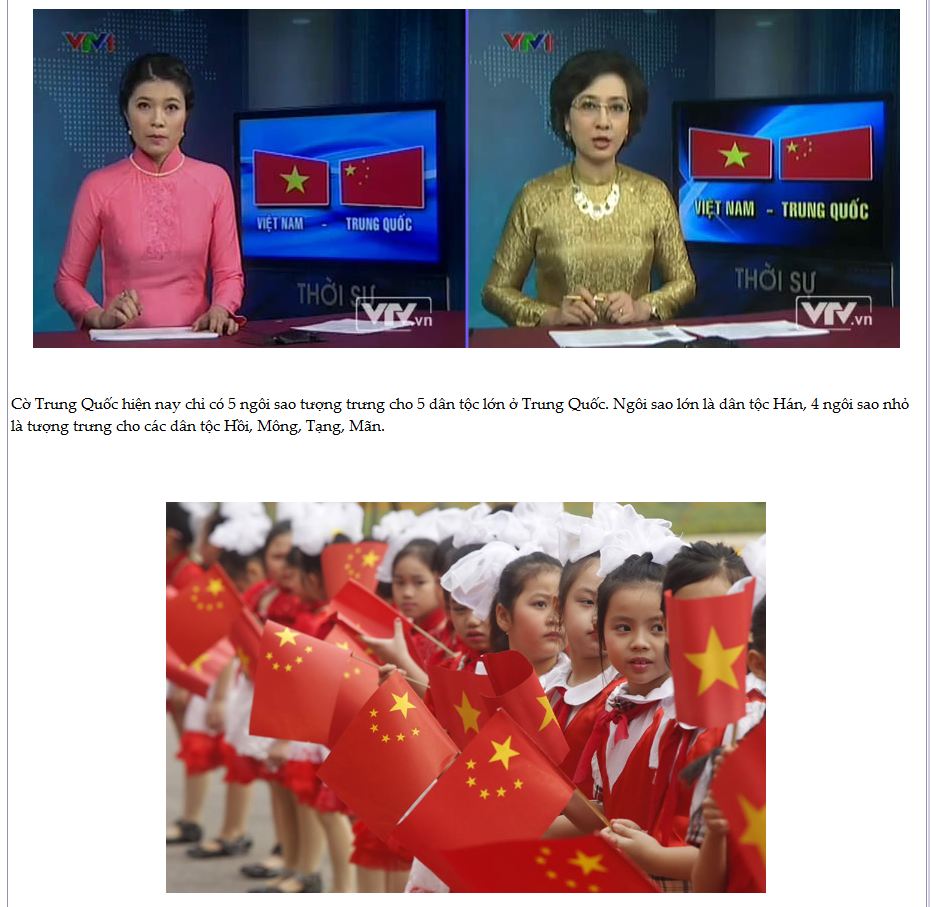
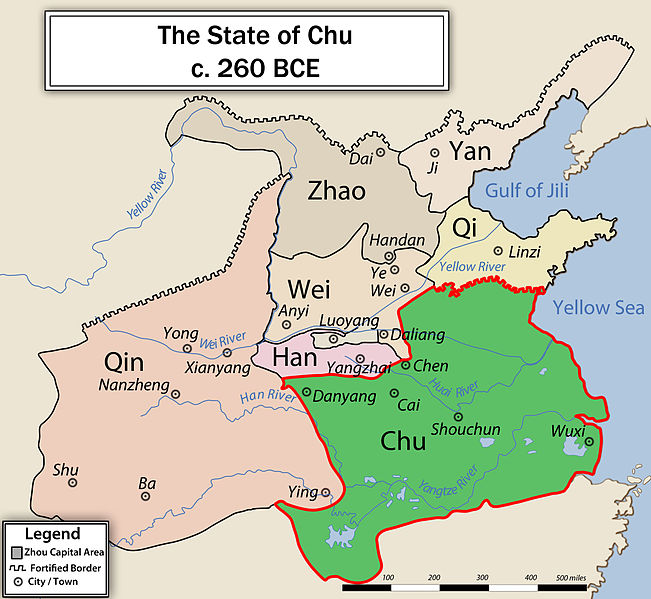
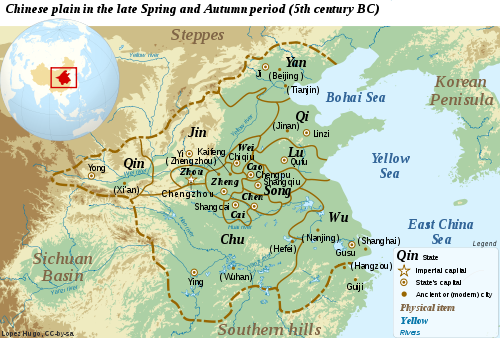
Vietnamese Chinese
What Makes Chinese so Vietnamese?
An Introduction to Sinitic-Vietnamese Studies
(Ýthức mới về nguồngốc tiếngViệt)
DRAFT
Table of Contents
dchph
Chapter Five
Be firstly warned of the unpleasantness that if you do not to like Sino-Vietnamese politics, skip reading this chapter now.
The forewarning is raised herein because the author is going to discuss politics in this chapter. The bottom line is it is not only limited to unitary political system but also embrace the global antagonism against China which most Chinese scholars cannot live with. If you do not feel comfortable reading something that sound fishy and bias, be open to accept certain of premises and prerequisites as starting points for what comes next in order to understand why the Sino-Vietnamese politics mess up linguistic matters. All exists with a reason, though. The underlying reason, etymologically, for the subjectivity raised in this research are those pros and cons in Sino-centric polarity in other related works by local scholiasts. The author will shed some lights on several underlining causes for the Vietnamese antagonism with the historical background of chronic Chinese bullies towards it. Get ready for what the subtitle says as the dicussion will consumate much space of this chapter aside from other etymological issues.
V) The politics of Chinese-Vietnamese linguistic studies
While discussing affiliation of both Vietnamese and Chinese in terms of history, the subject of politics, besides "political party's lines" (be reminded that Vietnam is still being ruled by her Communist Party), as often being disguised as "nationalism", would unavoidably creep in our talk certainly in an unpleasant way. Like Western office culture, nobody wants to hear discussion on such topic in an academic paper, neither does the author; however, the fact that local people in the mainstream have already submerged in it would spoil the validity of a purely academic matter. Unfortunately, Vietnam's history, nationalism, and politics are intertwined together that one could not talk about a related matter without the others.
Politics, first and foremost, is always bad scholarship to ride on for an academic, simply, because it distorts objective views with bad scholarly manners. The case under investigation affected by such an issue has long interfered in academic domain in all Sinoxenic countries, say, Japan's history with obssessive subjective views about her WW II defeat or Korea's hatred reverved for confort women under Japanese occupation and China's unforgettable of Nanking's massacres during Japanese invasion, and China's crimes committed against the Vietnamese throughout her long history are innumerable. In our contemporary era for those under the communist system, the rulers write their own history regardless whatever. Western scholarship, in general, as known to the world, is fairly enough being academically separated from political interests, it being no doubt about that; hence, seen as neutral, whether or not it is on political or linguistic history. In the meanwhile, for the same matter, in the mindset of Chinese or Vietnamese scholars, who have been trained as organs to serve the ruling regime they live in, the concept of unbiasedness in historical views basically exists only in virtuality. The term itself is just like another foreign loanword denoting another exotic idea from the west, no more no less, because, for the former entities, history is doubtless that of rulers.
What further implication political complication would bring about is another subject matter, yet, its influence has already smeared one's impartiality on what we are trying to ring up here. Upkeeping linguistic matters in a clean state devoid of any political contaminant that we should not be afraid of in confronting the issues but bravely addressing them head-on altogether. The author believes that by means of perpetuating historical facts we would be able to substantiate a better state of impeccability in the etymological business involved. That is the reason why we need to know respective history in depth to better identify sources of related etymologies accordingly, e.g., of 潮州 Cháozhōu (Tchiewchow), the word 潮 cháo (SV 'trào') > VS 'Triều' > VS 'Tiều' for the postulation of VS 'Tàu', a rather late development of the demeaning term to call the 'Chinese'.
Academically it is always true that the Vietnamese language has evolved alongside the develoment of Vietnam's national history. The issue at stake is how Vietnamese scholars cope with the Vietnam's history of her early period having been totally ruled by the imperial China for a full millennium before the 10th century with all historical records completely destroyed by the Chinese during the last occupation of 20 years under the rule of the Ming Dynasty from 1406 to 1427. Vietnamese historians are well aware that historical works on Vietnam, therefore, had been compiled from works by old Chinese historians such as that of the house of the Han's Sima Qian's Shiji (Records of the Grand Historian) (司馬遷 《史記》) or that of the Song's Sima Guang's Zizhi Tongjian (Comprehensive Mirror to Aid in Government) (司馬光 《資治通鑑》), etc., that are indispensable sources to paint a picture about the ancient 'Vietnam' through different stages of 10 centuries before and after her independence as late as the 18th century with some flip-flops falling back to a vassal state of China at intervals on and off. While 'Annam' was never mentioned as an 'independent state' in any time after 939 anywhere in Sima Guang's colossal work at all, I do not know how Vietnam's history could be written without relying on that of China. It is notable that hroughout its history, whenever China grows strong with its military might, it becomes a formidable threat to Vietnam's sovereignty at all times. For such reason, the Vietnamese constantly harbor nationalist sentiment against China so deeply inside their heart, which is in effect governing their interpretation of academic subjects. Homebound Vietnamese scholars are virtually not trustworthy of talking objectively about Vietnamese historical subjects, hence related linguistics as a result, without taking side on judgment about the history of their nation, politically right or wrong.
Vietnam history in any period has been in effect revised at least more than once every time a king or head of state is enthroned, which is a frequent 'political' practice, to be exact, the whole history to be rewitten to fit into the framwork of the ruler's ideology that explains greatly how the historical Vietnamese monarchies have acquired Confucianism, Buddhism, and Socialism. As far as related academic subjects are concerned, historical facts of what happened 2,000 years ago could be distorted with respects to what is related to anything Chinese after the border war between Vietnam and China in 1979 and their hostile exchanges of gunfires that lasted until 1990. Therefore, propositional episodes of the origin of her people and language would also have gone through revisions. It is noted that it must have been easier for Chinese historians to handle earlier China's history until 1911, on the one hand, because their viewpoints on the past were least influenced by both changing dynasties and foreign issues where history of the Yuan (Mongol) and the Qing (Manchurian) dynasties were equally treated on the continuum from the Han and the Tang, etc., as equals, to make up the complete Middle Kingdom. Therefore, its past will shed some light on the history of the Vietnamese, hence, and their language.
History of Vietnam before the 10th century, in effect, has been compiled from that of China for the reason that there had existed no Vietnamese history written in "Annamese" by the "Annamese" themselves ealier than that period. Before her independence in 939 A.D., what is known as today's Vietnam was formerly called Jiaozhi 交阯 (or 交趾, 111 B.C.–39 A.D.) and Jiaozhou 交州 (299 A.D.) in the Han Dynasty, and later in the Tang Dynasty it was known as Annam Đôhộphủ 安南督護府 ("Protectorate General to the Pacified South", 679 - 866). So, linguistically speaking, what has emerged out of the history of Vietnam as a vassal state of China is popular usage of massive Chinese loanwords that have found their way into Vietnamese, which is an inevitable consequence after 1,000 years under Chinese rule.
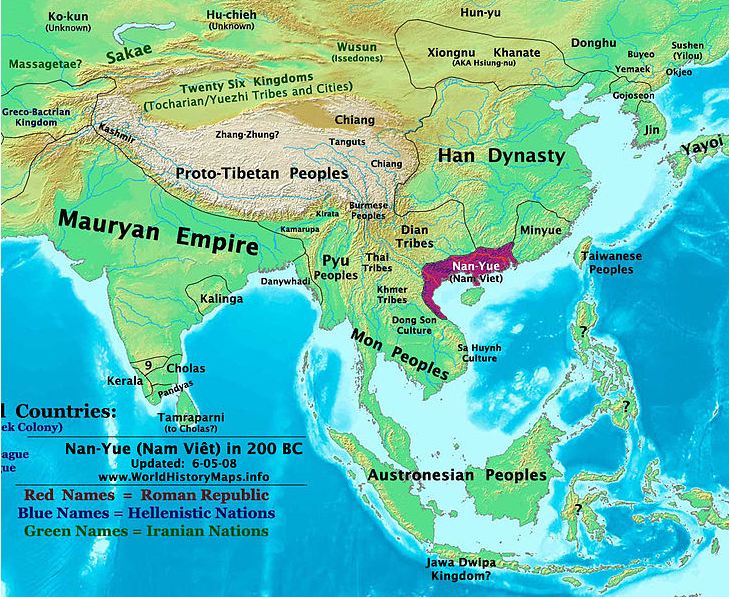

Historical records rendersnsopports to the author's postulation on the Sinitic-Vietnamese etyma, so to speak. From the history of the ancient Chu State (楚國) we learned that its subjects were then presumedly consisting mostly of the Taic-Yue aboriginal origin (see Binh Nguyen Loc. 1972) and we could also theorize that more than 3,000 years ago the Yue precursors had been indigenous inhabitants of the vast land of today's China South or 華南 Huanan (see De Lacouperie. Ibid. [1887] 1963.) Imagine what if 'China' would have become by now should the people of the Chu State have won in the contention against King Liu Bang 劉邦 and his subordiante generals –- they all having been of the Chu's subjects in the first place after all –- who founded the Han Empire 漢朝 after the fall of the Qin Dynasty (秦朝 221 B.C.-207 B.C.) from 206 B.C. to 220 A.D. for total domination over the Middle Kingdom? What if had NamViet Kingdom (南越王國 NánYuè Wángguó) won in the resistance war against the Han in 111 B.C.?
The core matter is in the substance, not in the name. When we question, "What makes Chinese so Vietnamese?" instead of the other way around, that implicates that the ancient Taic-Yue elements, ancestors of the majority of the Yue people in China South, made up the overall population of the pre-Qin-Han China since remote ancient times, that is, the native people before the Chinese. And it is the later ancient 'Vietnamese' who were considered as survivors of the Southern Yue people had established the nation of what is now known as Vietnam in the south. In addition to recorded history, if bronze drums were what the Yue people had been known for their ancestors' know-hows of advanced copper metalurgy, with archaeological finds of them, which scattered from China South across the vast southern hemisphere in the Indonesian archipelagos, it is possible to establish the connection that demonstrated that there first had existed the ancient Yue pollens and only then flowered the Sinitic ones . (日) Historical threads of the Yue roots have fabricated the whole piece of fabric with spots of their habitats that take up more than one half of today's Middle Kingdom map.
With regards to the Vietnamese language, however, in many cases the other way is equally true, i.e., the validity of the question "what makes the Vietnamese so Chinese?" That phenomenon as generally explained as in the heartland of the Middle Kingdom there had existed the proto-Yue of Taic origin before "China" ever came into existence as we all see it now, yet, strong Chinese cultural influence on Vietnamese is accounted for linguistic dominance, especially from diverse dialects brought into the country by the later Chinese newcomers since the ancient times. At the initial look, it appears that after one thousand years or so under the rule of China, its cultural impact had taken a heavy toll on the Vietnamese language with a great number of ancient forms that virtually gave way to common Sinitic elements in different usages, e.g., 車 chē (carriage) "xe" instead of "cộ", 房 fáng (room) "phòng" vs. "buồng", etc., along with those plausibly rare original aboriginal ones, e.g., 'mới' 萌 méng (new) vs. '*t1miʔ' (A) (cf. 新 xīn, SV 'tân' vs. VS 'xịn'), 'lưỡi'' 脷 lì (tongue) (L), etc., which are also late Chinese cognates.
As a matter of fact, the Yue elements left inerasable marks in Chinese. Similar to the two latter forms in Vietnamese as cited above, the names of those of animals in the Vietnamese zodiac table could have made a complete round trip from the Yue to the Chinese and back to Vietnamese that was a survival descendant of the Yue, again, as forementioned. For example, back in time prior to the eras of the "Han" 漢朝, the "Qin" 秦朝, the "Chu" 楚國, the "Yue" 越國, the "Wu" 吳國, etc.., in both cultural and linguistic terms, the original Yue zodiac elements definitely had evolved into those of Chinese with the original names of the 12 animals called 'chuột' 子 zǐ (rat), 'trâu' 丑 chǒu (ox), 'cọp' 寅 yǐn (tiger), 'mèo' 卯 măo (cat — rabit? impossible for the Chinese version), 'rồng' 辰 shěn (dragon), 'rắn' 巳 sì (snake), 'ngựa' 午 wǔ (horse), 'dê' 未 wèi (goat), 'khỉ' 申 shēn (monkey), 'gà' 酉 yǒu (rooster), 'chó' 戌 xù (dog), 'heo' 亥 hài (pig) that each carries the coresponding Sino-Vietnamese sound in later period, 'tý', 'sửu', 'dần', 'mẹo', 'thìn', tỵ', 'ngọ', mùi', thân', 'dậu', 'tuất', 'hợi', along with the later Tang's (Middle Chinese) Sino-Vietnamese sounds, 'tử', 'xú', 'dần', 'mão', 'thần', 'tỵ', 'vị', 'thân', 'dậu', 'tuất', 'hợi', respectively. Except for the odd variant of VS 'khỉ' and VS 'rắn' — 'thân' = 'khọn', and '巳 sì' like the shape of a snake and the sound similar to 蛇 shé = SV xà for 'rắn') though — VS 'cọp' carries the connotation of 'dữdằn' as in 'dữ như cọp' (as dreadful as a tiger), so ''dần' = 'dằn' (dreadful) with all name-callings for those zodiac animals matching perfectly with today's Vietnamese sounds, respectively. Now that the Chinese say '鼠年' (nămchuột), '牛年' (nămtrâu), '羊年' (nămdê), etc, in place of '子年' (nămTý), '丑年' (nămSửu), '未年' (nămMùi), or 'Year of the Rat', 'Year of the Ox', 'Year of the Goat', whereas 鼠=子, 牛=丑, and 未=羊, respectively. Along the line, note the discrepancy of the Chinese 兔年 'Year of the Hare' and the original one of the Yue as 'Year of the Cat' (卯年 nămMèo) because 卯 măo certainly must be "mèo". It is no-brainer for an academician to learn of what implication permeates therefrom. In this specific example, the substitution took place probably due to the supposition that in ancient times for the "Chinese" cats were superstitiously considered as "sacred animal" (靈動物 língdòngwù) so 卯 măo (cat) as 貓 māo (SV 'miêu') was substituted with '兔 tù' or VS 'thỏ' (hare)' 卯 măo curiously remained unchanged , though, which left a solid evidence for all the world to see. Besides, the original southern '未 Wèi' of the equivalent concept of 'Goat' was replaced with those of 'Ram' or 'Sheep' (羭 yú) even though 羊 Yáng still means 'goat' (cf. Tchiewchow /yẽw/) because the northern Chinese — admixture of ancient Altaic Turkish origin (see Peter A. Boodburst. Turk, Aryan and Chinese in Ancient China 1942. [ compiled by Alvin P. Cohen. Ibid. 1979] ) — are associated themselves with '羊' in the sense of ''sheep' or 'lamb' 羔 gāo (VS cừu). (羊) (where '羊' is the soul, being central to many core Chinese characters 美 měi (beautiful), 善 shàn (kindness), 膳 shàn (meal), 糕 gāo (cake), 羹 gēng (broth), 義 yì (righteousness), 議 yì (discussion), etc.) In other words, what the early 'pre-Chinese' — in the era that no Chinese had ever existed then yet — absorbed from the Yue and then in turn passed them down to the Han Chinese, who later re-introduced them back to the Southern Yue along with many other etyma of the same things with different names, e.g., 'chiếcđũa' 箸子 zhúzi (chopsticks) vs. 筷子 kuàizi, VS 'chanh' 橙 chéng (lemon = modern Chinese 檸檬 níngméng) vs. VS 'cam(+sành)' (橙+)柑 gān (orange), etc. That is, all 'mixed items' of as late as the Han Dynasty had transcended to become what the academics now call "Sinitic" could be descended from the Yue and gace back to the early 'Annamese' whose ancestors, in turn, had been of the fusion of both ancient Yue and Old Chinese, so to speak.
The etymological postulation of the zodiac items and other cultural concepts as discussed above may also help explain why Sinitic etymonic tems are customarily accepted by the Vietnamese naturally for their intrinsic Yue values and they both have been cited as of "Sinitic" to the effect that Vietnam was even referred to as "Little China" in the book by the same title by Brodrick (1942), all for a good reason. For instance, the annual festival called 端午節 or Tết Đoanngọ (the Dragon Boat Racing Festival) that occurs on the 5th day of the 5th month of Lunar calendar is to commemorate the death of the Chu's martyr named 屈原 Qǔ Yuán (Khuất Nguyên) (K). The racing boat custom to save the drown patriot dated back prior to the Qin Dynasty, which was shared by all other people of the six ancient states that succumbed to the hands of the Qin State. Given such affiliation, it is not unusual when we further postulate other cultural words where their cognacy is highly plausibility, e.g.,
- mùaTết= 季節 jìjié (holidays season)
- dịpTết= 節期 jiéqī (during the holidays)
- ănTết= 濄節 guòjié (celebrate New Year)
- Tếtnhất = 節日 jiérì (festive days)
- bánhtét = 節餠 jiébǐng (festive cake)
- bánhmứt = 甜餠 tiánbǐng (preserved prune)
- mứtTết = 甜梅 tiánméi (preserved prune)
- trướcTết = 節前 jiéqián (days before the Spring Festival)
- sauTết = 節後 jiéhòu (days after the Spring Festival)
- TếtNguyênđán = 元旦節 Yuándànjié (Lunar New Year Festival)
- TếtNguyêntiêu = 元宵节 Yuánxiaojié (The Spring Lantern Festival)
- TếtĐoanngọ = 端午節 Duānwǔjié (The Dragon Boat Festival)
- TếtTrungnguyên = 中元節 Zhōngyuánjié (The Ghost Festival)
- TếtVulan = 蘭盆節 Lánpénjié (Buddhist Mother's Day)
- TếtNhiđồng = 兒童節 Értóngjié (Children's Mid-Autumn Festival)
- TếtTrungthu = 中秋節 Zhōngqīujié (the Mid-Autumn Festival)
Magnitude of the Sinicizing process from the Han through the Tang dynasties in all areas has turned out to be enormous, which is analogous to our modern time widespread of the so-called American culture, e.g., American fast food, American music, or American English, etc. popular around the world. On becoming modern Vietnam, her developing model appears to be parallel to formation of sovereign statehood in line with numerous decolonized countries around the world, anthropologically and historically, even with those of shorter time span in comparison with some 2,500 years that has made history out of Vietnam -– such as Taiwan and Singapore of which a majority of the populace can communicate in Chinese, or Latin nations in South America in Spanish, or those republics separated from the old Soviet Union in Russian, etc.
Vietnam of nearly 1,100 years after separation from China has matured in molding her unique national identity by now for formally having decreed the adoption of the 100-year-old romanized scripts, for example. In her case, specifically, in spite of the fact that her culture and national language are so deeply Sinicized that what the Vietnamese and the Chinese both commonly share is so similar. Ironically, politically, unlike the animosity between the USA with England after the American Revolution, both Vietnam and China could barely co-exist in peace as far as Vietnam's long history can be traced. Who is to blame? As one can guess, history of one millennium under the brutal Chinese domination proved to be too much for the Vietnamese to bear in the fact that China has never loosened its alertness on any stance as it has never stopped pressing Vietnam so as to subdue her into submissiveness. At times when crises arise, therefore, their unequivocal ill-at-ease has maxed out over the brim of tolerance that shows in the Vietnam's increasingly growing nationalism that her people support any anti-China stand that is echoing to every corner of the world. Similarly, in the Chinese rulers' mindset full of sentiment of enmity against Vietnam's renegade ruse, i.e., fighting for her sovereignty, always arouses lively, as examplified in the figure 5.2 below, since no government should have instructed them to do such vulgar diplomacy — Vietnam's police suppress all anti-Chinese demonstrations in the last 10 years, to say the least — in the open during a detente period, all but from their subsconsciousness. That is exactly the way the mainlanders look at Taiwan or Hongkong and vice versa, but not the same view towards any particular country such as Malaysia, Indonesia, or Singapore for anti-Chinese sentiments on Chinese for unilaterally U-shaping the South-China Sea's claims or the spread of CoVid-19 in 2020 to their countries.
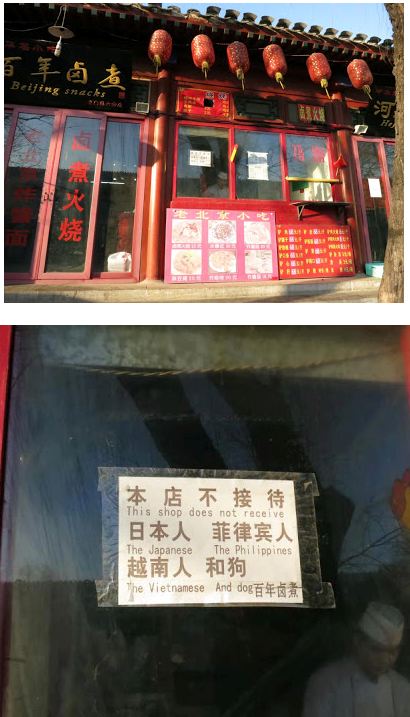
Fig. 5.2 — The sign on the front door of a restaurant name 'Beijing Snacks' near Prince Gong's Mansion in Beijing — photo by Rose Tang 2013
(Source:
http://www.voatiengviet.com/content/quan-an-trung-quoc-khong-tiep-khach-nguoi-viet/1610192.html)
Academically, for their deeply-rooted hatred of the hegemonic China that the Vietnamese would resent anything bearing the mark of China, at any price, dearly. There always exists an on-going resistance fight against Sinitic dominance. Linguistic identity justification, therefore, is ghostly spirit that haunts and smears Vietnamese scholarship in the whole that flows with the currents of diplomatic climate between the two countries. To account for such underlying antagonistic sentiment against China let us take a look at the relationship between the Vietnamese and Chinese under the periscope of their increasingly rising conflicts in the South China Sea. Similar to the case of Taiwan, as always, China treats Vietnam just like a runaway kid from the China's longhouse. For the sake of holding on to same stand as two of the last four communist nations still in existence, that is, their true color is currently hidden under disguised comradeship of communism. Ironically, the Vietnam's leadership relies very much on Communist China to have its grip on power in its own country because the survival of Chinese Communism could guarantee its own. Meanwhile, the Chinese heads of state have been aware of their dependence so they have never played fair games with their Vietnamese counterparts on any level field. The mutual distrust between the two neighbors is reciprocal with shows of contempt, which has increasingly contributed more in spoiling relationship that is already rough and easy.
To be truthful, Vietnam keeps swallowing her national humiliation to avoid possible wars with the abusive giant from the north. Under the shadow of the long imperial colonial past hung overhead with spells of sporadic invasions by her archenemy since the pre-Han onward, the historical Vietnam has displayed stretching patience with her being carefully taking catwalks in maneuvering the balance between "war and peace" by maintaining the underdog diplomatic relations with her formidable Chinese adversary. However, once peace with submission could not be a better option all the times, her people picked war. By and large, Vietnam have fought a total of 24 large scale wars with China if one only counts detrimentral ones from her independence day in 939 A.D., such as the latest bloody one that was firecely fought in their border in 1979 with thousands of casualties on both sides and periodical skirmishes went on well till the late 1989. There were times both countries entered the period of detente, all pretending being friendly. Historically, it is of nno secrecy that whenever China becomes strong and, as usual, its succeeding rulers have been overly confident in winning an upcoming war as the last war with Vietnam once and for all; it would likely wage another war with Vietnam. On the surface, anybody who contemplates at the strength of powerful China, especially in our modern time, would doubtless agree on the high possibility of triumphant outcome from the Chinese side. On the contrary, even though China's offical history has never mentioned it — except for the case of its current occupation of Inner Mongolia, Tibet, and Uyghur territories that is still an on-going matter until our contemporary era — China lost every single war with most of foreign armies that it had fought throughout its history, e.g., Mongols, Manchurians, Japanese, etc., and that is exactly what already happened in every war with Vietnam.(Q) On everage of every 90 years or so a large-scale war breaks out between the two countries with results that Vietnam has been always on the defensive stand in holding off Chinese invasions and won final victories in every independence war, not the other way around.
That is how the history has had its way in the past. Despite of the fact that the cycle of wars has repeated itself again and again between the two countries, the Chinese rulers have never truly learned a lesson or two from it. The wind of war is up in the air again and the magnitude of antagonism has intensified, which probably could occur within a decade or so as China does not want to let go its grip on Vietnam. That appears to be the case as their conflicts have escalated with clashes in the high seas more often. On land in the early 2014 street demonstrations once turned deadly with violences that were raged against recent mainland's Chinese guest workers in more than a hundred or so Chinese factories inside Vietnam. If a war were to occur by then because of reckless and uncontrollable outburst of temper of the common mass, Vietnam's rulers would have had no choice but gone with the fury by their people.
It must be reminded that Vietnam was a product of China. It had transformed a native habitat of aboriginal Taic-Yue states and their subjects by incorporating them into one Greater China by Qin Shihuang (秦始皇 - the first emperor of the Qin State) along with other northern Turko-Altaic states in ancient mainland in China North and unified all under its centralized rule in 221 B.C (see Peter A. Boodburst. Ibid. 1942). By the fall of the short-lived Qin Empire in 206 B.C. the ancient Yue people became subjects of the Southern Yue (NamViet) kingdom — a part of the Qin Empire — under the governance of a former Qin General called Zhao Tuo (趙佗) who became its first king later on. When the Han Dynasty was established succeeding the unified ancient Empire of China in 206 B.C., it totally conquered and annexed the Southern Yue kingdom in 111 B.C. Even though the Han Dynasty ended in 220 A.D., ancient Annam as a prefecture continued to have survived succeeding dynasties that raved the mainland of China for the next 719 more years until a portion of it broke up from the NamHan Kingdom (南漢帝國) –- geographically, south of China South by then as it was of what used to embrace the old territory of the ancient NamViet State (南越國) –- and became a sovereignty in 939 A.D.
For all of such historical reasons, it could be said of the Annam State (南安國), geo-politically, as representative state under the rule of all the Southern Yue descendants until its first native and locally-enthroned King Ngô Quyền — who had been appointed viceroy of the Annam Prefecture by the last monarch of the NamHan State prior to its collapse — as the country expanded further to the south throughtout the next millenium until it became of what is known as the nation of Vietnam in the 20th century until present. Anthropologically, to speak accurately, its populace included all other racial admixture of indigenous people and immigrants coming from the mainland of China when the ancient colonial Annamese land was being under the Chinese rule.
For the Vietnam's history, its solid sovereignty started from the year 939 onward. On the contrary, in China's "official history" (中國正史) throughout covered periods, Annam is never mentioned as an independent state at all. Historical events that lead to the sovereignty of the people living in Annam is just merely recorded by China's history as uprisings by a renegade prefecture, not even as a tributary state (Bo Yang. 1993. Vols. 69-71) (Y). In the back of rulers' head, including that of modern China, such a separatist territory should never have been allowed to happen in the first place. In fact, it is unimaginable for China to let the shadow of a Vietnam vassal country to stay outside its orbit, ever, parallel to the ill-fated Inner Mongolia, Tibet, or Uyghur — actually for them it is still early to foresay; it took Vietnam 1000 years to break away from the Chinese empire — not to mention the ongoing unrest of Hong Kong and de facto independence of Taiwan, that has been a continuance of what was known as great-nation chauvinism of the old days.
As the world has already stepped far into the thresthold of the 21st century, modern China is still living in the halo of its bygone imperial era. Our modern civilization gives rise to China's need to disguise its expansionist ambition that underlines each of its military operation, but China skipped them all once it grows. For instance, in 1979 Deng Xiaoping under the context of "teaching Vietnam a lesson" waged his border war against Vietnam, which was initially devised as a part of a larger strategic plan to advance southward to Indochinese peninsula, firstly by having sent aids to support the blood-thristy Red Khmer to kill hundreds of thousands of their own people in Kampuchea. It turned out that in the bloody Sino-Vietnamese border war Chinese troops had suffered heavy losses with their outdated weaponry, so they had to abandon its hemogenic plan thereof. Such humiliatory defeat did not stop its bellicose acts that were raging on with on-going skirmishes along and hold on to strips of borderland it had occupied since, e.g., Vietnam's Namquan Pass now located nearly 2 kilometers deep inside China's border. That is only a tip of an iceberg of the true reasons why the Vietnamese are having so deep hatred reserved for her bullying northern neighbor.
Historically it is noted that until the last decades of the 9th century, a half of the today's China's territories to the west still belonged to those two powerful southwestern autonomous regions now called Tibet and Yunnan, previously Tubo (土番) and the ancient Nanzhao (南詔) kingdoms, respectively, not to mention Uyghur's Xinjiang, all had gone against the Tang Empire reaching Chang'an and had effectively broken the empire into two halves. At present, we can see that the magnitude of thrusting force from China's enormous military powerhouse posing ready to crush down on any signs that suggest independent resistance movement without mercy as it has been bruttally handled in kind in both Tibet and Xinjiang. In the everlasting quest for reinstatement of domination of Vietnam as a satellite, throughout its history whenever China is getting stronger, its immediate focus would be asserting empowerment on the little poor southern neighbor, at the very least, until it could retake it one more time under its far-stretching wings as a vassal state. As it grows stronger, China would waste no time to seize any change that it is always time and one last time ever, exactly like what Russia did to Chechnya, Georgia, and Ukraine in our era. History repeated itself again with China to Vietnam following Sun Zi's The Arts of War waging a preemptive war (先下手為強).
Stepping into the 21st century after 40 years of modernizing it military capacity again from its bitterly self-taught lesson, China with preludes of encroaching upon Vietnam's northern border by forcing her to accept 1999 border delimitation treaty on its terms. At sea, it tested the disputed water by having moved its giant ocean oil rigs into Vietnam's internationally-recognized economic zone in her Eastern Sea which had sparked fierce protests from people within the country. It took noheed by the ruling by the International Tribunal at the Hague on July 10, 2016 with sweeping rebukes and final rulings that rejected China's sovereign claims on all existing islands and the sea routes that pass through the entire U-shaped region in the vast sea south of its coastlines as presented in its newly drawn map of a new world's order that that it has unilaterally defined. As events unfold, China does not hide its grand ambition to dominate the entire South China Sea, in exhibiton of its power to back up its claim on all fronts. For those already occupied islets of Spratlys, China has continued on constructing even more artifical islands while in the contested water it had its state oil rigs equipped with military radars moved into the regions around disputed islands, and conducted more warlike activities by moving in its navy deployment, built new airstrips in reclaimed militarized islands with bombers flying in the self-claimed airspace above while at the same time its frigates aggressively attacked and bullied unarmed small wooden fishing boats nearby right within the Vietnam's economic zone, with the latest incidents right in the intense period that its Wuhan's CoVid-19 in April 2020 raging the world in which that the Chinese frigates had sunken a Vietnamese small wooden fishing boat. At the long last they were only to see that Xi Jinping had already sent more flotilla of militia boats and fleets of warships to occupate disputing islets and built more airstrips for jet-fighters there where they called South China Sea "to protect its territorial sovereignty". In short, it has unilaterally claimed all adjacent busy sea routes off its occupied islets showing disregards for international laws, that is, refusing to recognize the Tribunal's verdict on the legality of its claim.
The antagonist stance against China has once gotten out of hand as a result of political scandalous leaks exposed by anti-Chinese factions within the ruling rank of the Vietnam's Politburo. There even exists a theory on a conspiracy having circulated around for some time, probably originating from disillusioned elite members either having retired from or still holding power in the Party, via their anonymous websites and blogs, etc., that China actually has no need to wage any military wars at all because it already had all Vietnamese leaders under their hands as stringed puppets, being purged, set up, installed, bribed, or bought for at a cheap price of some 6.8 billion yuans each to work as a traitor in its secret strategy to annex Vietnam into China by 2050, a part of a working 100-year scheme having been put together in place since 1949 by Mao Tse-dong, once and for all. All started with the help of Maoist China's lending military aids — a debt trap, to be exact — to the Vietnamese Communists to fight for their own ascending power in from the Resistance War against France (1945-1954) and the Vietnam War (1954-1975). As a part of its grand plan, China widely in the 2010s publicized the letter signed in 1958 by Democratic Republic of Vietnam's the long deceased ex-Premier Phạm Văn Đồng to acknowledge the Chinese sovereignty on some of the Chinese occupied islands over the Paracels and Spratlys so that they could justify their militarization of the whole international South China Sea navigational routes, which has become the root of the rising contentious propects of the growing Sino-American conflict in the region. In any case history of all Sino-Vietnamese wars recorded that for its hegemonic ambition China did pay a hefty price each and every time for their naughty actions in the end.
In December of 1922, the 4th World Congress of the Communist International (CI) cellular organs in the former Soviet Union (1922 to 1991) resolved to disseminate their communist ideology to the French Cocin-China by engaging participation of its agents in China. They cleverly cultivated a mystically revolutionary figure called Ho Chi Minh who was able to secure financing resources from their Chinese counterparts. While carrying the CI's assigned mission of siphoning aids to Ho Chi Minh's Vietnamese communist cells called Vietminh — Việtnam Đồngminh Hội — that oprerated under the guide of the Indochinese Communist Party founded in 1932 to serve the CI's purpose. The Vietminh members took his order to run CI's clandestine activities inside Vietnam, such as inducing grafts, seedling divides among local political prospectors and speculators, or prosecuting assassinations of political stakeholders and opponents, etc. The commies led by Ho Chi Minh strengthened their party's depotic power by all means, say, bribery to get cabinet's seats in the nation's provisional government that had been formed by alliance of nationalists who ended up holding only nominal official posts, and only found out later that they even were rescinded by the left wing in the government.
When the Vietminh seized power in August, 1945, following the Japan's defeat in the World War II, the post Nazi-besieged France's DeGault government made a big mistake when sending French troops back to Vietnam with the Allies in the name of disarmment of the surrendered Japanese army stationed in Indochina, which had given the Vietminh the excuses to direct nation's manpower and resources to serve their purposes of seizing government from the nationalists. That is, as the former French colonists greedily sought to reinstitute their colonial rule, their ambition had only rallied a united front of Vietnamese parties dominated by the Vietminh commies that, as said, resorted to the military aids from Chinese Maoist Red Army that defeated the Kuomingtang and took power in the mainland of China on October 1, 1949. The victory of the allies had opened up a good opportunity window to fulfill the China's the Maoist dream of raising the banner of internationalization of the proletariat revolution. Its priority was to broaden its plan to subdue all political factions Vietnam under its wing. At long last, the fierce Vietnam's resistance war against the re-instated French colonial rule ended in 1954 but the national final victory was totally reaped off by the communists as they secured half of the country north of the 17th lattitude as determined by the Geneva Agreement with France in July 20th of the same year. After the withdrawal of the French from the country, the U.S. hurried in to fill up the gap left by France in order to prop up the South Vietnam's government in the fight against the Vietminh commies who had already ruled the North with help of China and the Soviet Union.
After the division with the North with the Iron Curtain divided the world into two polarized ideological camps in the Cold War era, the U.S. government with its intervention policy in South Vietnam tried to contain the spread of communism by the Vietminh undercovered agents planted in South Vietnam which became the breeding ground for upcoming fierce battlefields in the next Vietnam War that increasingly escalated in 1965 with the participation of the rotating 2 million U.S. troops on the Vietnamese soil. So the North Vietnam seized the excuse and sent battalions of troops to fight the Vietnam War from 1965 to 1975. With the determination to disseminate the communist ideology throughout the region, the Maoist China provided North Vietnam with heavy military aids that even included Chinese infantry in anti-air artillery units having stationed in North Vietnam. The long war dragged on and the time was on the Noth Vietnam's side reaching the effects that had worn out the fighting will of U.S. troops in South Vietnam that took the U.S. more than 53,000 casualties. As it withdrawed in bitter defeat from South Vietnam in 1973 under the cover of Paris Peace Agreement being devised to withdraw the US troops from Vietnam in honor by President Richard Nixon and his Secretary of State Henry Kissinger, the architects of the US humiliatory defeat for the first time in her history. North Vietnam drummed up the momentum that was past April, 1975, and at the long last the North Vietnamese communists marched into Saigon winning the war against US-abandoned South Vietnam at the cost of some approximately 2 million deaths, including civillians, on both sides of Vietnam. (U)
The combined military aids from both China and the former Soviet Union, all for the purpose of engaging the Vietnamese Communist Party to aggressively partake in the process expand their communist foothold in the Indo-Chinese peninsula, for the hidden debt trap that the Vietnamese people to pay China's assisting the Vietnamese communist regime with their bloody hands started from 1932 untill 1975. Despite of a widespreading of a theory of conspiracies of the sellout of the nation by the top Vietnamese communists in the Politburo who are holding the power and pass down to their successors who, amusingly enough, all have been educated in the U.S.A., not China, there existed, though, those hardcore anti-China fractions who had gained upper hand in the politburo, such as Lê Duẫn, Đỗ Mười, Lê Đức Anh, etc., who once having had firm grips onto power throne went on setting their own agenda trying to steer off the China's orbit only to see that right in the Western flank of Vietnam the threatening Khmer Rouge regime that had been assisted by China all along to serve it as communist vanguards to gain foothold in the Indochinese region. The Vietnamese invasion of Kampuchea was hence launched in 1979 under the context of helping save the poor neighboring country from the genocidal policy against their own people with hundreds of thousands of deaths executed by in effect impeded China's penetrating influence into the region. The chained events eventually led to the Sino-Vietnam's border war between the two countries fiercely started in 1979 for 6 months, later with sparodical fightings that lasted 10 more years well until the end of 1989.
To sum up, the main point on the contemporary disturbing détente Sino-Vietnam relationship to remember therefrom is the fact that as China picked Vietnam as chosen battlefield of the Cold War between them the communist block versus those of the western one, the whole reality show had cost millions of Vietnamese lives that would only deepen even more the hatred that their survivors had already had for China. So said, as history dictates, for all the Chinese bullying Vietnam it is not expected Vietnam will become a province of China anytime soon but best show their stronger will against China since the ancient times.
For their identical historical settings, let us relate Vietnam to the case of Taiwan, an island nation in our modern time that has shared similar experience in its national development comparable to that of early Vietnam hundreds of years befeore independence in 939, with the latter, of course, having been through a much lesser time span than that of former. In the historical perspective that reflects on a series of contemporary events, nevertheless, path to full sovereignty for Taiwan from 1949 is also bumpy and tough, de-facto an independent nation but being still short of one more step in official declaration of independence as Republic of Taiwan.
Specifically, as Taiwan strived to become an independent country, it suffered from a series of diplomatic setbacks to retain official recognition from the U.S. since 1973 after being sold short by the same President Richard Nixon and his adviser Dr. Henry Kissinger. China has since wasted no time to chip in the opportunity and proactively pursued a more aggressive approach in dealing with the island state insisting that is has been part of China. Like what has happened to Vietnam before and after their breakaway from the Middle Kingdom, the pressure resulted from such China's national policy towards present Taiwan has never ceased because, deeply in the back of their mind, China's rulers always want to take them all back.
Now gone was the improved lukewarm detente relation between China and Taiwan under the former President Ma Yingjiu with his Kuomingtang's cabinet. If the newly re-elected President Tsai Ing-wen in 2020 and the ruling Democratic Progressive Party still continue on to be able to keep status quo that Taiwan as an independent republic, be it Republic of China or not, beyond the threshold of the 21st century for the next 300 to 500 years from now on when China will have sunken into an abyss of historical cycle as it has been, this island-nation would become a future Republic of Taiwan with all the Vietnam's national characteristics that exist now, culturally and linguistically. Today's Tsai Ing-wen's feet had been in the shoes of Vietnam's King Ngô Quyền as his wet ones once were in the end of the 10th century. Such supposition is to reflect the fact that Vietnam had undergone through the rule of China for one thousand years. The historical model of Vietnam might probably reduplicate in Taiwan in much shorter than fifteen-hundred years from now as it was for Vietnam, though, given the modern globalization that would only make Taiwan to look more like Republic of Singapore in a respect or two as it actually becomes a sovereign state regardless it would declare itself as an independent Republic of Taiwan or not.
In our modern time, the way that the imperial China actually treated the ancient Annam prefecture in the past can be equally applied to Taiwan with their provincial status, unlike other China's autonomous regions such as Inner Mongolia, Tibet, Xinjiang, and Guangxi of which nominal autonomy is currently granted. It is, nevertheless, just a matter of time before the official designation that sound pompously good as such will become things of the past. In all possiblities, the next one in its list for removal could be Guangxi Zhuang Autonomous Region, would probably fall for totalitarian rule under the communist central goverment. In other words, it will be just another Guangdong Province on becoming, Guangxi Province sans autonomy status granted. What is the difference? In Guangdong, it has become laws of the land that all TV programs must be broadcast in Putonghua since President Xi Jinping office in 2012. In the past, haughty Cantonese speakers of the land used to ignore those from the north who tried to talk to them in Mandarin, to say the least.
Historically, China successfully exerted its rule on Guangdong's proper after it had Sinicized virtually all descendants of the Yue natives in within by implementing national policy of sending more nothern Chinese migrants southwards, which is similar to the circumstances under which the Hainan Island Province is currently going through with all the available land have been bought at discount by the nouveau rich northerners as new resettlers. Ethically, unlike their Zhuang or Daic minority cousins in Guangxi's "autonomous" region, with its populace known as the Cantonese speakers, who were once descended from earlier ancient Yue-Han mixture in the NamVIet Kingdom as discussed in the previous chapter, the Hainanese are mostly of Han ethnicity from Fujian Province having migrated from other regions in China North. A long migratory process must have started centuries before the Tang Dynasty — this fact mitigating the myth that all Cantonese speakers were descents of "T'ongjajn" (people of the Tang Empire) — of which subjects emigrated en masse further southward into the Lingnan (嶺南) region, having moved beyond boundaries where China's Guangdong and Guangxi provinces are located in our contemporary era, with portions of populace spilling over its neighbors, including the ancient Annam (T) and such southern migratory phenomenon continued on long after the year 939. Note that by then the area of the Tang Empire's territory was roughly half of the size of today's China. The same process repeated throughout its successive dynasties that kept pursuing imperialist expansionism. That is how China has doubled its size as we see it today, i.e., encroaching territorial pieces of its neighbors until it securely established firm grips on each of them, namely, present China's provinces of Sichuang, Yunnan, Xizang, Xinjiang, Qinghai, and Inner Monolia.
With regards to Vietnam, it is no secret that China always regards her as an integral part missing from its geo-political map. Even when the whole world has already stepped far beyond the threshold of the 21st centtury, it is still trying tactics one after another to intimidate the little nation in the south with explicit threats of an upcoming invasion (平). It is of another empire in the making as it continues bullying and encroaching beyond its southern borders with Vietnam inceasingly. In 2009 after China submitted a map to the Commission on the Limit of the Continental Shelf showing a huge U-shaped expansion to mark its zoning claims on the whole South China Sea, covering virtually all islands with overlapped economic and international sea routes around and the airspace above them.
As you can see, China are always befriended with the most evil countries on earth, past and present, such as Khmer Rouge, Russia, Venezuela, Iran, North Korea, Cuba, etc. In fact, Vietnam and China could have been as friendly as good neighbors; nevertheless, because of its everlasting hegemonic ambition century after century China has stood up as an archenemy of Vietnam. The Vietnamese have learned how to live under the shadow of its threats since the ancient times. As the harder pressure China puts on, nevertheless, it becomes too much for Vietnam to withstand the heat from the Sino-sphere, i.e., communist state of the arts in Chinese style, anything Chinese would become an igniting agent when her endurance would bear off. The next war would break out, as a result, at a much fiercer degree accompanied with deadly weaponry such as bioviral aerosol droplets similar to those coming out from the CoVid-19 test-tube likely having originated in Wuhan biolab that leaked as early as December 2019 and spread to the city's wet-market nearby. Such China's weapon would possibly kill hundreds of thousands people in the world by the end of 2020.
To ward off the neigboring devil, for over the last 1,300 years or so the only job the Vietnamese men have done continually is to go to fight in wars, one generation after another, with each one always with the Chinese interference. It seems that the Vietnamese men were born so busy to fight the Chinese that they do not have the time to rebuild their country after a war ended, of which the economic roles all fall on the women's shoulders. The last war just barely ended in 1989 after 10 years fighting against the China-backed Khmer Rouge in Kampuchea (Cambodia), which is, in essence, was really the war against China, a continuation of their border war in 1979, so to speak. Interestingly, Vietnam always scored time and time again with victories against China's invasions. History would explain how Vietnam has kept her sovereignty since 939 until the present day. For example, in the 13th century the most notable war with China was her 3 times of having defeated the Mongol-ruled China's Yuan Dynasty's invasions while the other side of Euro-Asia had been trampled mercilessly under the feet of Ghenghis Khan's warriors on horsebacks.
At present, the strained diplomatic relation between China and Vietnam is disdained in détente because of their inter-dependence on the common ground as the last stand for communism — not for the idealistic doctrine itself but betterment of their previleged life by holding on to power — that is their own existence at stake and the true survival factor for members of both ruling parties on each side. If China has learned something from the past, it would rather not invade Vietnam in this 21st century or beyond. History has it that humiliation is readily in store if the Chinese ever come. The point to emphasize here is, in comparison to what the ancient Vietnam had gone through with a long colonial period having been governed by imperial China's rulers that lasted for 1,000 years, culturally and linguistically, no country in the world could be able to sustain the same original state without having succumbed to hostile changes under similar conditions. There exist other similar cases around the world including France whose people do not even speak their ancestral Gaulish mother's tongue at all but completely Latin-derived French as we know it. A reminder on such notable detail is to ring up attention from Vietnamese scholiasts so that when they discuss about history of Vietnam, they could objectively evaluate about the perception that what made up Vietnam today has not only been a result of Sinicization that the imperial China imposed on the her but also the outcome of the affiliation of several entities, i.e., the Yue and Sinitic among others. Historians, hence, need to re-work with the postulation that the ancestral Yue was an indispensable part that made up the Han populace, e.g., speakers of the Wu, Fukienese, or Cantonese, etc. Readers can recall that while the populace of the Qin State originally confined in the Shaanxi Province consisted only a fraction of the population in the Han Empire, the latter was established by the Chu subjects, that is, Liu Bang (劉邦), the first king of the Han Dynasty, who was also a subject of Chu, and his subordinate generals, and Chu populaces were a mixture of Taic and Yue people.
All in all, the main point for the readers to keep in mind here is that after the Chinese conquered the whole China South (華南) region, the northern part of current independent Vietnam is the refuge where the last battalions of the later Viets (交) as descents of the Yue aboriginals had emigrated and resettled. Their early native habitat, in fact, is confirmed not only in oral legends but also recorded in Chinese annals for some 2,200 years before present. The history of Vietnam started with the Yue-unified NamViet Kingdom (南越王國) located in today's Guangzhou's Fanyu District (廣州番禺) in 200 B.C., only that it had been under auspices of the Qin's General Zhao Tuo (趙佗) who later became its first king after the Qin Empire's collapse. Subjects of the kingdom living within perimeters of it's borders were naturally of Yue indigenes. They had been originally descendants of the pro-Taic people, the one that was accounted for the rise of the Chu State (楚國). Historically, it was later defeated by Liu Bang in the historic final Han-Chu contention for the imperial throne to rule the fallen Qin Empire in the aftermath of its collapse. After the Han Empire had been established, it conquered the NamViet Kingdom in 111 B.C. Since then Annam became a prefecture of the Middle Kingdom that would last until the end of the Tang Dynasty in 907 A.D. when the old NamViet Kingdom territory rose up and became NamHan State, which paved the way for the ancient Vietnam to have emerged as an independent country in 939 A.D.
The Yue had many tribal branches that had scattered in the vast expanse of China South and made up respective states, e.g., LuoYue, OuYue, XiYue, DongYue, etc., and had evolved into ethnic minorities such the Zhuang, the Nung, the Daic, etc., with their widespread presence in the China South and North Vietnam in our modern time. Just like the Yue who built Vietnam, the ancient Yue people were also ancestors of early Daic emigrants out of China South region who established Thailand of the Thai people in the Southeast Asia's map in a much later period. They conquered and annexed the Western part of the ancient Khmer Kingdom, of which its population were composed of mainly the Khmer people. That would help explain why the Austroasiatic theory has crept into the regional arena in a series of events that actually had roots from the north along the Yangtse River Basin. From that home base their migratory movement could also account for other people designated as descendants of both Austroasiatic and Austronesian origin, e.g., the Li in Hainan Island, the Cham in Central Vietnam, the Indonesians, etc., in the southern sphere as postulated by Binh Nguyen Loc (1972). As previously pointed out, recent archaeological findings support theories of human movement in this part of Asia to be more likely to have started from the north of Indochinese peninsular.
By now our general readers have learned a bit about the history of China and Vietnam and their generic affiliation originating from the Yue and the Han, and then the Han and the Annamese. They will not, however, understand the Vietnamese linguistic matters without a concensus on other issues if they miss neither anthropology nor archaeology, not hypotheses, that the Yue made up racial components of the Han stock and later the Han immigrants who would become a part of the Viets when the former moved southward; the later, meanwhile, originally descended from a branch of the Yue, possibly of ancient Taic aboriginals whose their ancestors had emigrated to the southern hemisphere and later would be known as the Austroasiatic and Austronesian peoples. As recently as August 2020, archeaologists confirmed that stone tools such as axes and chips previously found in Guizhou region actually had existed there had been locally made some 17,000 years ago.
Moreover, for those Vietnamese students in Chinese and Vietnamese historical linguistics, as a matter of fact, whether or not they accept the proposition that the origin of the ancestral Vietnamese is likely that of the Austroasiatic hypothesis, they can still benefit from its analytic approach as initiated by Western theorists with their methodology to have come up with bold supposition on the anthropology of the ancient Viets depending on which stance they take on regarding genetic strains of either the paternal or maternal side. For instance, comparable to the case of Taiwanese, the ancestral Viets should be regarded as the racial admixture of the ancient Yue-Qin and later Yue-Han emigrants from China South who were intermarried with local aboriginal women of Yue origin in the ancient Annamese land. Such proposition is true for not only the modern Vietnamese but for many other ethnic groups living inside China's border as its nationals, characteristically typical southerners of Chinese nationals who have been inhabiting the vast region south of the Yangtse River to the Annam's border with the Champa Kingdom. For most of the natives, in all probabilities their ancestors were the ancient Yue indigenous people.
Historically up to present, characteristically similar to the racial composition of the Vietnamese after one thousand years under Chinese domination, all those natives still living in China South are definitely of a mixed stock as of now, portions of them having been 'Sinicized', and as defined in every aspects of the term, be it 'Qin-ized' (of Chinese charaterization of the populace in Shaanxi 陜西), 'Tang-ized' (Cant. /tong2jajn2/ 唐人 in Guangdong and Guangxi), or whatever 'Han-ized' being called, such as VS 'ngườiTàu', or 'the Qin (people)' 秦 (SV "Tần") as opposed to the Han or the Dai, etc., regardless of their self-claimed affiliation of nationality nowadays.
Parallel to those southern anthropological entities, as for the northern Chinese , we understand that they speak a variation of northern Chinese dialect spoken in both Northeastern and Southwestern regions of mainland China, of which Mandarin has been representative of variant sub-dialects that are deviated greatly from one another and different from other southeastern dialects. For example, Fukienese and Cantonese were formed by Old Chinese superstrata imposed on top of indigenous Yue linguistic layers during the reign of King Trieu Da of NamViet. Parallel to the development of the latter two large southern dialectal families, Mandarin could also be considered as descended from Ancient Chinese and Middle Chinese, though. In essence, it was a final product of the speaking habit of the northern Chinese in the northern region known as Huabei 華北 or China North — as opposed to China South — who were composed of Altaic, Turkic and Mongolic entities. Ethnically, the northern Chinese have been also consisted of of Manchurian or Korean ethnicity as China's sinicized nationals and, altogether, they were made up of distinctively biological and physical traits, who used to reside in areas across the north of Huanghe (Yellow River) beyond the northern border of China, from Mongolia's grasslands to Siberia's taiga forests, whose ancestors are known in Chinese history as the Xiongnu, Yuan, Jin, and Manchurians (see Peter A. Boodburst.
As a matter of fact, composition of the northern Chinese populace has been also the racial hybridization after wars and donination by the Xiongnu who established their own dynasties in northern China North hundreds of years after the fall of the Han Empire (Alvin P. Cohen. Ibid. 1979, pp. 240-264). The racial transformation of the Han Chinese had started approximately from the 1st century and lasted until the founding of the Republic of China in 1911, of which a total of over 900 years during which the Middle Kingdom had been under the rule of dynasties of foreign origin, namely, the "Barbarians" Buluoji (步落稽), the Liao (遼), the Jin (金, the Aisin or Jurchen's Jin dynasty), Yuan (元, Mongols), Qing (清 (Later Jin or Manchurians) (see 伯楊 Bó Yáng's edition of Sima Guang's Zizhi Tongjian 司馬光 《資治通鑑》 , 1983-93), not to mention ancestors of those hypothetically-Altaic Hakka (客家) minority groups having fled from the war-ravaged region in China North not only to every corner of the Middle Kingdom, but also to other countries in Southeast Asia, including today's Vietnam. In other words, ethnically, the northern Chinese were more of biologically mixed race of Altaic-origin Turco-Mongolic in addition to those sinicized Taic-Yue southerners of the racial admixture from the Han Dynasty onward.
In fact, the term 'Chinese' is not about race. Chinese is a culture and whoever is affiliated with it can be called 'Chinese'. In such respect it is shoulder to shoulder the concept of 'Jewish'. In the meanwhile a Chinese national is a person of Chinese origin, whose father is known to be Chinese, who is a descendant of members originating or currently living within the borders of the People's Republic of China (read 'Union of the Peoples of China', that is what 'Middle Kingdom', or 中國 Zhongguo, is known). In short, "Chinese" are the northern Chinese who have ruled the whole China by encroaching and colonizing pieces of southern land, one piece a time, incessantly.
To be specific, with naked eyes, one can make out apparent distinctions in both countenance and physical trait among northern and southern Chinese, their builts and features are of different genetic stocks even though, unlike Americans, people of the Han nationality have already been highly mixed race. As a matter of fact, instinctively the northerners prefer to holding on to the harsh weather of China North as they adhere to have finally picked Beijing for their capital since the Ming Dynasty, considered as strong base for the northern Chinese, as capital since the 15th century. Having ruled China with annexed territories such as Tibet, Uighur, and Yunnan for centuries, they were not even tempted to move to the perfect eternal-spring weather of Yunnan where the Nanzhao and Dali states used to be located in the Tang Empire's southwestern region.
In a restrict sense of racial proper, the becoming of the Han nationality, i.e., Chinese (漢族), has been a long process of hybridization of different ethnic stocks from several native habitats from the west to the east and the north across the two longest rivers down to the south; at present the counts total over identified 56 minority groups, who have been inhabiting the mainland of China since the ancient times. Again, compare it with those entities of 'European', such as in 'Indo-European', and we shall see many similarities; that is how 'Chinese', or 'Sinitic' for the same matter, is so termed, even though the "Yue entity" had long existed prior to the very dynasty that led to the naming of China, i.e., the "Qin", hence, "Sino", "Sintitic", and the likes. The "racial mutation' in China had taken place to not only those Shaanxians of the ancient original Qin subjects, but also those 'Sinicized' Manchurians, Shandongese, Beijingers, Cantonese ("Jyet"), Tchiewchow, Fukienese, which is applicable also to nearly any Chinese nationals as long as they prefer to so claim, such as those millenial-long Sinicized Cantonese or Fukienese speakers who were offsprings of those minority groups of whatever multiplied thereof, still living in China South since the ancient times, especially descents of some 20 million people of the Zhuang nationality, etc.
Like what had commonly recurred in many countries across continents, the racial transformation of people from several different racial stocks in ancient China had gone through similar transition that would later repeat with the Han's subjects having emigrated southwards, then mixed with aboriginals across its vast stretch of land and gradually begot the Vietnamese people. As a matter of fact, it was those new resettlers who escaped the grips of the imperial China's long arm and built their country further down in the south called Vietnam presently. While the term 'Vietnamese' means exactly "the Viets of the South", their early ancestors, i.e., founders of the historical Vănlang State (文郎國 Wenlang) — possibly 'Binglang' or 'blau' state. Possibly it might mean country of 'betel nut' (Areca catechu) trees, similar to what the meaning of Malaysia's 'Penang' State conveys — located where ruins of the walled Cổloa Citadel are located today, were believed to be native to the Red River Basin. In effect, their late descents were mixed descendants as a result of intermarriages among themselves and those Daic descents who had earlier moved in from the southwestern region of today's North Vietnam along with the Yue people out of China South as well. As waves of the Yue people advanced further to the south and resettled around Annam's Red River Basin, hence the cradle of the ancient 'Annamese' motherland, already of aforesaid admixture of multi-racial stocks, resulted from intermarriages with the earlier ancient resettlers' offsprings and the indigenous people. Interestingly, they as a whole are currently designated as of Austroasiatic and Austronesian stocks like the Mon, the Khmer, Daic, the Yao, the Hmong, the Miao, the Li, the Cham peoples in the south. To be truthful and to say the least, such blanketing has not taken into the factors that new breed of Vietnamese nationals the later Annamese latecomers at a much later time (Phan Hữu Dật. 1998. pp. 455-704). So, they should be not counted as the earliest southern aboriginals as their ancestors. The rationalization is exactly applicable to the fact that their cultural artifacts that were excavated from the land they live on.
The ancient Annamese gradually increasingly would become more of a racially mixed people hundreds of years since the Han Dynasty annexed the NamViet Kingdom in 111 B.C. It had been not until 939 A.D. when the NamHan State (南漢帝國) collapsed after seven decades under its rule, the ancient Annamese wasted no time to seize the opportunity to gain their national independence. In comparison, for those Yue people who had stayed behind in the mainland whose ancestors of the ancient Cantonese and Fukienese, like other minorities in China South, whose descendants have become China's nationals, they still consider themselves as children of the "NamJyet" (南越) and "MunNam" (閩南) people, respectively, though.
Overall, with 1,000 years of under the Chinese rule, like what had happened to Guangdong and Fujian provinces by then, China's history recorded the influx of the migrants of the Tang's subjects from the China South had already arrived in large numbers into in the ancient Annam's Red River Basin, and, altogether their racial composition became more of the Sinicized Yue people than indigenity as their offsprings were the forefathers of not only the early but also late period populace of ancient Vietnam, the First king of Le Dynasty, Le Thaito, like several of precedessors of Annam's ruling class, was descended from the family of Chinese origin. As time went by their descendants mixed again and again with continual Chinese immigrants from the north, including Chinese exiles, expats, émigrés, infantrymen, war refugees, etc., many from China South being indigenous or already Sinicized Yue descents (Phan Hữu Dật. 1998. pp. 483-511). As for those Chinese latecomers, nostalgically, they also even carried geographical names — e.g., Tỉnh Hàbắc vs. Hebei Province 河北省, Tỉnh Sơntây vs. Shanxi Province 山西省, Tỉnh Hàđông vs. Hedong Province (河東省), etc. — and, linguistically, sub-dialectal lexicons and idiomatic experessions — e.g., 'sưtử Hàđông' vs. '河東獅子' ('tiger wife'), 'thiếuphụ Namxương' vs. '南昌少婦' ('legend of th faithful wife in Nanchang'), 'Sơnđông mãivõ' 山東賣買武 ('street hawker'), etc. — from their old homeland with them to the new resettlements, having added on to the already existing sinicized lexical items in Vietnamese, not to mention other forms of cultural activities such as traditional (Chinese) opera performance arts. i.e., Vietnamese 'hátbộ' (red-, white-, black-face opera) that mirrors virtually most popular Chinese classic operas, e.g.., 京戲, 粵劇, 崑劇, etc., with many popular classical drammas that any scholars could think of, e.g., '梁山伯 和 祝英台', '范蠡 與 西施', '荆軻 刺 秦', '送酒 單雄信', etc., and the lyrics, of course, are sung in Vietnamese. On a side note, in my childhood, I used to accompany my grandfather to see some 'hátbộ' operas, but I never understood a word from what had been sung. Similarly, it is likely that common mass must have experienced the same intelligible difficulties but they might enjoy them anyway before they already know what the storylines of each and every classic opera, which is originally Chinese, anyway. (H)
However, all the similarities from culture to language stop there when they reach the borderline of the national identity as prided upon by the Vietnamese.
The issue of the national identity, therefore, for the Vietnamese cannot be taken lightly. Could that be the reason why Vietnam still exists as an independent nation? Unlike the pride taken by 'the Americans' for their old world's heritage which means spiritual values of England or other places in Europe, it is a much more sensitive and complex than just some agitating experience in dealing with an unpleasant academic topic such as anthropology (see Phan Hữu Dật, 1998, for his experience in dealing with party's line political correctness). That could be the result of their strong nationalism that weighed heavily on the soul and heart of the Vietnamese at all times as China is always seen a big threat to the nation. History of their country tells them not to trust it, even though for many Vietnamese national China is where their ancestors have been from.
To bring back everything into focus, in Vietnam overall patriotic sentiment that echoes "nationalism" has interfered objectivity in many aspects of academic fields. What is being discussed in this chapter is partially to address also some misconceptions so as to set the record straight before we go on to the core matter of the Sintic-Vietnamese etymology. To put them in perspecive, Vietnamese scholars would in kind bluntly reject any claims that have any affiliation with China, even in a field of scholarly subject, such as history or linguistics, regardless of their racial affiliation under an anthropological perspective, say, the legend of 'Thầnnông' (神農) or 'God of Agriculture', which is in reality shared by several cultures in China South. That is the reason why numerous newcomers in the Vietnamese historical linguistics are frequently misled by misinformation about Chinese affiliation in Vietnamese academic subjects.
For the Vietnamese people, nationalism is embedded in their bone that always shows off with strong sensitivity on China-related issues such as their national sovereignty. For the worst or the better, it is often damped with politics of diplomacy. Heads of state of their country seem to be occupied with the move of each checker in playing the Chinese chessboard. Foreign policies with the Chinese counterparts, in effect, are in the hands of the head of the Politburo's members of either country, whether as a result of a calculated move or not, neither side wants to severe its tie with the other's for both respective communist parties can possibly come out both being losers in a contention.
After each clash between the two countries, either of staged scenarios or cat-and-mouse games, the Vietnamese leaders of the Party give their cheeks for the Chinese hands to pamper after a humiliating slap. Relevant cases in sight could be seen in the unfolding events in the South China Sea as the Vietnamese government put its tolerance in disguise by having allowed a series of unprecedented street demonstrations by protestors against China's expansionism on several occasions. One of the notable incidents that took off fiercely when the China's National Offshore Oil Corporation had its government's nod to move the oil rig name-coded Haiyang Shiyou HD-981 off only 180 nautical miles south of China’s Hainan Island trespassing economic zone within 120 miles off Vietnam's coast, southeast of the Paracel Islands in her Eastern Sea, from May 2 to August 15, 2014, conituned ong to successive incidents up until now, end of 2020. For the specific mark, it is because chained events set off heavy clashes at sea and that triggered the eruption of deadly riots against Chinese workers in more than a hundred Chinese factories in the country in May 2014. While they were about to get out of hands, to put a stop to actions of the demonstrators in such orchestrated incidents became bargaining chips on the Vietnam's diplomatic agenda when dealing with China.
Owing to the most violently stormy monsoon season — just like the dragging on of stormy floods that were inudating the whole mainland of CHina in their quarter of 2020 — ever for centuries in the region in the same year that had worked in Vietnam's favor (V), China was forced put off their provoking drill operations of its oil rigs deployed within Vietnam's Eastern Sea's economic zone. After all violent protests were over, ironically, several anti-China activists ended up in jail not long after the standoff at sea between the two countries ended; the true price they had to pay for their misjudgement of the true motives of the ruling parties of both countries. That was when the Vietnamese government ruthlessly suppressed all Vietnamese demonstrators swiftly. In the communist Vietnam, the ruling Party could not tolerate the idea that their people would demonstrate against anything, even China. Dumped are those who mind, though. Even though in plain view everybody sees what is going on, it appeared that the Chinese rulers slapped Vietnam in her face with one hand and rub it with the other. That said, diplomatic relation in both countries is back in détente on and off but ill at ease, territorial loss of islands in her East Sea to the Chinese hand seems to be of no return. The point to make here is that the whole episode shows how much hatred the Vietnamese are having towards China. Regretfully, it is too bad that the Vietnamese citizens do not have the lawful right to protest against even the aggression of the archenemy.
To be truthful, Vietnam could only react as such as if they are ready for any upcoming invasion from China. While it is thought that the majority of the Vietnamese Politburo members take anti-Chinese stand, at least on the surface, the resent that becomes on-going outbursts of nationalistic sentiment on their nerve is understandable. As it is said dying dogs could blast out their barks on top of their lungs with the full might. For everage Vietnamese citizens, once relations between both countries go sour, each occurrence of emotional display of patriotism in protesting their archenemy is really a big deal. Only being Vietnamese to openly admit that they hate anything that is related to China, no Vietnamese will openly admitted that they appreciate and acknowledge the cultural heritage their country has directly inherited from China. Now that they view those so-called Confucius institutes that have sprung up around the country in the last two decades along with the building hundreds of China-owned factories with battalions of migrant laborers, legally as well as illegally, from China moving in to have replaced Vietnamese workers after initial local hirings in recent years are parts of China's expansionist scheme.
In the long and constant struggle against their colossal aggressor from the north no collective emotional outbreaks on earth were thought to would have surpassed what the Vietnamese people have gone through for their 1,000 years under the Chinese rule. In a bigger picture of the Vietnam's history, anti-China demonstrations would rather be viewed only as a tempest in a teapot, boiling up and then cooling down. It is noted that her people may be divided in fighting for titbits among themselves, mostly among greedy officials and their henchmen, yet, undoubtedly, when it comes to fight against Chinese invaders, history will once again see people in the whole nation to go to war to fight poachers this time.
Political issues under discussion herein are what has decapitated one's ability to judge historical facts of related academic matters objectively. People from Western culture may never be able to comprehend it, or are they? Let us try to accommodate all collective memes thereof altogether within an academic framework that local scholars should possibly accept by ignoring the noise about political no matter whatever excusable nationalism to focus only on historical linguistics. Common sense clearly dictates that scholarship needs apolitical stand in academics. Nevertheless communist fanatics — under the guise of patriotic nationalists — would ever like to deprive themselves of the bestowment of truthfulness only to go after what only exists in utopia, i.e., out of imagination that things appear the way one one wants to see. Likewise, most of Vietnamese are strong believers in oral history of their forefathers, such as legends of 18 heirs to King Hùng despite of overly exaggeration of their lifespan that last hundreds of years each. Such enthusiasts just simply show one's ignorance of historical perception of timeframe, i.e., length of the national being actually 2,000 years shorter and, for that, their mentors are partly to blame. Such perception on nationalism is wrong in very sense of it. In other words, they are gung-ho nationalists but poor logical thinkers, which is commonplace with those brain inceptors with ideological syndrome.
It is regretably that newcomers in the Vietnamese historical linguistics field do not try to take a detour out of politics by joining the crowd, that is, following the trails left behind by the Western initiators of Austroasiatic Mon-Khmer hypothesis. As a matter of fact, it is fashionable to talk about Vietnamese under the periscope of Indo-China as craddle of the regional civilization nowadays. It has been on the safe side for them to do so even though all will end up talking about the same thing eventually, given that Austroasiatic Mon-Khmer being another branch descended from the Taic ancestry as previously discussed. Followers of either Austroasiatic or Sino-Tibetan approach believe that both camps are correct when a new name could be called to favor their national ego, for example, their overall embracement of all adopted Austronesian cultures such as Sahuỳnh and Ốc-Eo as of their own, the same way as they have done so in adopting prestigious legacy from other ethnic minorities from north to south in the annexed stretch of land regardless of specific timeframes when their forefathers had not reached the southern territory yet, which should be claimed only by descendants of the natives. Even in the high of the rise of the nationalist pride, to save our skin for the future we may still be better off to keep our tongue-in-cheek and learn streetsmart at the same time so as to keep our sanity with 'so what' attitude from now on to fend off assaults from those trendy uniformed Austroasiatic militants slouching behind the nationalist barriers. In other word, should we not put Austroasiatic Mon-Khmer under a political but anthropological scope, it is simply one among other academic issues.
It is suggested, therefore, while doing linguistic research, one needs to isolate politics and is not afraid to take down patriotic barricades put up by nationalist scholars. Unfortunately, the matter appears not to be as simple and straightforward as a piece of artistic work purposedly created for the sake of the art, that is, the former one that serves political agenda, e.g., nationalism will be inevitably blended with related academic matters. On the political arena, in our modern time as of 2020 and years to come there still exist despotic states with even more sophisticate media to gain effective control over the mass such as CCTV as previously mentioned. There is no need to elaborate on impacts from their fallouts in academics. Policing system, a remnant of Soviet-styled regimes, still rules many countries beyond the border of Russia, among which Vietnam and China are covered under the same umbrella. They were dangerously abandoned ordnances left from the era of Cold War but being pampered by dictatorial hardliners from each respective politburo that is governing each respective country with communist doctrine. To say the least, what appears to be problematic and too hot to handle at the present time, it will have become a laughing stock to chat on ten years from now. Difficult times come and go but Chinese people had a long laugh when they watched many TV sitcoms broadcast sometime before the Xi's era depicting Chinese society in the Maoist era up until the early 1990s. And Xi will fall into the same pitfalls for sure.
The current communist model differs from its past monarchical models that has laxly adopted to seat not just one but multiple 'kings' called 'politburo members' onto a longer bench of modified 'imperial throne'. No need to say, while each one rules the country like an individual king, one is always on alert of the other 'kings'. It is important to point out that the Chinese and Vietnamese rulers need to hold onto their rigid communist ideology because it helped legitimize their holding on power after the collapse of the socialist countries in Eastern Europe in the late 1980s. In fact, both ruling parties depend on each other to survive, which repeats the same strategy that Chinese feudalistic culture that cheated their people from the long past. Under their economic reforms, the two countries appear a bit smarter than those holding powers in Cuba and North Korea, to a certain extent, the so-called market-oriented socialism in Vietnam and China in practice is actually an upgraded version of the 21st-centuried neo-feudalism, a continuation of what must have existed hundreds of years ago.
Young readers in the West may have read or heard of the novel 1984 by George Orwell (1948) written about a totalitarian regime where people were living in a society totally under the watchful eyes of the "Big Brother" with the 'tubes' everywhere. Such state is today's China, not doubt about it with closed ciruit TV lined up along any alleys and electric poles Eventhough the story is fictional, no less than the magnitude of the intrusion of privacy in the West, especially since the Donald Trump was elected as the president of the USA with the help of Russian agents, they can also see how far-reaching, they will be able to imagine how it feels to be on constant watch in China and other communist countries with those heavy iron hands of the police apparatus that have committed innumerable crimes against humanity (M), much less human right violations. Not long ago in 2017, when I was staying in a hotel of a convention center in a seaside city in China, I could not send out any text messages in English via Viber after a note I had happened to write in Vietnamese to a cousin traveling in Japan to buy Jintan for me to treat diarhea for eating dirty food on my trip, not to mention another incident that when I tried to use Chinese Youku, an imitation of Youtube in the freeworld, I was greeted with a message "Your phone is not registered." As a matter of fact, in China everyone must register with a form of their ID in order to obtain a cell phone or simply a SIM card. 'Bad' people are blacklisted; they can not book a seat on a train or airliner. Amusingly, it is noted that after the Wuhan Corona virus period, approximately 20 million cell phone numbers just simply disappear as reported. The point to make here is under such oppressive political system nobody wants to risk one's own life to challenge the totalitarian system to voice factual truths. Hong Kong is a case in sight where some 3 million people are now scramble to leave the territory
In a state-controlled society, besides its protective apparatus of police and army, members of privileged class deployed along the lines of the ruling hierarchy benefit greatly from serving the system. Among them, they are scholars and academics, all being also governed by ideology and acting accordingly as political cadres to oversee all servants of the regime. There are incentives for upkeeping partisan ideology, which is governed by stick and carrot policy. We all know too well in any scholarly issues, including Chinese-related linguistics like Sinitic-Vietnamese we are discussing here, all those political and historical issues would certainly interfere with one's capacity to handle the linguistic matters objectively. It was true then and it is still true now, at least in both China and Vietnam, the political factors in academics make their scholars untrustworthy. (See Phan Hữu Dật. 1998)
History is the history of the rulers, being governed by their ruling parties. Official version on Vietnamese history has been rewritten over and over again by each ruling class of every dynasty until present day, the modern dynasty run by communist monarchy. As we can see what has been written today will become the truth beheld by future generations. In the internet era, on the one hand, for the majority of the common people to form their own critical views on a politicized subjects such as history, they will be put under the watchful eyes of the state police even they change to pseudonyms in their blogs or social media online.
It is of no surprise their own people tend to distrust public figures, especially those of authority, for whatever they say or do. For those who do, they are the police, officials, civil servants, etc., who depend on the system to prosper by living off grafts from the common mass. Corruption and cronyism are rampant. Propaganda organs of the despotic regime have taken a good care of all scholars' well-being matters, which made them to praise the goverment as the savior of the nation — read writings by Professor Phan Huu Dat, Ph.D., ibid., and you want to throw up! — whether they are honestly believe so or not to fall into political disgrace. As scholars, in both Vietnam and China alike, should they have nothing nice to talk about the Party, they'd rather not to say anything to save their skin, literally. That is to say, if someone utters something politically incorrect, they are gone not only with their career but also collars. A series of arrests and jail terms were bestowed journalists, bloggers, musicians, students, etc., simply for the reason that they, not only limited to human-right activists, all had taken part in demonstrations or voiced their protests against the China's aggressive expansion, which is exactly what happened in 2013 and 2014 for all the world to see. Evidences of such political oppression and execution can be easily found on the internet at your finger tips. The type of freedom that people are enjoying in the West is luxurious, out of reach to the common mass in China or Vietnam.
Every once in a while in our modern time, as there have been international renown defectors from "the other side" to the freeworld, they were usually invited to appear in discussion forums in the West to explain motives of their exile. Western students would be appalled something beyond their wild imagination, for example, Chinese virologist Li-Meng Yan's exposre of China's having intentionally released Covid-19 from Wuhan Bio-Lab, ordeals of Falungong practitioners, or forced detention of more than million Uighurs in concentration camps in Xinjiang Province, China, so many issues at stake, so to speak.
To add complications to the oppressive system, in the bottom of the hearts of homegrown scholars, nationalistically, hatred of China appears to cloud their views whether or not they purposedly serve the rulers in the elite class as theorists. Influence of their biased view is not as less powerful, though. It is they who have, as a matter of fact, molded other people's, such as those of students, cognitive view on national identity, past and present, from Trần Trọng Kim (1883-1953) and Đào Duy Anh (1904-1988) to Cao Xuân Hạo (1930-2007) and Bùi Khánh Thế (1936-present), etc. When Western scholars cooperate with those well-groomed scholars of the state, what is presented to them would be the most beneficial to the ruling regime. Our Western scholars need to exercise their brain power harder in order to rationalize contradictary messages conveyed underneath plain language contained in academic papers prepared by those local prestigious scholars. (See
Hardcore nationalists are simply shortsighted in a sense. Their mindset has never surpassed beyond national borders to understand and appreciate the benefits that cultural diversities would bring about to their country. For instance, they do not understand why Germany accepted over 1 million immigrants from the Islamic Middle-East countries in 2015. It is not simply that was out of its generosity in taking care of new influx of immigrants to sooth the country's conscience over its crimes against humanity committed by Hitler's Nazis in World War II. For other old Western imperialist powers such as Great Britain, France, or Holland, each has paid a hefty price for their past ambitious expansionism, including the U.S. or Australia that accepted hundreds of thousands the Vietnamese refugees in the 1980's long after the war ended in 1975. As the argument goes, colonialism is for the betterment of their national development in backward countries since the mid-19th century; however, the old 'colonialist motherlands' all have been now instead steadily becoming more diversified nations with those multi-racial immigrants from their former colonies in African and Asian continents alike. Diversities in ethnic characteristics have increasingly aligned each nation in line with what the U.S. truly represents now in our modern time even though it has only short history and no past colony. This superpower democracy has attained culturally and economically rich as a result of having attracted the best and brightest from all over the world (until the Trump administration since 2017). The latest batches freshly off from boats include those Chinese elites who left the world's second largest growing economy nation and chose to restart their again in as humble as common citizens. With regards to contribution to the U.S. country, even from the wretched Vietnamese boatpeople of the early '80's of the previous century had brought flavorable bowls of 'phở' , not to mention the innovative invention of smart bombs that could penetrated deeply into the enemy's underground bunkers to win the Iraq War in 2003 had been invented by a young Vietnamese female scientist.
Additionally, as the new world's order is being born with less respect for the U.S. around the world after Donald Trump was elected president, China's Xi Jinping has seized the opportunity to have increased China's influence abroad as he showcases Chinese military powerhouse with intrusions of sovereignty not only with Taiwan, Southeast Asia but also with India. Xi's communist party's mouthpiece has begun challenging the U.S. 'not to play with fire' when she voiced her condemnation against China's repeating military drills with live ammunitions, over fighters' 50 sorties intruding flying deeper into the past Taiwan Straight mid-line airspace since September 2020. In fact, it has effectively recaptured all its past imperial glory of both the Han and Tang dynasties combined, being its first peak prime in more than 100 years since the fall of the Qing Dynasty in 1911. It has increasingly become more coersively resorting to its military power to resolve conflicts with its neighbors.
The momentum has not lasted long, though, for example, n the academic field, nevertheless, China-funded Confucius institutes offshore that had seen having drummed up momentum and mushroomed around the world as, in effect, has resversed its past glory as China's hemogenist growth at least until the 20th century before being shut down in droves. In fact, before the world see the dangerous rise of China is threatening the peace stability, virtually every university in the West rushed to establish each own Sinolology research center focusing more in Chinese culture and attracted much of attention in language learning than new development in the field of historical linguistics as a whole.
From the mainstream of mystic Chinese theories regarding the Vietnamese origin, with a cooler head will be able to distinguish the Chineese people from their oppressive government and party-lined extremists, we all shall benefit in dealing with Chinese entities. In reality, locally groomed Vietnamese historical linguists have been literally tiptoeing prudently in balancing themselves order to keep nationalist spirit alive in SInitic Vietnamese linguistic field, i.e., denial of Chinese factors in Vietnamese linguistic origin, while trying to please the country's ruling class who does not want to agitate the big brother in the north by pretending the country was still in the past as a vassal state. In the face of China's southward advancement, the Vietnamese government does not want to alienate its own people as well, so its propaganda apparatus is trumpeting the national anthem from time to time for the regime's elite servant scholars to follow suit. Under such highly political circumstance, it is barely noticeable for any breakthroughs in Sinitic theorization to gain popular acceptance from outside world beyond the institutional circle of local Sinologists who present their paper only within their circle. In this case, they look smart enough in their own game then. It is, therefore, of no surprise that in a bid to eradicate historical facts that those holding power in the country are playing the game of rewriting on-demand history time and time again.
Despite of international Sino-centric trends for China's rising as a superpower, local Vietnamese institutional scholars still choose to divert their focus on either Austroasiatic or Austronesian with backups from Western theorists, regarded as the alternate safer route. In the meanwhile, they do not show any specific liking of the upper hand played by those Western ideologists armed with neo-colonial intellectual mindsets as demonstrated in the case of Austroasiatic theorization. Comparatively, in many ways they are honorably respectful scholars, those who would neither necessarily settle for any face value superimposed on them by whichever culture, even just for pure academic purposes. For the time being joining the Austroasiatic camp seems fashionable to serve as their venting valve against China, like the rest of the Vietnamese people, for nationalism as they are firm and determined carrying anti-China banners. Like wounded birds trembling, many of nationalist scholars switch online medium which dangerously expose themselves to the state's policing system.
To the next generation of nationalists of Vietnam, let us appeal to them to open their mind for reason — on seeing their comments in social media we know that it might never occur to them there exist principles of impartiality in academics, just like those of checks and balances in separation of powers of Western political democratic systems — to approach historical linguistic issues to be discussed here in their true essence whether they are called by the term 'Sinitic' or whatever actually involves therein such as Yue or Taic. Regardless of what policy the ones in power lead in terms of nationalism, the level of collective consciousness on the issues of national sovereignty nearly 90 million people in Vietnam today simply follows the steps of their forefathers who had continually fought and finally won every single war against formidable Chinese invaders at intervals throughout the length of her past 2,300 years of national development.
As said, since Vietnam just got out of the shadow of war for the most part of the 20th century and stepped into the threshold of the next millenium, the Vietnamese rulers do not want to risk a war with China, neither do any Vietnamese. Their wish is what that syncs with their quests in maintaining their nation's sovereignty, so their stand appears somewhat to be submissive in appeasing the giant neighbor in the north. As a matter of fact, the country had been engaged in one war after another over the last 300 years, to be exact, until the last one that just barely ended in 1989 when she overthrew the China-backed Khmer Rouge regime in Kampuchea.
To see the reason why empathetic factors in either nationalism, politics, or both, carry a much heavier weight in examining Vietnamese affiliation with the Chinese other than what normally is expected from the subject of history in comparison, one must see that underneath its surface a Chinese-conscious enmity. Whatever arises from there will in turn become premises for other academic subjects like the case of historical linguistics as discussed so far about the so-called politics of Sinitic-Vietnamese linguistics that all depends on the overall climate of diplomatic relation at a specific time tightly controlled by governmental organs. Historically such episodes have occurred as such from the past hundreds of years ago, not jus in our contemporary era. Now that one can see how impeccably the impacts nationalism has innocently played tricks on academic precepts whenever specific subject matters are Chinese-related. In other words, the Vietnamese nationalists have become defensive and self-centric nowadays more than in the past as retold by Vietnamese history books, prohibitively a taboo being cleverly camourflaged from the plain view. For instance, when debating the Chinese roots of a Vietnamese matter, youngsters are eager to bluntly deny parts of their national written history which are related to details involved with something 'Chinese'. Specifically, they started to rebut the role of King Triệu Đà (趙佗 207-111 B.C., of present Hebei Province origin, originally a general of the Qin Empire) (史) who started the Triệu Dynasty to have become the first king of NamViệt Kingdom (南越王國) for 94 years.
Due to revolutionary transformation of the writing system from Chinese- to Latin-based orthography, modern Vietnamese readers, possessing only meager knowledge of Chinese scripts, which cut off their historical connections with their national past, mostly depend on the official state's version of history that was actually already rewritten time and time again when the ruling class change hands. In fact, throughout different dynasties of both China and Vietnam similar chains of events keep repeating itself for every new dynasty, i.e., regime, emerged. Within the next few decades those makeup versions of history to fit new mindset would be doubtless accepted by the next younger generations. We are now talking about politics having rewritten national history as it is occurring in accordance to the political views hold by the ruling class which will be dictated to be the "truth" from now on. For instance, in our modern time, the much notable locale of the Pac Po Cave which used to be located inside the territory of Vietnam — which is revered as sacred pilgrimage place for the communist revolutionaries of the current socialist Vietman's President Ho Chi Minh and General Vo Nguyen Giap used as a revolutionary staging base to launch their guerrilla warfare against the French occupational forces and defeated them in Dienbienphu in 1954 — or the undeniable fact that any school students past or present learn in Vietnamese history that the historical Namquan Border Pass (南關) — where the Vietnamese troops had pushed back Chinese invasions for numerous times in history — for which its locality historically was located right at the border's crossline between Vietnam and China, but those two places are now found several kilometers deep inside China's territory. Similarly, the new border treaty have slashed new borderline in other areas on the Vietnam's side. Recent historical events — such as the 6-month border war in 1979 and short detrimental clashes at sea between the two countries in 1974 (with the US-backed South Vietnam navy then), 1984, and head-on confrontations at sea in 2012-14 that had taken place intermittently — revealed that Vietnam has been experiencing through the same harsh lifecycle and ill fates under the hammer and sickle of greedy modern communist China.
Specific cases as such are numerous. Here they are and there they disappear, hopping in and out of schoolbook history as if such events had never occurred. In reality, they have been in effect weighed in a political scale of all times as new perspectives on diplomatic politics with China are being delicately on balance, especially for nearly five decades since the Vietnam War ended, having constantly emerged from either left or right wings within its own socialist system depending on who is running the country, i.e., of friendly Sino-pact or not.
As a matter of fact, Vietnam's stance toward China hence has been a balanced act which could be found in a reconciliatory tone compromising her national pride especially in recent diplomatic makeovers in 2011, 12, 14 when Vietnam had experimented her open political reform before the Vietnamese government started to brutally suppress series of anti-China demonstrations by Vietnamese activists for weeks in each of respective event. Among other funny notables there had come with another act of appeasing their Chinese counterparts, this time, mysteriously staged spectacular shows — something unbelievably unprecedented — which featured the China's red flags with official 6 yellow stars — instead of the correct five-starred flag for their having appeared notably on occasions of two separate state visits, highlighted with the latter incident showcasing flag waving formality by little Vietnamese schoolgirls to welcome a visit by Xi Jinping as mentioned previously. No need to say, the extra one was speculated wildly on all social media as suggesting the inclusion of Vietnam as a new province of China.