Vietnamese Chinese
What Makes Chinese so Vietnamese?
An Introduction to Sinitic-Vietnamese Studies
(Ýthức mới về nguồngốc tiếngViệt)
DRAFT
Table of Contents
dchph
(Continued)
Chapter Six
VI) The Chinese connection
China? Chinese? What is it? Who are they? In what way are they related to the Vietnamese? How closely is Vietnamese affiliated those Chinese languages spoken in China historically? Why is it considered invasive to tout reflection of Chinese linguistic imprints in the Vietnamese language in light of its speakers having been long so conscious of their national identity? Under no circumstances could we take off the connection of their country's history from that of China and retain just what the Vietnamese like. Account of the birth of a nation could not be solely based on some invented account that was solely based on on-going innovative hypotheses and those based on make-me-feel-good folktales and legends by Vietnamese nationals such as unfounded 4000-year cultural history. (K) Similarly, with respects to the Austroasiatic Mon-Khmer theory on both Vietnamese and Khmer affiliation, its initiators mainly spoke of southern basic words with which they had built their case (W).
To complement on all other works built on such previous foundation, this survey is to explore records in those historical periods that can support linguistic facts. If linguists take lightly the historical issues that exist in their etymological realm, novices in the historical linguistic field will be tempted to take the same old road that their predecessors have gone before. There still exist many other unresolved methodological issues, admittedly though, on both old and newer theories that could damp down one's impartial view very much depending on where one stands.
In this chapter the author will attempt to answer the foregoing questions under the historical perspective by addressing and substantiating evidences for the argumentations that
- geo-political factors did bring about negligence and negation of factual records in terms of history and linguistics due to strong nationalism against all Chinese influences,
- there always exists unavoidably bitter antagonism inferring China's hegemonism, a sentiment that has interfered with impartial judgment on the becoming of the Vietnamese language in the early periods,
- the reason why it matters so much that Vietnamese etymology on the whole could be discriminately weighed on the Sinitic scale as its principal element in the Vietnamese linguistic development until presently in the postulation of the Chinese affiliation,
- in line with "natural selection" theory (Charles Darwin. 1859), the core Chinese linguistic elements in the Vietnamese language are actually transcendence of racial transformation from cross-marriages among the ancient Vietnamese indigenes and later Chinese resettlers – mutated interminglings – which has in all capability been an on-going process since the prehistoric times,
and, if the Austroasiatic theorists want to talk hypothetically about things that have taken place thousands of years agao, we also have something to counter, least but not last,
Each language has each own history of development. We can theorize onw by envisioning the origin and the becoming of the Yue, the Chinese languages, and their affiliated sub-families such as Sinitic of Sino-Tibetan or Mon-Khmer of Austroasiatic linguistic family. At the early day of the 18th century Sir William Jones (Merritt Ruhlen, The Origin of Language. Ibid. 1944 [1994]. p.27) has first postulated an Indo-European family by identifying the commonalities of the Sanskrit, Greek, Latin all have sprung from the common source with other languages such as Gothic, Celtic, Persian and that was the result of his mastering 28 different languages to get that. Even before Jones, resemblances among languages have been recognized, but he realized that the similarities among them were due to their having each inherited these words independently from Proto-Indo-European. "His crowning achievement was not just that he saw these similarities, but that he explained them. And the evolutionary explanation he gave – descent with modification from a common ancestor – was the one Darwin would give 72 years later for biology." More than two centuries passed since Darwin and such a concept seems natural and obvious, but the static mode of thinking of the eighteen century was revolutionary. (Ruhlen. Ibid. p. 28)
The similarity of basic vocabulary of different language families determines their classifications, and hence their affinities. Darwin recognized this simple basic of biological taxonomy quite clearly in 1871 that "[i]f the two languages were found to resemble each other in multitude of words and points of construction, they would be universally recognized as having sprung fom a common source, notwithstanding that they differed greatly in some few words or points of construction." Unfortunately, it is a lesson that has been largely forgotten by historical linguists since the last 20th century. (Ruhlen. Ibid. pp. 135-136) Studies of the relationship between human genetics and comparative linguistics seem to be leading toward a better understanding of the origin and spread of modern humans around the earth. With the integration of all related fields such as the evolution of biology, archaeology, clearly, has a vital role to play in unraveling this intricate and complex history. Ruhlen saw it fit that we pay homage to Darwin, in the The Origin of Species (1859), he forsaw the biological and linguistic evolution would have to proceed the parallel lines: "If we possessed a perfect of pedigree of mankind, a genealogical arrangement of the race of man would afford the best classification of languages now spoken throughout the world; and if all extinct languages, and all intermediate and slowly changing dialects, were to be included, such an arrangement would be the only possible one." (Ruhlen. Ibid. pp. 159-160)
Stuffed with such a mindset, Ruhlen's approach is what we follow next on the theorization of the Yue as precedessors before the pre-Chinese set foot on the mainland of ancient China, anthrologically and linguistically.
A) The Chinese intruders
Regarding the pre-Chinese and the Chinese, Courrien de Lacouperie in The Languages of China before the Chinese (London 1887, reprinted Taiwan, 1966), theorized that the original Chinese neucleus consisted of about a dozen Bak tribes from the West of Asia and their tribesmen, to be accurately, the Bak leaders were more civilized than the normadic horsemen from the North who now we know of Altaic Turco-Mongolic origin (see Peter A. Boodberg, Ibid., 1979.) The Bak tribes were from the Southwest Asia, West of Hindukush; they had been under the influence of the civilizations of Susiana, an offshoot of Babylon. They all learned the elements of the arts, sciences, and government, including derivatives of cursive styles in writing. They reached the country some 2,300 years B.C. and, along with those Altaic tribes from the North into the basin of the Yellow River, they all fallen in with populaces of Southern origin. For many centuries the early Chinese established themselves in the region of today's Gansu and Shaanxi at the lattitude of Taiyuan because they could not cross the Southern bend of the Yellow River as they had met with forceful strongholds stationed by the Jung invaders from the North stationed there previously, that is, the barbaric Xiongnu (匈奴) as so called by in Chinese records. That was the period of King Shun (舜 2043-1990 B.C.) who had inherited the annexed territory in the Southwest Shaanxi ruled by King Yao (堯 2146-2043 B.C.). (Terrien de Lacouperie, 1966. Ibid. pp. 9-11)
As soon as the early pre-Chinese arrived in the new land, they interpersed individually or in groups in different directions in graduality infiltrating into aboriginal communes and established their dominion over the vast new territory. At the same time, other infiltrators from the north kept slipping into the south, joined hand with the indigenous tribes eitther in rebellion or under false suzerainty with the early Celestial government. Those who objected to the absorption were partly destroyed and partly driven southwards. Unlike the scattered aborignal tribes found in Tibetan borders, Taiwan, and the Philipine islands, the majority of people in Indo-China were formerly from China proper. "The ethnology of the peninsula cannot be understood separately from the Chinese formation" and vice versa. As a result, there is no doubt that the Chinese language were affected by the aboriginal ones while the latter were considered as distinct from what were known from the speech of the northern Altaic or Turko-Tartar former occupiers with that the early Chinese were NOT connected but the Western or Ugric division of Turanian class-family, and in the division it was allied with the Ostiak dialects." However, for a time the intermingling of the language of the conquerors with that of the previous inhabitants as they advanced into the South East towards the mouths of Yangtze River about 2000 B.C. during the Xia Dynasty. (Lacouperie, 1966. Ibid. pp. 12-14).
"[..]The aboriginal tribes, of the Flowery Land, with whom the Chinese Bak tribes, advancing through the modern Kansuh to South Shensi, fell into contact, did not receive them all in the same way. Some were friendly from the beginning, others objected to their advance, and the same thing occurred over and over again in the course of their history. Small and unimportant at first, the Chinese had no other superiority than that of their civilization. In their advance they had to make their way through the native settlements, either by amicable arrangements and interminglings, or, in case of need, by war and conquest, with the help of the friendly tribes. They used to establish advanced posts and military settlements, around which their colonists could take shelter when required by the hostile dispositions of the native populations among which they were interspersed. As a rule, in the history of their growth and development, the advance of their dominion was preceded by the settlements, always increasing, of colonists in the coveted region. It was their constant practice to drive away their lawless people, outcasts and criminals, who with the malcontents and the travelling merchants paved the way to the future official extension. The non-Chinese communities and states were in this way always gradually saturated with Chinese blood. This policy was never long departed from, even when in later times their power was sufficiently effective to permit a more effective way of bringing matters to a short conclusion.
Under the pressure of the Chinese growth by slow infiltration or open advance, the Pre-Chinese populations gradually retreated southwards; some of them were absorbed by intermingling; others, satisfied with the Chinese yoke, lost slowly their individuality, and formed part of the Chinese nation. Others were entrapped to the same end by the insidious process of the Chinese government, which, bestowing on their chiefs titles of nobility and badges of office, thus made them, sometimes against their secret will, Chinese officials. Light taxes and a nominal recognition of the Chinese suzerainty were only required from them as long as the government of the Middle Kingdom did not feel itself strong enough to ask more and overcome any possible resistance. But those of the Pre-Chinese who objected altogether to the Chinese dominion were thus gradually compelled to migrate away, either of their own will and where they chose and could, or, as was the case in later times, in such provinces or regions left unoccupied by the Chinese for that very purpose. Numerous were the tribes who were gradually led to migrate out of China altogether, as we have had many occasions to show in the course of this work.
The gradual submission of the Pre-Chinese was a very long affair, which began with the arrival of the Chinese Bak tribes, and has not yet come to an end, though the finish is not far at hand. For long the Chinese dominion was very small, and later on, when very large on the maps and in appearance, it was, as a matter of fact, effective only on a much smaller area. The advanced posts on the borders of the real Chinese domain used to give their names to regions sometimes entirely unsubdued, though the reverse has long seemed to be the case, because all the necessary intercourse between the independent populations and the Chinese government passed through the Chinese officials of these posts, specially appointed with great titles of office, for that purpose."
(Lacouperie. Idbid. pp. 106-108.)
Figure 6.1. The Chinese Intruders
It is not one of the least interesting results of modern researches in oriental history and philology that the Chinese should now be known as intruders instead of aborigines in their own country. This blunt statement must, however, be qualified, as the modern Chinese are a hybrid race, andtheir speech is a hybrid language. both of which are the outcome of interminglings between the immigrants from the north-west and north and the previous occupiers of the soil belonging to different races, and especially to the Indo-Pacicific ones.
This better knowledge, for the benefit of the philosophy of history, was brought about by a closer examination of their early traditions, a rigorous identification of the geographical names mentioned, therein and in the course of their history, and the study of many historical statements and
disclosures about the non-Chinese races actually settled within the borders of China proper, clumsily arranged under the heading of foreign nations, in the Chinese Dynastic Annals.
The early Chinese intruders and civilizers were the Bak tribes, about sixteen in number, who arrived on the N.W. borders of China not long after the great rising which had taken place in S.W. Asia at the beginning of the twenty-third century B.C. in Susiana. Their former seat was within the dominating influence of the latter country, as they were acquainted with its civilization, a reflex of the Babylo-Assyrian focus."
(Lacouperie. Ibid. pp. 113-114)

Figure 6.2. The Other Intruders
"Numerous were the tribes and races who, for the same reasons as the Chinese Bak tribes, or attracted by the wealth and civilization of the latter, forced their way into China, imperilling the existence of its government, often superseding it altogether over a part or over the whole of the country, and afterwards disappearing, not however without leaving traces of their sway in the civilization, the language, and the population.
The Jungs, who had partly preceded the Chinese, the Teks, the Kiangs, etc., have been already mentioned in this work as having contributed to swell the ranks of the malcontents and banished Chinese families, as well as those of the aboriginal tribes, in pre-Chinese lands. Now we must refer more particularly to those of the intruders who have exercised an influence of some importance either politically or in civilization.
The oldest intruders of this class were the Shang 商, whose name suggests that they were traders, while their traditions indicate a western origin near the Kuen-lun range, and perhaps a parentship with the Jungs. They appear on the N.W. of the Chinese settlements since the beginning of and in the sixteenth century [B.C.]; they upset the Hia dynasty, took possession of the parts of Shensi, Shansi, and Honan then occupied by the Chinese, driving the Hia [廈 Xia] towards the coast.
The Tchou 周, formerly Tok, who drove away the Shang-Yn dynasty [殷 Yin], established their brilliant rule over the Middle Kingdom in 1050 B.C. ; some of them had lingered on the Chinese borders in Shensi for several centuries. They were, most probably Red-haired Kirghizes, and were not apparently without Aryan blood among them. It seems so, from the fact that they were acquainted with some notions derived from the Aryan focus of culture in Kwarism, which they introduced into China, and that several of the explanations added to the Olden texts of the Yn-King by their leader Wen-wang were certainly suggested by the homophony of Aryan words.
The Ts'in 秦, or better Tan [ SV "Tần" ], as formerly pronounced, formed an important state on the west of the Chinese agglomeration.
It grew from the tenth century to the third B.C., when, having subdued the six other principal states of the confederation, its prince founding the Chinese Empire, declared himself Emperor in 221 B.C. Their nucleus was not Chinese, and made of Jung tribes who absorbed gradually many Chinese families from inside, and also Turko-Tatar tribes from its outside borders, the limits of which are not well known. This state was a channel through which passed,
or a buffer preventing the passage of, any intercourse of the west with the Middle Kingdom."
(Lacouperie. Ibid. pp. 123-125)
We will elaborate more details in the historical facts of the hypothesis above which led linguistic formation of both Chinese and Vietnamese with the preliminary review of what could be used to support the author's argumentation on the historical development of Sinitic-Vietnamese etymology.
China's history of recorded contacts between the ancient BáchViệt (百越 BaiYue), i.e., the Yue people, or Peh Yueh, that is, 'all the outside-borders' as defined by Lacouperie (ibid. p. 116), and the China's historical Yin Era (殷代, or 'ĐờiÂn' in Vietnamese) early during the period of 1718 B.C.-1631 B.C. when they were at war with each other. By that time the Yin had long separated from the Tibetan (Bak) root and its subjects had long been resettling in the northwestern region of Gansu and Shaanxi. The Yin might be already an established state as archeaological excavation evidence as recently as August 2016 that proved the existence of its succeeding Xia 廈 and Shang 商 dynasties. (周)
Figure 6.3. Yin-Xia-Shang-Zhou timeline
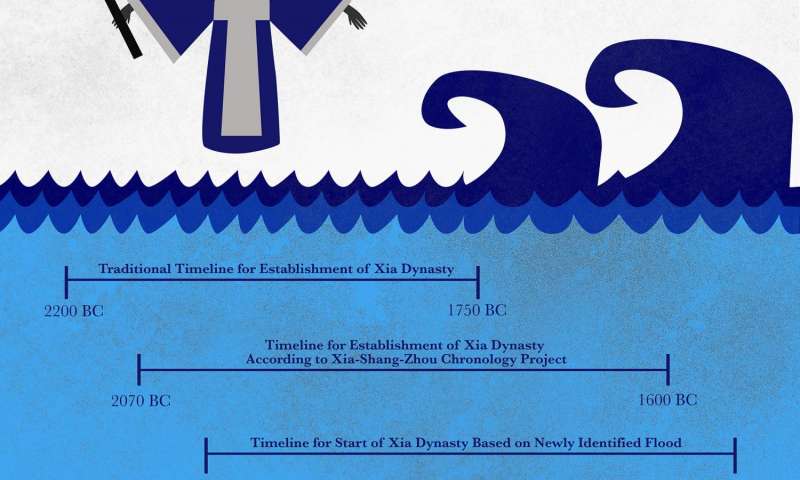
The findings in the journal Science may help rewrite history because they not only show that a massive flood did occur, but that it was in 1920 B.C., several centuries later than traditionally thought.
This image highlights the variable timelines for the start of the Xia dynasty according to traditional Chinese culture, the Xia-Shang-Zhou Chronology Project and the flood that was newly identified and dated by Wu et al. (Credit: Copyright © Carla Schaffer/AAAS)
Following the fall of Xia and Shang dynasties, successors of the Yin, the Zhou Dynasty (周王朝) era emerged with the newly mixed populations with the Rong, Turko-Tartaric normadic tribes who established the Zhao 趙, Wei 衛, Liang 梁, Liao 遼... in the China North (華北) with all the subjects from the vassal states of Qin (秦), Lu (魯), Qi (齊), Yan (燕), Han (韓), in the Central Plains (中原), combined to have made up the people in the united China under the Qin rule in 221 B.C. Up until that time the "diplomatic language" among them was recorded in the Yayu (雅語), a dictionary of the local dialects, and Wenyanwen (文言文), or classical Chinese, both as their tools in interstate written communiqués. There is no need to say people did not speak the same languages then as now, so to speak. The northern languages were different from those spoken in the southern states of Chu (楚), Wu (吳), Yue (越), and later the XiYue (西越 TâyViệt), Dongyue (東越 ĐôngViệt), MinYue (閩越 MânViệt), WuYue (吳越 NgôViệt), LuoYue (鵅越 LạcViệt), OuYue (毆越 ÂuViệt), and Yuechang (越常 Việtthường), all were descended from a common root being referred as "the Taic linguistic family" in this research, as opposed to those of the Sino-Tibetan linguistic family as known today with the Chinese language. Meantime, the "Yue linguistic sub-family" is postulated as a branch that parallels with what the Austroasiatic Mon-Khmer linguistic sub-family was hypothesized, which are in opposition with the Daic-Kadai linguistic sub-family.
As a matter of fact, in the early 20th century the southern linguistic group was lumped together into the 'Austroasiatic linguistic family' (AA) by Western linguists which also embraced all those Mon-Khmer languages spoken Southeast Asia's region. However, like their cultural fossils excavated further in the southern Indo-China regions of today's Vietnam's territories, the Mon-Khmer or the Chamic languages spoken by the indigenous people there had nothing to do with the Annamese latecomers long after the 13th century when they set foot in the region. The Annamese by then had already spoken a form of Yue language with thick layers Chinese lingo which was unlike any of the Mon-Khmer languages but it must have sounded like a variation of vernacular Mandarin. So said, we are speaking of era recorded in history, not prehistoric periods.
History had it that as China ended with the Spring and Autumn Warring Period (春秋戰國, 770 BC - 221 BC), subjects of several states that were defeated by the Qin State (秦國) fled southwards to China South (華南), among whom were those of the Yue indigenous people – who were recorded in different Chinese characters such as 鉞, 粵, 越 (Việt), etc., and had long established their rightful aforementioned Yue states by then. The Chinese of the Northern states always contemptuously referred to those people as NamMan (南蠻) or "Southern Barbarians". All together the Yue tribes evolved into ethnic minorities in our time known as the Dai (傣), the Zhuang (壯), the Yao (瑤), the Miao (苗) (Hmong), the Mon (猛 or 毛南), etc., respectively, with their languages each having evolved separately.
Tracing down the family line, it is noted that the Chu State (楚國) had its subjects being of Taic descents (原始傣族 - Tai-Shan). When Chu – along with other several vassal states of the Eastern Zhou Dynasty (東周王朝) era – was defeated by the Qin State, all of its populace was absorbed into the Qin Empire. In 208 B.C., the Yue states from MinYue (閩越) to Vietnam's northern Giaochỉ (交趾) across a vast stretch of land in the China South, that were then ruled by the former Qin's general called Triệu Đà (趙佗 Zhào Tuó), would later be incorporated into the NamViệt Kingdom (南越王國) that lasted nearly 100 years until it was finally conquered by the Han Empire (大漢) in 111 B.C.
Essentially the racial components of the Han Empire consisted of mainly those who were from the combined populations of both the Chu and former Qin Empire's states in addition to the populace of the later annexed NamViet Kingdom. In other word, racial balance of the Han people, hence, was composed of basically the same Yue ethnic ratio based on the fact that the racial makeup of all the subjects of those states previously defeated and incorporated into the Qin Empire already having included a great number of people of Taic stock of the earlier Chu State. Again, be reminded that King Liu Bang (劉邦) who founded the Han Dynasty and his subordinates had been formerly subjects of the Chu State (楚國居民) as well.
As the Han Empire expanded with the annexation of the former NamViet Kingdom, part of it became the Giaochâu Prefecture (交州 Jiaozhou) that would later be known as the historical Pacified Southern Protectorate 安南都護府 (Annam Đôhộphủ), located in today's Vietnam's northeastern territory. In Annam in the advancement of the Han colonialists the indigenous Viet-Muong groups, descendants of the LuoYue (雒越) people – who originally inhabited inside the ancient Vănlang State (文郎國, a semi-legendary state postulated as under the rule of 18 ancient Vietnamese Hung kings 雄王, possiblly a misreading of the first Chinese character in 雒王 or "King Lac" ) considered as the early ancient Annam – defiant Muong people broke up and fled to remote mountainous regions. Those left behind in the lowland of the fertile Red River Delta formed the Kinh ethnicity (京族 Jingzu) majority. Many of the later Kinh people were born from intermarriages with the later Han resettlers who, except for those had deep and remote roots from China North, were also of Yue origin, e.g., descendants of the Chu State's subjects and those coming from the Eastern states of Wu and Yue, now belonging to Zhejiang and Jiangsu provinces. Note the connotation of the word "京" for "Kinh", which means "the metropolitan people", as the Annamese called themselves since the ancient times. In short, the ancient Annamese Kinh were formed with the interminglings of the "Yue-mixed Chinese" – from the Han subjects in China South – with the local aborigines in the Red River's Basin in North Vietnam.
Historically, since 208 B.C. onward, the language of the Qin Dynasty, e.g., 秦 as "Tần", had already impacted the indigenous Vietic language in the process of forming the early ancient Sinitic-Vietnamese vocabulary stock. Furthermore, the imposition of the Han's language around 186 A.D. as decreed by Viceroy Sĩ Nhiếp (士攝) over the use of the indigenous Yue language caused the Ancient Chinese basic stock to have continually penetrated deeply into the local fundamentally linguistic base. As more ancient Sintic elements continued to blend the cout's language of the mandarins as adopted by the changes of each dynasty in the Middle Kingdom with different colonial policies as late as the Ming Dynasty in the 14th century in Annam for a period of 25 years more under its rule. Their linguistic mixed use contributed to the shape-up of the Middle Vietnamese as spoken locally at the time. In short, long after the split of Viet-Muong group, the linguistic division between the Muong and the Kinh became much deeper and turned out to be unintelligible to each other as different languages in our contemporary era.
To sum up the total impact of those foreign intruders into Northern China and the pre-Chinese penitrators into the prehistoric land of the Yue in China South had on the linguistic aspects of Chinese, for the overall Chinese history, Terrien de Lacouperie wrapped it up nicely as follows.
"The influence of the Turko-Tatar races has been considerable. Several of them [...] belong to olden times. For several centuries after the Han period, ignorant Tatar dynasties have ruled over parts of Northern China. The Sien-pi, cognate to the Coreans, have produced the dynasties of the Former Yen, 303-352 A.D.; the After Yen, 383-408 A.D.; the Western Yen, 385-394 A.D.; the Southern Yen, 398-410 A.D.; the Southern Liang, 397-414 A.D.; the WesternTsin, 385-412 A.D.
The Hiung-nu Turks have produced the dynasties of Northern Liang, 397-439 A.D., of the Hia, 407-431 A.D. in W. Shensi (to be distinguished from the later Si-Hia), and afterwards the Northern Han, in 951-799 A.D.
The Tchao Turks produced the dynasties of the Former Tchao, 304-329 A.D., and After Tchao, 319-352 A.D.
The Si-fan have produced the dynasties of Tcheng in Szetchuen, 301-346 A.D. ; of the Former Tsin, 390-395 A.D., After Tsin, 384-417 A.D., both in Shensi. The Tobat Tatars, who produced the great dynasty of the Northern Wei, 386-532 A.D., belonged to the same group. They were apparently acquainted with the Syriac writing, at least about 476-500 A.D., and they had a court language of their own, in which their ruler Wan-ti at that time (in 486 A.D.) ordered that a translation of the Hiao king or 'Book of filial piety' should be made. Its use was not abolished before 517 A.D.
The rule of the Northern Wei extended over the whole of Northern China, with a few regional exceptions in the proximity of the Yang-tze Kiang. Later on, that of the Mongol dynasty of the K'itan or Liao, 907-1202 A.D., was restricted in the north-east. In the north-west, the Si-Hia or Tangut dynasty ruled from 982 to 1227, until it was swept away by the Mongols. [..] The Kin or Jutchih, the ancestors of the present Mandshu dynasty, ruled over a larger area than the N. Wei, from 1115 to 1234 A.D. The Mongol Yuen dynasty established by Kubila'i-Khan in 1271, and which lasted until 1367, was the first to rule over the whole of China; its great power did more for the homogeneity of the Middle Kingdom than any previous effort.And at last, in 1644, the Mandshu Ta Tsing dynasty established its sway all over the Empire[..]
These various dynasties brought each of them their own language, as their names suggest, and restricted as it was in its use to the court and soldiery, its influence was in every case limited, though by no means unreal, as shown by the alteration of pronunciation and the introduction of words in the official dialect. With regard to the [..] Maudshus, their presence has hurried on the phonetic decay of the Peking Mandarin dialect, now the official language, on the path of hissing and hushing the sounds, where it had entered since the days of the Yuen Mongols. Their small number, and their habit of living somewhat apart from the population, restrict the influence of the soldiery, which is felt only in the proximity of the post-towns over the empire, by the introduction of a few terms in the vernaculars."
(Terrien de Lacouperie. Ibid. pp. 127-129)
With regard to Taic roots of the language that subjects of ancient Chu State spoke, including King Liu Bang (漢高祖劉邦), the founder of the Han Dynasty, and his generals who helped found the Han Empire as discussed earlier more than once in the previous chapters, the Sinitic-Vietnamese fundamental words shared some of them from the descendant Daic-Kadai family, of which variant dialects are spoken by the "Tày" ethnic groups in North Vietnam. This Sinitic-Vietnamese linguistic survey will show that my newly-found dscovery, including those of the earlier period, i.e., the glossarial vestiges of the proto-Taic elements that existed in the pre-Sinitic linguistic being older than Archaic Chinese forms as found in the Minnan dialects in MinYue (閩越) State, located in today's Fujian Province of China as they are linguistically affiliated with some basic words found in the Yue aboriginal language. (See Chapter 7 on the Tày worldlist.)
B) Is it Chinese or Vietnamese?
It is not always easy to identify the oriigin of a cognate in both Sinitic-Vietnamese and Chinese. What is the appropriate way to classify a "Sinitic-Vietnamese word" if it originated from either the Yue root or Archaic Chinese via its cognateness with both roots, such as those that have evolved into lexical variants or derivatives, e.g., 牙 yá originally a Yue word meaning 'tusk' which became 'tooth' in Chinese? (See APPENDIX G: Tsu-lin Mei's The Case of "ngà". If it was of Yue origin, should the Chinese form be then considered as an Yue loanword or a cognate of the same Sinitic-Vietnamese etymon affiliated with some indigenous "proto-Yue" or "Taic" linguistic family? As a matter of fact, a native basic word could distance itself from other forms which are likely related as well, not only the case of 牙 yá. For example, an indigenous form *krong are cognate to both Vietnamese 'sông' and Chinese 江 jiāng (SV giang, Cant. /kong11/, 'river', as in "Mekong" and 湄江 Méijiāng), the word 江 being an irreplaceable word in Chinese but having a deep root of some ancient Yue language in China South. By the way, in Khmer the modern form "krong" means "city", though, such as 'Krong Siem Riap'. Phonologically, the specific phonetic shell that "wraps up" the etyma evolved from *krong in Vietnamese 'sông', SV 'giang', Cant. /kong11/, M 江 'jiāng', etc., are constructed with the vocable constructed with the toneme[C+V(+C)] that compasses all existing Vietnamese and Chinese vocabularies; every morphemic attribute – such as its tonality – of a Vietnamese lexeme /sowŋ11/ or /səwŋ11/ is characteristically of the same nature of the ancient root */krowŋ11/. So said, by the same analogy, M 江 'jiāng could have its root in 水 shuǐ (SV thuỷ) of Tibetan tchu origin or the Chinese 川 chuān (SV xuyên), both meaning 'river' as well (See Chapter 9).
Such a linguistic build is parallel to that of genetic stock forming the same biological physique, which makes people ask themselves the question 'Is she Chinese or Vietnamese?'. Metaphorically, what counts is not the mechanics of bio-engineering that grafts Chinese branches onto the trunk of the Yue tree that bear similar Vietnamese fruits, branches, leaves, flowers like other trees but the bio-genome (Charles Darwin. 1859). That is what made the Taic and Yue racially mixed Chu subjects, including Sinicized nationals of Yue descents as in the case of coercion of local Yue women to marry northwestern Qin infantrymen in Qin Empire in China South who later became subjects of the Han Empire, including those in Jiaozhi Prefecture in North Vietnam.
Vietnamese is a language that has populated all Sinitic elements on top of its common base of ancient aboriginal strata with some indigenous basic word remnants still in existence. In fact, Vietnamese etyma largely consist of a greater amount of Chinese loanwords in both Sino-Vietnamese and Sinitic-Vietnamese categories, a small number of the latter had actually evolved from ancient Yue roots which had also been shared by several Chinese dialects as well, e.g., those variants from Cantonese, Fukienese, Hainanese, etc., in China South (see illustrations in the succeeding sections after the next). However, it must be noted that the case of the Vietnamese development had gone through the 1000-year domination of Chinese rule had it totally transformed into a Sinitized language, literally, but not a creole or some other postulated 'hybrid' languages, such as Creole or Albanese of which vocabularies are totally comprised of loanwords from several other prominent languages with a few hundred of native words of its own left (Bloomfield. 1933).
It is interesting to note that some of the basic Yue-based words had already existed in ancient Annamese prior to their doublets finding their way back again into the Vietnamese fundamental stock, the second or the third time, by way of other routes, e.g., 'chuột' vs. 'tý' for 子 zi SV 'tử' (rat), 'dê' vs. 'mùi' 未 wèi SV 'vị' (goat), 'trâu' vs. 'sửu' 丑 chǒu SV 'xú' (buffallo), 'mèo' vs. 'mẹo' 卯 SV 'mão' (Cat), 'ngựa' 午 wǔ SV 'ngọ' (horse), 'heo' 亥 hài SV 'hợi' (pig), etc., including those postulated as of Austroasiatic Mon-Khmer languages of which the Khmer zodiac names of animals are attested from trade route from Annam in ancient times. In the same way, the whole process is similar to that of how Japanese words of modern Western concepts of the early 20th century such as 'dânchủ' 民主 mínzhǔ (democracy) or 'cộnghoà' 共和 gònghé (republic), that were built with Chinese materials, have found their way back into Chinese and then later the Vietnamese language.
Figure 6.4 - Is Vietnamese of Austroasiatic Mon-Khmer or Sino-Tibetan linuistic family?
James Campbell in Vietnamese Dialects once rediculed my ignorance of linguistics but he states it best that
"I originally included Vietnamese in this study/website because of the fact its phonological makeup is very similar to Chinese and, indeed, its tonal system matches the Chinese one. Originally I wrote at this site: "Vietnamese is neither a Chinese language nor related to Chinese (It is an Austroasiatic > Mon-Khmer language more closely related to Khmer/Cambodian). Besides having a very similar phonological system, and due to the heavy Chinese influence on the language, it also has a tone system that matches the Chinese one." However, after reading and conducting a bit more research, it appears that Vietnamese affiliation with Việt-Mương, Mon-Khmer, and Austroasiatic, may in fact be a faulty case."
[...] [Vietnamese] may not be considered a Sinitic language or one of the Chinese dialects, but the Kinh have a lot in common with the Chinese culture, and the language leaves little to doubt. I will not go into great detail about how this is claimed, as a great deal has been posted at some other websites (see below [for study by dchph, the author of this very paper]) and that is not the purpose of this site. However, one can see that Vietnamese shares many traits in common with Chinese: 60-70% Sinitic vocabulary, another 20% of vocabulary is substrata of proto-Sinitic vocabulary, much of the grammar and grammatical markers share similarities with Chinese, along with classifiers. One would find it very difficult to draw similar parallels between Chinese and other Mon-Khmer languages. It seems that after considering all of this, what is left that is Mon-Khmer is actually very little, and probably acquired over time through contact with bordering nations. For example, the numbers are of distinct Mon-Khmer origin, however, used in many compound words, Vietnamese uses instead Chinese roots (as is common in the other Sino-Xenic languages, Japanese and Korean)." (X)
Let's talk a bit more about the affiliation of the two countries in terms of political geography where nothern Vietnam's region once was a part of the Middle Kingdom before the 10th century. On the one hand, to write Vietnam's history of the early days as it was first written – such as the The ĐạiViệt Sửký Toànthư (Complete Annals of ĐạiViệt) in 1479, the official history of the Lê Dynasty, originally compiled by the court-appointed official Ngô Sĩ Liên, by the order of King Lê Thánh-Tông – historians normally referred to Chinese records for historical anecdotes of the place once called Giaochi (交趾 Jiaozhi), even all the national names – State, kings, places, people, etc – are called by Sino-Vietnamese translation such as vua "Hồngbàng", "Hùngvương", or "Andươngvương" to relate to the establishment of ancient state of ÂuLạc.(A). In search for an even more archaic period with those already existed folklores of which some legends could be attested also with earlier Chinese historical records, for instance, the legend of Vietnam's "Thánh Dóng" who fought against Yin invaders (1718 B.C.-1631 B.C.) (董)
Early Vietnam's history is made up for pieces of China's history. At the very least, they have been essential parts to what happened to Vietnam's prior to her independence in 939, on the other hand. Annals of ancient Vietnam was a part in China's history as Annam was never recognized as a sovereign state in any official China's history (See Si Maguang's Zizhi Tongjian in modern Chinese language, 72 volumes, by Bo Yang. 1983-93). Throughout the long Chinese colonial rule from 111 B.C .to 939 A.D. there emerged one short interval of an independent Vietnam ruled by the Early Lý Dynasty from 544 to 602 A.D. and ancient Vietnams was still considered as only a vassel state of China. Meanwhile, for the most part Annam was normally treated by China as its renegade prefecture even long after it became sovereignty; it simply dispeared in Chinese history. In effect, the ancient Vietnam had been considered as a prefecture of the Chinese empire until the Qing Dynasty late in the 19th century. By then its declining Manchurian government was forced to sign the Treaty of Tientsin (1885) with the French government to renounce its protectorate rights in Annam to France. It is only by then that Vietnam was called by name as another country in China's offical records.As a matter of fact, to compile specifically about the nation of "the Yue of the South", i.e., Việtnam, in continuation, Chinese history is indispensable in providing with records of all chronological phases of the develoment of the nation of Vietnam unless Vietnamese historians do not seek to connect the ancient Vietnam prior to her independence in 939 A.D., that is, 1,000 years long of "northern colonization period" (北屬時期) that was imposed on the region of Giaochi in the eastern part of today's North Vietnam starting in 218 B.C. under the rule of the First Emperor Qin Shihuang (秦始皇) as a prefecture of the Qin Empire until it became part of the larger Namviet Kingdom established and ruled by the Triệu Dynasty (207–111 B.C.). Ancient Vietnam continued to be a prefecture of the Middle Kingdom as Giaochau and Annam under the rule of the succeeding Han Dynasty until the end of the Tang Dynasty in 907 A.D. as the Middle Kingdom entered a turbulent period having been broken up into 10 states, which created favorable condition for the emergence of an independent Vietnam in 939 A.D.
History of ancient Annam had simply been "Annals of local events" (地方誌) of China. Throughout the colonial period under the Chinese rule, as sporadic uprisings and rebellions were always expected to be suppressed eventually; therefore, there was no recognition of any "constant resistance wars". Vietnamese historians, however, like to assume that Vietnam used to have her own written historical records and literary works which include the two declarations of independence of their ancestral "Southern Yue State" (NamViệt) (I) despite of the fact that they all were written in Chinese even after her independence.
Many Vietnamese scholars believe many Vietnam's historical records could not be found now because they were destroyed by constant resistance wars. They further imagine that when the Chinese aggressors left the country, they did not forget to bring home with them all available books from their old colonial Annam. As a matter of fact, Giaochi, i.e., aother name of China's prefecture of Annam, as previously mentioned, was never considered as an independent state in China's history; therefore, the Chinese colonialists had no neason to feel any threats and excuses to be prepared for a total evacuation from the Annamese colony, let alone having plan to bring back to their motherland all cultural artifacts and historical records for Annam was their homeland as many of them had been actually born and lived there for all their lives; the colony would be always there for their heirs to exploit. Specifically, all other greedy Chinese mandarins would never care much about cultural heritage but monetary valuables such as gold taels and precious germs and Chinese generals were busy securing their interests in their own soldiery stations as their estates. (V) Such supposition was highly probable for the reason that throughout the time span during the chaotic period immediately after the collapse of the Tang Dynasty in 907 as the whole union of Middle Kingdom was broken up into 7 major different states, with each having been ruled by different self-claimed emperors or kings overall for 72 years until 979.
As a matter of fact, before and after 939 back in the mainland those divided states had been ravaged in ferocious wars among warlord factions raging on while the Annam Prefecture, inside the Qinghaijun Military Zone (清海軍區) then, was the prosperous and safe haven usiness as normal, home away from home. Again, note that by then even though Annam had been a de facto sovereignty, Chinese rulers and their historians just treated it like a renegade prefecture, comparable to the picture of Taiwan or even Hong Kong at present time. It is understandable that, moreover, most of the Chinese colonialists and their family – of high officials appointed by the NanHan State's imperial court (南漢王國, 917-971, consisting of territories of today's China's provinces of Guangdong, Guangxi, Hainan, and the northeastern part of today's North Vietnam) which was then controlled and manipulated, interestingly, by eunuchs – in this case the stationed colonists would rather choose to remain in the Annam Prefecture than to return to the inner mainland up north as the state of NanHan show signs disintegration. Besides, for all high officials of the state in order to hold important governmental posts, they were supposed to be castrated, each one to become an eunuch among some 20,000 significant others. (Bo Yang, Vol. 72, p. 160. 1993)
Figure 6.5 – Fourth Chinese domination of Vietnam
China's province of Zhejiang around the 940s was the origin of the Chinese Hồ/Hú family from which Hồ Dynasty founder in Vietnam, Emperor Hồ Quý Ly came from. The Ming invasion had been preceded by a campaign against Chinese culture during the combined 7-year reigns of the two emperors of the Hồ dynasty, Hồ Quý Ly in 1400 and his second son, Hồ Hán Thương, from 1400 to 1407. During these 7 years the two Hồ emperors asserted Vietnamese culture and language and banned use of Chinese language and writing in government. When the Ming invaded the cultural campaign was reversed; all classical Vietnamese printing blocks, books and materials relating to Vietnam were suppressed. For this reason almost no vernacular chữ nôm texts survive from before the Ming invasion. Various ancient sites such as pagoda Bao Minh were looted and destroyed. The Ming dynasty applied various Sinicization policies to spread more Chinese culture in the occupied nation.
Source: wikipedia.org
Linguistically, in order to understand the becoming of the Vietnamese language it should be put under the historical perspective in terms of such dynastic events. The ancient Annam, as a colony of China, was a place for the Chinese colonists to exploit natural resource at the expense of the local people. The commonest colonial consequences were the displacement of the native from their homestead and disruption of their economic activities, and in this case, they became minorities in their own ancestral land. The invaders who governed dictated what they saw fit. Their colonization policy was enforced by heavy-handed oppression at times, apparently demonstrated in cutural resistance clashes as well. With the presence of those had solid grips of power, several factors had detrimentally influenced the developmental course of the ancient Vietnamese language because that was determined by the rulers what the people in the colony would learn to speak. Examples like that were commonplace in the world's history. In Annam, while it had been already under strong Chinese linguistic influence for the last 1,600 years until it fell again into the dark 20-year period of the Chinese occupation again in 1407 as the Ming invaders implemented their annihilative policy to wipe out the local culture, including any extant 'Nôm' literary works. For the next 500 years after winning the resistance war against the Ming in 1427, ironically, the kings of the Annam's post-Lê Dynasty would but return to the same centuries-old course of development. Academically, while inflexible use of the formal classic Chinese Wenyanwen (文言文) adopted by the ruling monarchy throughout the national history, there existed Sino-centric scholars with their willingness to adopt Chinese lingo wholeheartedly, from literary to dialectal and coloquial speeches within circles of the officials in the Annam's court. Except for Vietnam's annals, there went hand in hand with look-down attitude toward local academic works. Such unpatriotic craze of Chinese scholarship lasted all the way until the first 2 decades of the 20th century when the focus turned to other direction that went after the newly introduced Western culture brought in by the French colonists, that is, introduction of the French language in the national examinations – in concurrence with the classic Chinese language – and the newly adopted national Vietnamese romanized orthography called 'Quốcngữ' was first implemented in the nation in 1909, then those of 1910, 1912, and thereafter subsequently. (Nguyễn Thị Chân-Quỳnh. 1995. pp. 16-46, 104-110).
Obsession of the Chinese culture was widespread among the common mass in the countryside as well. Nguyễn Thị Chân-Quỳnh (ibid. pp. 110-111) quoted Nguyễn Văn Xuân (1970) in his Phong-trào Duy-tân ('Reform movement for modernaization', Saigon: Lábối publisher, 1970) that, surprisingly, even villagers up until 1970 still put paper written with Chinese scripts called "ChữNho" (儒字) in the sacred places around the house while newspapers with printed material with Latin alphabets could be made used of as toilet tissues. Now that contemporary scholars have made a 360-degree turn with heated nationalism that smears neutrality in academic realm. The damages have been done, though. Such an attiiude has been looked down by today's nationalists and been seen as a disgrace to the nation.
In quest of finding Chinese etyma that show cognates with Vietnamese basic words from the same source, it is recommened that historical linguists, especially local Vietnamese scholars, should try to bring back legitimate scholarship by means of making use of Chinese literary works and dictionaries such as Guangyun (廣韻) and Kangxi Zidian (康熙字典) or even latest work by Western academic in surveys on SIno-Tibetan and Old Chinese historical lingistics; otherwise, we will never be able to comprehend why there exist vestiges of northern dominant Chinese dialects in modern Vietnamese, that incudes the basic realm. As a matter of fact, many Vietnamese etyma can be identified as of the northern colloquial expressions and vernacular mandarin were supposedly spoken only by the general public living inside the Middle Kingdom but somehow also found in spoken Vietnamese, which indicates its pupularity that was spread to the general Vietnamese public as well, for example, 'mainầy' 明兒 míngr (tomorrow), 'lúcnào' 牢牢 láoláo (all the times), 'luônluôn' 老老 láoláo (always), 'khôngphảisao?' 可不是 kěbùshì (isn't it so?), 受不了了 Shòu bù liăo le! (Chịu khôngnổi rồ!), etc. Those forms of expressions are common usages in the official northern dialect. Historically, most Chinese rulers of the Middle Kingdom were northerners, including those of Altaic Turko-Mongol origin, which could be seen through the fact that their capitals mostly built in the northern region of the mainland of China, including the Ming's imperial palace, which had been initially located in Nanjing (南京) in the lower Yangtse Basin and then later was moved to today's current Beijing (北京) location despite of its extreme hash weather elements over there, including dust storms from the Gorbi desert in the north that have caused desertization by movable sand dunes.
How such Vietnamese and northern Chinese colloqiual forms have been affiliated might originate from racial entanglements that occurred throughout the colonial period. We could imagine that with incessant flows of Chinese immigrants who kept pouring in to the Annam prefecture since 111 B.C. and the trend continued on well beyond the period of Chinese colonialization with aforementioned northern Chinese dialectal speakers from China such as officials and infantrymen, along with their family members, who were stationed in the Annamese land and many of them eventually intermarried with the local people.
The fact that the Koreans and Japanese could not absolutely be identified with the Chinese still currently shows as those people of Chinese ethnicity living in South Korea and Japan for many generations remain aliens. Even though Vietnam survived the longest history of Chinese dominion, the process of Sinicization had put a heavy toll and left a permanent Sinitic mark on her people and their language. In comparison, unlike the other East Asia's Sino-xenic countries such as the two Koreas and Japan who uniquely display their own national identities, dispite of the fact that the northern Chinese consist no less Altaic-origin people than the racial ratio of the Yue to the northerners.
Ethnically, Vietnam's 84 percent of her nationals are of the Kinh majority, who are also known as Vietnamese ethnicity, supposedly their having a mixture of early ancestral Yue natives who had inhabited a wide-spread area stretching out from Lake Dongtinghu located in Hunan Province in China South to today's North Vietnam's region, including the lately acquired territory in the southeastern area for of the ancient Nanzhao Kingdom (南詔 738-902) – and subsequently of Dali State (大理國 937–1253 ) located in south of today's China's Yunnan Province – where Vietnam's present northwestern area is with a large number of Daic ethnic concentration. The Kinh populace have, in other word, evolved from racial admixture of Yue-Han resettlers who emigrated from the southerrn region of China with those indigenous people living further in the south since the Han Dynaty. The remaning 16 percent of the population consists of other designated 54 ethnic minority groups inhabiting in Vietnam's mountainous region up north stretching southward to the western plateau running from north to south where those Mon-Khmer and Cham minorities have been living in the eastern coastal lowland stretches that were seized from the two former kingdoms of Champa and Khmer in a much later development starting from the 12th century to the early 20th century. Those ethnic groups of Mon-Khmer origin were also known as montagnards while the Cham minority were descended from those subjects of the bygone Champa Kingdom who had survived the earlier annihilative slaughter in the 18th century for their uprising against the Vietnamese usurpation committed by King Mingmang of the last Nguyen Dynasty.
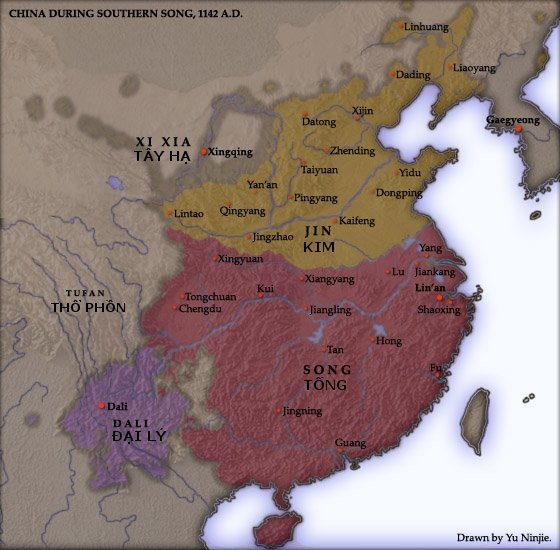
Figure 6.6 – Map of the Dali State in 1142
(Source: https://upload.wikimedia.org/wikipedia/vi/d/d5/China_11b.jpg)
Anthropologically, with respect to the Chinese and Vietnamese racial affiliation one would be able to distinguish those Han resettlers in ancient times (who constituted a portion of the early Kinh populace in terms of their mixture with the aborigines) from those contemporary latecomers of Chinese immigrants as late as after the end of the World War II who followed the foosteps of Generalissimo Chiang Kai-Shek's troops to come to Vietnam disarm the Japanese surrender. Both former and latter Chinese immigrants lived mostly in the lowland and the coastal cities and townships, e.g., numerous Chinese Hananese and Fukienese ethnic groups living in Huế, Đànnẵng, Faifo (Hộian - 會安), Tamkỳ, Tamquan, Bồngsơn, Quynhơn, Tuyhoà, etc., who have made up the Chinese ethnic group officially called the Hoa (華) minority of around 1 million people whose ancestors were forced to adopt the Vietnamese citizenship by the southern government during the 1960s. All in all they gradually become fully intergrated members of the Kinh majority over the years. For those early Chinese resettlers – such as thousands of those refugees coming in by boats after the Ming Dynasty in the China's mainland fell into the hands of the northern Manchurians – they were credited for their contribution in development of new towns in 6 newly established southernmost provinces, especially Hàtiên, Bạcliêu, or even Sàigòn (西岸 Xī'àn), which historically belonged to the ancient Khmer Kingdom before the mainstream Kinh people moved in by the late 18th century.
More proofs can be found in a notable recent development in the transformation of the children of early Chinese immigrants to have become members of the Kinh majority who were no longer counted as Chinese in the official census are descendants of many Chinese-Vietnamese who were still left behind from the exodus of the Chinese ethnic groups who got out of the country by boats in 1979 right before the imminent Sino-Vietnamese border war started and the waves of boatpeople continued on until 1996 with approximatey 400,000 Chinese-Vietnamese refugees plus who fled Vietnam were later resettled in the US, Canada, and many other Western countries. (H) Let us take other samples on the ration of Chinese-ethnic populace that made up the Kinh majority with many of their forefathers such as King Hồ Quý-Ly or Governor Phan Thanh-Giản, along with with many other unsung heroes and common people alike in the general population of those millennials, a sizable portion of the Hoa minority, have become famous performance artists and persona in showbiz in contemporary Vietnam, such as Trấn Thành, Đàm Vĩnh-Hưng, Quách Thành-Danh, etc., not to mention all other personages in the political arena. It is so enumerated because the ratio of renown artists and the common populace is a fractional percentage in the overall population, say, one in a million, which demonstrates the magnitudes on becoming Vietnamese among descents of Chinese immigrants in Vietnam have been in remarkable droves.
As a matter of fact, the Vietnamese Kinh people, historically, were descents of early waves of Chinese immigrants followed the footsteps of the Han's invaders who had occupied and established their rule in the ancient Annamese land since 111 B.C. throughout the period that followed for at least 1000 years later. The Chinese immigrants from the north kept coming, resettled, and intermarried with local wives. They and their offsprings, as a result, mostly constituted an integral part of the already established "Kinh ethnicity" (京族) as previously mentioned. The term "Kinh" originally was used to indicate those "metropolitans" who resided in large townships around the Red River Basin and in the lowland along the coastal areas as the country expanded further to the south. No need to say, it is in those places where the Han colonialists had first built barracks to station their troops and residences to house their administrative officials. Many of them stayed over and made their homestead in the ancient Annam prefecture and never returned home, especially, when the Tang Empire totally disintegrated in 907.
The key word here is "millennium". As history has it, events that shaped up Vietnam from China's bondage are measured by units of 1,000 years each. After the country's independence, Annam repeated the process of colonization that China had done to the ancient Annam for 1,000 years before. For the next 1,000 years, in fact, just like those earlier Chinese who colonized the ancient Annam, the later Annamese invaders took their turn to play the role of expansionists. After 939 A.D. as people of the newly established sovereign state of Annam advanced further to the south, they encroached and annexed its adjacent territories hold by weakened neighbors through wars and bold resettlement. Over time and along the way southwards, they intermarried with the local Chamic and Khmer people. Those local people of the two lost kingdoms in effect mixed with the Annamese resettlers to have given rise to the latest new mixture of the late Annamese generations. As a result, the racial integration and language development continued on with a new twist of the Chamic and Khmer elements in the later period of development that made a more lax pronunciation by speakers of the whole distictive class of Southern Vietnamese that have been formed in the last 300 to 500 years than the ancient 2,200 year-old northeners, anthropologically. As a matter of fact, by the early 18th century the late Annamese resettlers had reached the region of today's Rạchgiá Province and mixed not only with those Khmer people but also with descendants of those earlier Chinese refugees led by Marshall Mạc Cửu and his people fleeing the Manchurian rule in China after the fall of the Ming Dynasty who had first been allowed to resettle there by the Nguyễn monarchs.
The newly racially mixed offsprings emerged and they would pose no distinction with the Kinh majority in terms of racial mix for their physical appearance look alike probably due to the similarity of the harshly warm climate of equatorial region where they were born. In sum, the Vietnam nationals as we have seen all over places in modern Vietnam, altogether the 6 main ethnic stocks have made up the Kinh majority, i.e., the Taic, the Yue, the Chinese, the Daic, the Chamic, and the Khmer people. Their populace plus those who were later identified as of Chamic ethnicity in the official 2010 census were made up only a small portion of the Kinh population due to historical events by the end of the 19th century – as the population of the Annam reached to 20 million – for the reason that, firstly, there occurred ethnic lynching committed during the reign of King Minh Mạng against the Chamic minority for their past cooperation with the opposing Tâysơn forces and, secondly, descendants of those native minority of the lost Champa had to claim themselves as of the Kinh ethnicity in order to avoid indiscriminate mistreatment and execution by the late monarchs of the Nguyễn Dynasty. So were those Khmer ethnic groups in the south after portions of their ancient kingdom's territory were annexed into the southern part of today's Vietnam.
While Cham or Khmer heritage has been largely acclaimed with prestigious cultural artifacts and colossus monuments, many Vietnamese academics have missed the point mainly more on the Chinese racial factor. It is probably that the term "Chinese" has bothered them all along just like what we already discussed about nationalism and politics in the previous chapter. It is understandable because what else would one expect to see could have emerged from an ancient prefecture of the Middle Kingdom for 1000 years then? Compare the case of past Vietnam with many other former colonies in the world, such as Ireland vs. England, Mexico vs. Spain, or in China where Canton's or Amoy's indigenous entitties, i.e., aboriginal Yue people in ancient region's where today's Guangdong and Fujian provinces located, have been totally assimilated into the Han Chinese mainstream, Vietnam experienced the same fate that it would fail to resist and subdue increasing pressure of assimilation after hundreds of years under the domination of a much more powerful country than itself. It is a plain and simple cognizance. It is not hard for even a novice to grasp the core matter with the reinstatement as such.
Figure 6.7 – Bảngiốc Waterfall over the river
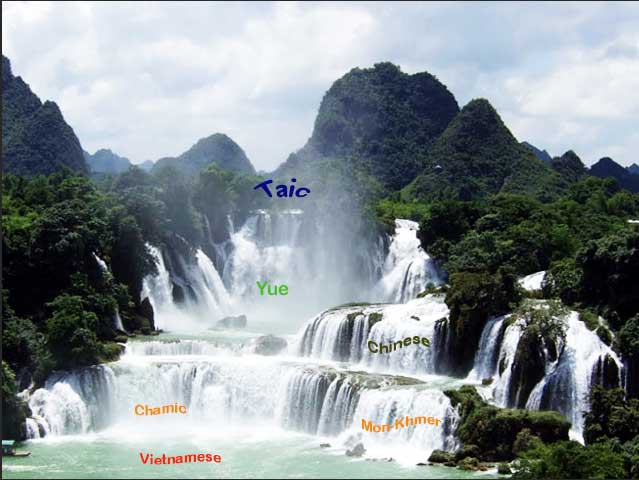
Artistic render of the Taic-Yue-Chin-Chamic-Khmer cascades of the modern Vietnamese language.
(Source: modified from a photo of Bangioc Waterfall)
To be easier on the brain similar to those of artists who could visualize strings of data, here is another way to depict of the whole rationalization as discussed above.
Let's paint a picture of an imaginary Vietnamese national landcape with infusion of water-colored ink with the dark spot on top and the lightest one down below. Analogously, the overall process looks like multi-tiered waterfall with the current flow that streams down and inundates a pool at the bottom cascade. Imagine the cascade underneath the top one stood for the early Chinese – as the Han Empire's subjects – who were largely made up with all the subjects in the ancient states of Qin, Chu, Wu, Yue, etc., of which their offsprings had been descended from the Yue root as well. It is the Taic, or proto-Daic (先傣) and pre-Yue populace of the Chu State (楚國 c. 1030 B.C. - 223 B.C.) – who were called "Malay" people by the Vietnamese author Bình Nguyên Lộc (Nguồn-gốc Mãlai của Dân-tộc Việt-nam or 'The Malay origin of the Vietnamese'. 1972) whose arguments were supported by the early 20th century academics (Phan Hữu Dật, 1993) or the Shan-Taic by Lacouperie (1887) as opposed to 'Taic' or 'proto-Daic' and 'pre-Yue' as mentioned herein – who were represented by the cascade that towers at the peak as the source pouring downward until the muddy water body – symbolizing foreign objects that made up the early proto-Chinese normadic horsemen who had conquered the ancient mainland of pre-China – was totally infused with other elements at the bottom. Submerging in the lightly colored stream further down below are current that blended all foreign substances all the way down from the top – that is, the racially-mixed populace of both the Han and Yue people – and pick up other elements – e.g., Cham and Khmer, etc. – along the way before reaching to the Annamese pool. What is inside it analogously made up the ancestors of ancient Vietnamese and other southern racially-mixed populace in region of China South who were descended from the Yue people as well. Altogether, they integrated well into the Vietnamese racial composition.
Such a theory as discussed above is construed with Chinese historical records. Many Vietnamese nationalists, nevertheless, might find it hard to accept such Sino-centric view because it is inundated with Sinitic elements per se on what they already considered as of "pure" Vietnamese entities, racially and linguistically, pertaining to their respective origin (subjecting to how we define it). On discussing about history of a language and its speakers, one has to choose between non-fictional and legendary stories to start with. If one chooses to go with history, they (T) must understand that the composition of the Vietnam's "Kinh" people have been an inevitable result of racial mixture of the native Yue people and the so-called Han people over time, a product of China's continually encroaching the southern region that pushed the Yue refugees to flee further to the south. Many ethnic groups in Northern Vietnam indicated the trend went on until at least 100 years ago, of which the whole process took place in the very similar fashion to what made up the populace of the Han Empire after it had conquered the NanYue Kingdom in 111 B.C.
There existed, however, no such entity called the "Chinese race" but only the Chinese culture and the people who adopt it. With respect to the Chinese people, before or after the Han Dynasty, they are actually of racially mixed stock, having emerged from the unified empire first established by the First Emperor Qin Shihuang of the Qin Dynasty which establised what now known as "China". The Qin Empire initially encompassed (a) all the subjects of other 6 states (whose forefathers were unlikely of the same ancestors with those of the Qin State in the northwest region in Shaanxi) that it had previously conquered and added to the racial stock of (b) its original populace who were descended from an ancestral line passed down by those proto-Tibetan normadic horsemen and (c) those ancient northern tribes of non-Taic origin from the earlier periods of the Shang and Xia (ancestors of the Altaic line and its Turkish descendants in the northeast region of Shanxi and Shandong, China North), plus (d) all the people in those earlier states which had paid tributes to the feudal Western Zhou's kings whose earliest ancestor came from the Hunan, China South. As the Qin Empire conquered and expanded further to the south, the Chinese people emerged from the latter groups having mixed with indigenous Yue inhabitants in China South. Its population were multiplied with more indigenous Yue tribes as their territories were incorporated into the geo-political map of an entity being known as the Middle Kingdom (中國).
In a succeding course of events, nevertherless, the short-lived Qin Dynasty finally collapsed and the contention with the defiantly reborn Chu State to take over the whole empire was finally won by the empowered Han's first king, Liu Bang, and his generals, notably all having been the old Chu subjects who were descendants from the same Taic ancestors of the Yue.Figure 6.8 – Map of the Zhou Dynasty
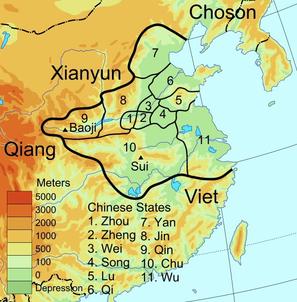
(Source: http://web.archive.org/web/http://www.art-virtue.com/history/shang-zhou/shang-zhou.htm)
The Han Empire, a continuation of the unified Middle Kingdom, had its territory expanded and populated with a great number of the subjects of all other ancient states. Racially and linguistically, the Han's elements grew on top of what was already composed of those populace of the Chu State and then later added up with those Yue components from the later NamViet Kingdom. Thenceforth there emerged the people called 'Han', including those later acquired territories in today's of Guangdong and Guangxi provinces. In other words, they consisted of all people living within the Han Empire since then would be called the Han people (just like an Amercian born in the US, analogously). In other word, the formation of the Han Empire's populace was the result of the mixture of those original subjects – who previously had already made up a part of the multi-state populace of the Eastern Zhou Dynasty – of the subjects from the fall of the Qin Empire and were blended with the people north of the Yangtze River and the Yue people in the China South region.
It was not of any secret that the Han soldiers were those of the wretched poorest who had no means of making a living so they join the army. In Chinese, there is an old saying that goes, "好男不當兵, 好鐵不打釘" (Good men don't join the army; good iron is not for making mails.) The idiom is so cited here just to emphasize the fact that out of hundreds of thousands of Chinese solders who went to colonize ancient Annam only a few would be able to make it back home. As a members of "the elite ruling class", their life would better off resettling in the fertile land of Annam.
Since 111 B.C. after the Han Empire had annexed the whole NamViet Kingdom into their newly unified Middle Kingdom, the racially-mixed Han people from China South kept infiltrating continuously into the southeastern region of the empire, that is, the northeastern part of today's Vietnam, where the newly annexed Giaochỉ prefecture was established. Of the first waves of the Han colonists with their infantrymen marched southward, many of them originally of BáchViệt (百越 BaiYue) origin in the China South as forementioned were displaced from their ancient habitat in the northern region – just south of the Yangtze River (楊子江) in today's Hubei and Hunan provinces – to other faraway places in Vietnam's Red River Basin (Đồngbằng Sông Hồng) and many of them resettled there, permanently, mostly because they had no means to return home.
At the same time, following the long-marched Han soldiers were those exiled officials and their family, and other refugees fleeing ravages of wars and hunger, as well. Altogether they moved in en masse and finally all made their homestead in their newly occupied territory which was later known as 'Annam Đôhộphủ' (安南督護府 'Southern Pacification Protectorate Prefecture') until the end of the Tang Dynasty. Many of them even encroached further into lower level cultivated land of southeastern basin in Vinhphuc and Hoabinh provinces of today's Vietnam, resettled there, and never returned home. Altogether, 1,000 years after that colonial period, they made up the larger part of the Kinh mojority population of the newly independent Annam.
Figure 6.9 – Map of the Han Dynasty
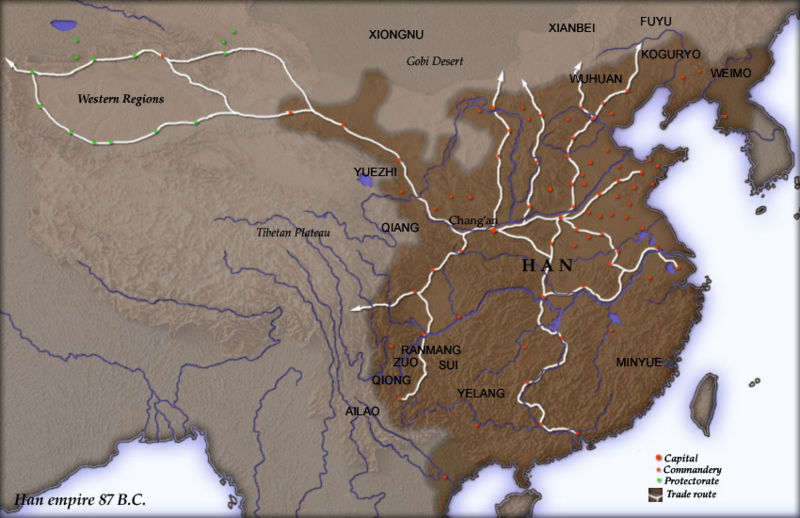
Map of the Han Dynasty
(Source: http://en.wikipedia.org/wiki/Han_Dynasty)
As a matter of fact, 99 percent of the Kinh people today bear Chinese family surnames. Note that the social intercourse was similar to events of racial integration process during the short-lived Qin Dynasty that carried out an imperial decree that coerced more than 30,000 local women to marry their soldiers. We already discussed much of this matter in the previous chapter on politics. In short, to say differently, it is because either home-groomed scholars mostly keep themselves in the line of politically-correct code or they are among those Vietnamese people who misplace their national pride.
To understand the matter better under the perspective of anthropology, one can compare what was postulated on the origin of the Vietnamese people with some other similar development of those countries that have taken on the same path in establishing a new multi-racial nation, regardless of specific ethnicity origin. That was how the Annamese entity began to emerge some 2,200 years ago. For example, contemporary Asian history has witnessed the three consecutive prime ministers of Singapore and all Taiwan's presidents, like their fellow countrymen, are all of China's mainland's origin in terms of where their ancestors come from, specifically Fujian Province, and they take pride in themselves as Singaporean and Taiwanese, respectively, in such a proud manner that goes hand in hand with one's national identity. Read the Figure 6.10 below and you will see the parallel development of both Vietnam and Taiwan. What happened to Vietnam 2 millennia ago is currently happening in Taiwan in our contemporary era. Of course when making an anology, one can eliminate modern technology factors, e.g., transportation, communication, linguistic orthography, etc., out of the equation, so to speak, because the modern factor, obviously, retain the consistency of standard ponunciation of a language and prevent it from changing.
Figure 6.10 – Taiwanese Identity
Of the 23 million people in Taiwan, 98% are descendants of ethnic Han Chinese immigrants who migrated from China from the 17th to the 20th century. Of these, around 70% are descended from immigrants from Fujian and identify themselves as Hoklo whilst 15% are Hakka from Guangdong (Canton) and also Fujian. The ancestors of these people were laborers that crossed the Taiwan Strait to work on plantations for the Dutch. It is believed that these male laborers married local aborigine women, creating a new ethnic group of mixed Chinese and aborigine people. It is these descendants who identify themselves as Taiwanese and increasingly reject their identity as Chinese. The reason for this lies to a great extent with the authoritarian rule of the foreign Kuomintang (KMT) which fled mainland China during the Chinese Civil War and set up government in Taiwan. There was martial law that lasted four decades and was discriminatory against the existing inhabitants of Taiwan. Mandarin, a foreign language, was imposed as the national language (國語) and all other languages were made illegal. The harsh rule over Taiwan was lifted in 1988 and began a new era in Taiwanese history when Lee Tenghui, a Taiwanese, became president. The first transition of power from the China-centric KMT occurred in 2000 when Taiwanese Chen Shui-bian of the Democratic Progressive Party won the presidential elections. He made efforts to push for Taiwan independence with statements that there are two nations across the Taiwan Strait; a push for plebiscite on independence; and the abolishment of the National Unification Council. Taiwanese opinion on independence is split between the northern and southern half of Taiwan which interestingly also divides the "mainlander" (外省人) in the north from the "Taiwanese" (本省人) in the south.
Source: http://www.taiwandna.com
Think of projected total of all children born to more than one hundred eighty thousand Vietnamese women (as of 2018) married to those local husbands in Taiwan – except for those new arrivals in 1949, most of whom are original descendants of fully Sinicized Fukienese {X2Y3Z4H} (交) immigrants from the mainland of China since the 17th century – from the last 30 or more years. The population of the offsproing from their union as of now could probably have surpassed the total population of about 900,000 people in ancient Annam as recorded in the Han's population census of the Giaochâu (交州 Jiaozhou) prefecture 2,000 years ago. The racial ratio and balance of the two racial compositions could have been at the same level except that Chinese descents in Annam are called 'Annamites' while the other 'Taiwanese', each speaking diferent a Sinicized version of their own language, including the proportion of each respective aboriginals. In the context that it does not matter much what their actual country of origin is; it is where their birthplace that counts. The Taiwanese shoul include both the "mainlander" (外省人) and the "Taiwanese" (本省人) withstanding they all are holding tight on the precious status-quo of sovereignty, short of the last step in declaring independence for Taiwan as a new nation just like Vietnam. In fact, regardless of the Chinese-origin of many Vietnamese, they take the pride in their long history fighting against mostly Chinese invaders, especially their incredulous victories of having unprecedentedly defeated the Mongols 3 times in the 13th century (M) who conquered and ruled China for nearly 100 years. They have sacrified a great deal to defend and keep the foreign forces at bay for the last 1,080 years one generation after another. Except for Vietnam's aggressive expansionism on the historical acquisition of stretches of land south of the nation, one by one, that used to belong to the now extinct kingdoms of the whole Champa and, partly, of the Khmer, her sovereignty still hold as a model that both the Tibetan and Uyghur people all are longing for their respective homehand that is still under the control of the Chinese . That is so said because they are undergoing what ancient Vietnam had gone through hundreds of years ago before the 10th century.
For a linguist, sole elaboration on the political, cultural, and historical aspects of a language under survey is sufficient if the matters under discussion are considered as irrelevant to one another like those of Mon-Khmer and Vietnamese for the reason that history of their development had been independent of each other until the last 350 years. What previously belonged to the Khmer then became part of Vietnmese and vice versa. The point is that is used to be the cases between the Vietnamese and Chinese and the Taiwanese and Chinese, per se. In the field of Sinitic-Vietnamese study it is more of the norm than not, one still needs a more comprehensive approach to cover all of the above plus other anthropological elements because they all are relevant and interrelated intimately; otherwise, one could not explain the cognateness of unrefined words currently existing in Chinese and Vietnamese, such as private human reproductive organs and sexual acts such as 'cu', 'cặt' 龜 guī, 'hĩm', 'lồn' 隂 yīn, 'bề' 嫖 piáo, 'đụ', 'đéo' 屌 diăo (SV điệu, Cant. diu2, Hakka diau3), etc., not to mention all other 'refined' words, e.g., 'ânái' 恩愛 ēn'ài, 'giaohợp' 交合 jiāohé, 'giaocấu' 交媾 jiāogòu, are of the same roots. Those similarities are the underlined genomes that gave rise to unique peculiarities that exist only in genetically affiliated languages, so to speak.
Their linguistic commonalities are characterized in all different 'Chinese' dialects and sub-dialectal variants, exposing intrinsically shared features that could not be found in other languages of different linguistic family, say, Austroasiatic Mon-Khmer, to say the least. It is such uniqueness that also masks the true appearance of the same etyma since they possess so much likeness that could only be either used to posit as of the same root or discarded outright as loanwords because of their closeness. For example, 'đường' 糖 táng (sugar) vs. 'đàng' or 'đường' 唐 táng (path), both Chinese and Vietnamese forms are of the same origin, with the former as originated from a Yue root (because Guangxi region historically has been a place to plant sugarcanes since the ancient times) and the latter, /dang2/, highly likely from Middle Chinese, respectively. You will see more of this kind of cognates later when we extend them further, each as component of dissyllabic and 'bisyllabic' (reduplicative) words as in "đáiđường" and "tiểuđường" 糖尿 tángniào (diabetic) where 尿 niào (SV niệu) are wholly cognate to both "tiểu" and "đái" and 尿尿 niàoniào can be postulated for "điđái" or baby 'pee pee' or '(go to) urinate' and compound ones such as 'đáiđường' (to pee on the street in public view) 'điỉa' 屙尿 Cant. /o5niu2/ (go to poop).
There exist so many basic words in fundamental category that carry similar interchange patterns as such in both Vietnamese and Chinese. We, nevertheless, still cannot solely depend on etymological properties, i.e., characteristics and attributes, to determine the linguistic family affililation of those cognates because in Chinese they coud also be of foreign loans. We can look further at their dialectal distribution as well. In this specific case, the word 'đường' with its phonetic make-ups [ɗɨə̤ŋ˨] (VS) and its variants [ɗaŋ˨] (SV), [t'ɔŋ˨] (Cant.), etc. could not be pronounced differently if they are not related at all. For eample, while 唐 táng in Vietnamese reads as 'đường' or 'đàng', M 糖 táng /t'aŋ2/ (sugar) as 'đường' /dɨəŋ2/ (sugar) cannot be pronounced prominently as 'đàng' /daŋ2/ because the latter mean only 'road' in V. M 唐 táng (road) as 'đường' is an alternate pronunciation to the form 'đàng' /daŋ2/. For the word that conveys the meaning 'sugar' (糖 táng), except in subdialects, 'đường' is not equal to 'đàng' if there is no alternate media of /t'ɔŋ2/ and /djɒŋ2/ (Central Vietnamese), yet M 糖 'táng' in all probabilities could originate from 'đường' [ɗɨə̤ŋ˨], given that a southern produce, undoubtedly a Yue word. Both forms are related then, but one may ask why is it "đường" vs. "táng" but not something else arbitrarily like '@#$%', bla... bla... ? Etymologically, what signifies 唐 táng as 'đường' or 'đàng' to mean 'road' might be associative with the meaning of 'path inside a palace' of the etymon. It is obviously because of the fact that both Vietnamese forms SV 'Đàng' and VS 'Đường' are from the same word 唐 Táng (Tang Dynasty) that in turn is a phonetic for M 糖 táng which was used to transcribe the sound of the etymon of what is known as 'sugar' from sugarcane by the southern Yue. Similarly, the same postulation can be applied to the etymology of the word 道 dào (SV 'đạo') for VS 'đường' is based on their corresponding pattern of /-owŋ/ ~> /-ɒw/ { cf. "đau" (pain) ~ 痛 tòng (SV thống)" }.
Analogically, let us wrap up the whole argument above under a different prismatic perspective. Suppose that Vietnamese were "English" and the etyma of Chinese language with its 7 major dialects exisitng its core – just like those of Germanic, Greek, Roman, Latin, French loanwords in English – Vietnamese then could be treated in the same manner as English is within the framework of Indo-European linguistic family (IE). For comparison purpose, hence, analogously IE were playing the role "Sino-Tibetan linguistic family" (ST) and Vietnamese pretended to be "English" in our highly theatrical scenario hereof in a much larger prismatic picture. Such analogy is another way to substantiate the interrelationship of Vietnamese with all Chinese dialects in the Sino-Tibetanlinguistic family (ST) tree where ST herein equates with IE in this symposium and English would took the Vietnamese position. In other word, what English relates to the IE is similar to those of Vietnamese and ST.
Let us further suppose that should China be not a unified nation, but a "Untied States of the Middle Kingdom" of which each state – currently equivalent to a province of its – were a sovereignty like an individual European country before the formation of the European Union (EU), then each dialect in Guangdong and Fujian provinces could not be called dialects but languages themselves as a matter of fact – analogously, cf. Danish, Dutch, German, English, or Italian, Spanish, French, etc. Reversely, for the same rationalization, if Vietnam had not become an independent country and remained in China, there is no doubt that the Annamese language – modern Hainanese still call it /a1nam2we5/ – like Cantonese and Fukienese, would have been classed as one of Chinese dialects by now in China as well.
Methodologically, while most renown Sinologists in the West are trained with modern methological tools commonly utilized in Indo-European linguistic application, it is noted that their approach might not do justice to Sinitic Vietnamese linguistic studies and their western linguistic principles would yield little help in understanding a 'strange language' (Bloomfield, 1933, p. 93). For example, syntactic concepts of inflective cases, i.e., accusative, nominative, dative, etc., in Latin, German, or Russian, are virtually non-existent in all Sinitic languages except for what appears only in the forms of reconstructed Old Chinese roots *-s as verb function (Bloomfield, 1933. p. 17), or dimidiation of consonant clusters in Archaic Chinese such as *GL- ~ *BL-, *GS- ~ *BS-, *GDZ- ~ *BDZ-, etc. (Peter A Boodberg, 1930. [ Alvin P. Cohen. 1979 ] Ibid. pp. 390-393). In the earlier period of French colonialization in Vietnam, French linguists even mocked the Annamese language to the effect of "primitively having no grammar", so they had all those of Vietnamese syntax plugged in the framework of French grammar, so the if substitutes were invented in the absence of different concepts, such as parts of speech, verb conjugation, or tenses, etc., that are aggregately altogether absent in the Vietnamese language or any Chinese language for that matter.
To achieve fairly the same degree of objectivity our main task here is to juggle certain compromises in balancing between what was rendered by those French pioneer linguists in the early 20th century – such as Maspero and Haudricourt, who might neither give a thought about influential fact of nationalism nor feel the heat of Chinese influence – with Sinitic oriented academic works by Vietnamese or Chinese scholars – such as Nguyễn Đình-Hoà, Lê Ngọc-Trụ, Wang Li (王力), or Chao Yuen-Ren (趙元任) – given the limit beyond areas of their specialties. For example, Maspero linits himslf with what old redary known in "few Annamese words of Chines origin"; Haudricourt wrongly stated that Vietnamese tones fully developped only after the 12th century; Nguyễn could not surpass beyoud the Sino-Vietnamese, Lê was trying to set Vietnamese words out of Sino-Vietnamese words such as 漢 hàn (SV hán) for 'hắn' (him), Wang just repeated what other Vietnamese scholars said; and Chao barely mentioned Vietnamese. It is regrettable, though, that those revered veterans are no longer with us in our time to disagree more with the author so that the new historical – implicitly including both geographical and cultural as well – framework on which the modified Sinitic theorization of Sinitic-Vietnamese etymology initiated in this research is based could be further strengthened.
One could not, nevertheless, shy away from analytic methology tools utilized in Indo-European surveys while working with historical approach in etymological linguistics. Long before recently, Vietnamese home-grown scholars such as Bùi Khánh-Thế and Cao Xuân-Hạo, have finally sorted out and modified the whole western approach based on previous work done by those Western-educated scholarrs as previously mentioned. All their efforts, nevertheless, appear to belong to the realm of mechanics, not of substance to get directly into nature of the Vietnamese language (see Cao Xuân Hạo, 2009). Understandably, that could be interpreted as the result of one's privately hold sentiment on irreconcilably nationalistic issues like what was elaborated in the previous chapter on politics. They are essentially the core matter for evaluation and cognizance on the origin of the Vietnamese language. In any case, we all may be in agreement that it is those early linguists who have solidly set up monumental groundwork, or at least seen as a movable springboard, for us to seriously continue the task in this Sinitic-Vietnamese linguistic field having started with the same western methodology and spirit, i.e., analytics and impartiality, to say the least.
Meanwhile, by identifying shortcomings of previous works by pioneers in the field, this research will propose certain local concepts to fill in some vacant categories with exotic concepts lacking from other authors. For example, for the issue of tonality, we can treat each extant tone as a morphemic feature that can be framed into lexemes associated with western flexible syntax to indicate registred sound pitch that vibrates to produce different levels of tones. Let us associate that identified tonality with the concept of toneme that exists largely in both Chinese and Vietnamese. A toneme can function as a primary morpheme suprasegmentally to differentiate lexical meanings, e.g., ye1, ye2, ye3, ye4, ye5, ye6, ye?7, ye?8, etc. Call each lexeme that is embedded with a tonene in a glosseme or vocable that goes with each syllable – including a morpheme – or a word. In English, the closest thing that may be found is in intonation, but that concept is for a phrase or sentence (see Moira Yip. 1990). Variant intonation of a similar lexeme or syllable /ye/ in English, autosegmentally, does not change the core meaning of it at all, even if it is embedded with any glosseme, say, 'yea?', Yeh?', yeh?', 'yes?', yep?', yah?', 'ya!', etc., given that what makes a word sound like a tonal one, i.e., stress, pitch, intonation, etc., is variations in its pronunciation, which makes the meaning to change accordingly; however, in most cases, the basic meaning does not change much. In general, in Indo-European languages, concept of such a lexeme feature associated with tones, being perceived as pitch-registered segments, does not exist on the other side of equation. By the way, similarly, neither do those in what appears to be limited tonality in the Khmer language.
In addition, common "laws" of sound changes, phonetically, applicable in western Indo-European linguistics, therefore, could not satisfactorily explain all phenomena of many irregularities in the evolution of sound change patterns in Archaic Chinese (see Peter A. Boodberg's Proleptical Remarks on the Evolution of Archaic Chinese [ Alvin P. Cohen. Ibid. 1979. pp 363-406.] ). Similarly, irregular patterns in sound changes between Chinese-Vietnamese cognates could be evaluated in ad hoc basis, so to speak, of which the main reason, among others, is the internal interchanges in internal Chinese subdiadects there exist already great disperancies. The Grimm's law of sound changes such as the Theory of the Great Shift that is proved to work well with the Germanic languages seems to have their limits in supporting etymological evidences by batches that would solidly purport claims of SIno-Tibetan and Sinitic-Vietnamese etymological cognateness except for those applicable data in Sino-Vietnamese loanwords which characterize sound change patterns from Chinese to Vietnamese forms in a uniform fashion such /s-/ ~ /t-/, /c-/ ~ /th-/, etc.
As a matter of fact, in many plausible instances Sinitic-Vietnamese etyma could probably be discovered mostly by chance, not completely by "Grimms laws", or any other laws for that matter, simply because their uniqueness does not fit well into cross-referenced patterns or, at least, those correspondences that appear with high frequencies. In staging a case for that scenario, that is of Chinese and Sinitic-Vietnamese regular interchanges, the law appears to run rather erratically on Sinitic-Vietnamese side with syllabic values even in the category that are proved to be regular in Sino-Vietnamese loanwords that should carry similar phonemic forms in regular corresponding patterns as previously mentioned, for example, 鼻 pí ~ SV 'tỵ' instead of "bĩ" (nose), 番禺 Panyu ~ SV "Phiênngung" but not "Phanngu", 丞相 chéngxiàng ~ "thừatướng" (prime minister), 民 mín ~ SV 'dân' (people), etc.
There are underlinging reasons behind such phenomenon. The case could be that of the sound change pattern that shows one-to-many correspondences. When a polysyllabic form that evolved from monosyllabicity along with associated tonemes, or tonal morphemes, all is affected by a complete change. For illustration let's examine the case -書 shū /shu1/ in 教書 jiàoshū, that means 'teach', being associated with -學 xué /sye2/ to gives rise into the Sinitic-Vietnamese form as 'dạyhọc' or 教學 jiàoxué, that is 'giáohọc' in Sino-Vietnamese where SV 'giáohọc' means 'teacher in Vietnamese'. That is to say, the VS 'dạyhọc' becomes symnonymous to 教書 jiàoshū which has been a later development in modern Mandarin. Specifically in this assimilative case, for the loss of the stopped ending /-wk/ in 'học' /hɔwk8/, 書 shū is identified with 學 xué, that is, /shu1/=/sye2/. In the meanwhile 教 jiào in modern M 教師 jiàoshī (SV 'giáosư' ) gives rise to the metathetical form #'thầygiáo' for the same concept 'teacher' with the dissyllabic form with the 2 syllables being in reverse order while, at the same time, SV 'giáosư' in modern SInitic-Vietnamese usage now means 'professor', that is equivalent to 講師 jiăngshī or SV 'giảngsư', that is 'lecturer' in Mandarin. In both the cases 'giáosư' and 'giáohọc', the former also means 'high-school teacher' and the latter 'village teacher', respectively, as being used in Vietnamese Central and Southern dialects. Each of those two Sinitic-Vietnamese forms, i.e., 'giáosư' and 'giáohọc', still maintains the same identical Sino-Vietnamese sound but with an extended meaning, which previously mentioned as 'Sino-Vietnamese loanwords' to be used as Sinitic-Vietnamese with the derived meanings 'thầygiáo' and 'dạyhọc', respectively.
With respect to Chinese and Vietnamese linguistic affiliation, justification of Sinitic to Sinitic-Vietnamese transformation seems to belong to a separate field of research with different sets of expertise which demands a high level of mastery of both Chinese and Vietnamese, in and out, not just collegiate linguistics. Western linguistic mechanics are just like the machine codes running behind modern computer operating systems (OS) in which language-specific applications (apps), analogously, the Vietnamese and Chinese languages that run on top of it, are not in computerese programmer's expertise but that of those localizers who know linguistic specifics in related languages. In that case, Vietnamese etyma of Chinese origin could be solely reconstructed not only by a formulated rule genralized by Western linguistic methodology but also deep knowledge of classic Chinese. Once being equipped with Old Chinese, one could dig in those estranged and orphaned dialectal items or alternative lexical forms to find their root in the Kangxi Dictionary (康熙字典) as well as they have the capacity to cleverly extract an etymon that is buried deeply in some textual quotes scattering in some ancient book. For example, a frequently quoted classic case of the notatation of 車 chē, VS 'xe' (carriage), in 後漢書 HòuHànshū (Book of the Later Han) reads like 居 jū (SV cư) or */ku/ as indicated by the phonetic 古 */ku/ and that is equivalent to 'cộ' /ko6/ (cart) which gives rise to "xecộ" to mean both 'cars' in general and specific 'cart' in modern Vietnamese. Meanwhile, in the Kangxi Dictionary, they can still find 'cộ' in the form 輂 jù, 輋 jù, 檋 jù, or even in the derived form of 轂 gǔ with the same connotation. Any Vietnamese words that have roots found there could distance themselves a bit differently from what it might sound like in the ancient times. The changes could occur due to dialectal and historical factors depending on their popularity and frequency of usage even if they were derived from the same ideographic forms of character building principles. For instance, for the Vietnamese concept of 'boat', the VS form 'tàu' appears to correspond to either 刀 dāo (SV đao), 舠 dāo (SV đao), 艘 sōu (SV tao), while 'đò' to 舟 zhōu (SV chu), with which we can reference to VS 'đỏ' 彤 tóng (SV đồng), etc.
In fact in the Kangxi Dictionary there exist so many characters and words that are no longer in use such as other alternative forms and doublets, i.e., one concept but represented by several various characters, e.g., for VS 'xanh' (blue) ~ 靑 qīng (SV thanh) ~ 清 qīng (SV thanh) vs. 'xanh' 倉 cāng (SV thương) ~ 滄 cāng (SV thương) ~ 蒼 cāng (SV thương), with which we can make references to the concept of 'trờixanh' (blue sky) # 青天 qīngtiān ~ 蒼天 cāngtiān (blue sky and the Supreme Almighty), etc. What is left in current repository of characters is selective picks at our disposal today. Under the modern romanized orthographic form of 'xanh', if we wish to pinpoint exactly the correct Chinese etyma used in Vietnamese, it is not easy to tell right away which Chinese character has been selected. It could be the other way around, though, that a Vietnamese character could be considered a dialectal form in Annam Prefecture and it had been recorded in the Kangxi dictionary. Such character would be difficult to be identified unless it is so mentioned discreetly.
From the 10th century onward, many exotic characters might exist in the Vietnamese domain only. That was another parallel development after Annam's separation from the Middle Kingdom when the new Vietnamese scripts emerge called the Nôm characters. In effect they were created from the same building blocks of solid Chinese ideographs for which 'Annamite scholars' (NhàNho 安南儒家) had adapted, of which only a very few of 15th centuried Nôm works stil remain after the Ming's invasion.
Lexically, most of Sino-Vietnamese vocabularies are literary forms so their usages are always associated with written Chinese characters, a high level system of ideograph-phoneticization, on which many characters are based, coined, or created. In the end some infrequently used words have become absolete as people adapted some other forms instead for actual usage. Certain Chinese words were modified semantically before they passed down to the next generations, such as derived SV "tửtế" 仔細 zǐxī for the concept of 'kindness' while its Sinitic-Vietnamese form as "kỹcàng" (a reduplicative bisyllabic word) to mean 'meticulous', "thấtlạc" (lost) 失落 shìluò vs. "lạcloài" (at loss), etc., along with other newly coined words or adapted in polysyllablic formation such as "lịchsự" 歷事 lìshì (polite), "íchkỷ" 益己 yìji (selfish), "khoảngthờigian" 一段時間 yīduànshíjiān' (a period of time), etc., probably long before the introduction of the current and modern romanized Vietnamese orthography.
Sinitic-Vietnamese etyma could change in all shapes and sounds, so to speak. Coloquially, pronunciation of many words would have easily deviated from those dimidiated forms and contracted sandhi etyma alike, which can be examined via the romanized writing systems, for example, 'rác' < 'rácrưới' < 垃圾 lāji (trash), 'đừng' < 甭 péng < 不用 bùyòng (do not), etc. Some Sino-Vietnamese forms with opposite syntactic order of the syllables in compound words co-exist and are put in use concurrently, such as "bảođảm" vs. "đảmbảo" 擔保 dànbăo ('guarantee), "lươngthiện" vs. "thiệnlương" 善良 shànliáng (kindhearted), "độcác" vs. "ácđộc" 惡毒 èdú (vicious), "thânmẫu" vs. "mẫuthân" 母親 mǔqīn (mother). etc.
In any case, Sinitic impressions left deep marks in the Sinitic-Vietnamese vocabulary, much more than one could imagine. All their cognates seemingly point to the same origin where the Vietnamese to Chinese correspondences make them to appear as they were from the same root while specialists oftentimes consider those in Vietnamese are Chinese loanwords simply because they are so close. Newcomers in the field should be able to determine shared basic words in both Chinese and Vietnamese, of which their linguistic peculiarities may shed light on their ancestral roots, e.g., "charuột" 親爹 qīndiè (biological father), "mẹruột" 親母 qīnmǔ (biological mother), etc. Readers will see illustrations of some hard-to-find Sinitic-Vietnamese etyma in this paper along with those classic etyma long cited by pioneers in the Sinitic-Vietnamese field such as Maspero and Haudricourt in the early 20th century. However, for some of the cited words by the latter two authors, there still existed innumerous irreconcilable issues left regarding their questionable Austroasitic roots that need to be straigthened out before they were plausibly posited in the right linguistic family.
For those basic words, their distribution could have spread on a vast region from one linguistic family to another of a different one. For example, it is not only the case of /mat/ (eye) uniformly appear in Malay /mata/ as opposed to the cognateness of VS 'mắt' (eye) with Chinese 目 mù (SV 'mục'), the etyma VS "máu" (blood) and Chinese 衁 huáng (SV vong) are ones among others except Khmer /phnek/ (phn- ~ m-, perhaps?) and /chheam/ respectively. For many of those cognates, eventually theorists in both Austroasiatic Mon-Khmer and Sino-Tibetan camps would come to terms reckoning that it is indeed that those basic words actually originated from the same root that not only evolved into Vietnamese but also spread widely accross multiple linguistic families as well.
Interestingly, one of the most topic that was talked about had been those Mon-Khmer numbers found in Vietnamese. As amusing as it seems to be, novices in the field settled with the idea that each Austroasiatic Mon-Khmer cognate word in Vietnamese is a caput and that is the core, proleptically though, of the Vietnamese language. Readers will eventually learn in the end that some basic words other than numbers are more fundamental than other categories in different languages. That is to say, those basic words that are used to establish the genetic affiliation with a language in other different linguistic family does not mean the same with languages in the same family. Do not let the enraging Austroasiatic waves to sweep off your feet. Be reserved to contrast opposite views against those of the Austroasiatic theory that predominate the internet, with counter-examples found in the next chapters. What is incited by new discoveries herein will support a counter view. You will appreciate what is being elaborated in this paper with SIno-Tibetan historical etymological evidences that will take you to go beyond the realm of the first 5 Vietnamese numbers with Mon-Khmer for numeral cognateness does not necessarily dictate all languages that containin them to be genetically affiliated. In fact, you will see that more than 90 percent of Vietnamese common and fundermental words could be Sinitic-Vietnamese etyma. However, you need not to fall for my theorization on Sinitic-Vietnamese yet for the time being but at least new data will help you preprare for the defense of your SIno-Tibetan stand if you already take one with your belief.
The idea that controversial issues of something Vietnamese having to do with anything Chinese are always a matter of delicacy is not new as previously mentioned on numerous occasions. At all times for majority of Vietnamese populace, facts regarding certain Chinese influences on their culture would be always downplayed and overwritten with depictions undoubtedly dampened by nationalism. To be honest nobody could argue with Vietnamese militant nationalists, who are ready to fight in a real war physically, not just verbally, because they believe only in what fits into their existing mindset rather than things historical that incline to follow the Chinese path.
Hidden political agenda, as a result, have unproductively affected the course of Vietnamese linguistic development as a result since the remote past. Thanks to current climate in the diplomatic relation between China and Vietnam, political absurdity would once again play a critical role that already deeply affected the academic arena with the same effects in the field of Sinitic-Vietnamese linguistics. Let us examine a few cases to see how such factors have influenced scholarship all along from the ancient time. For example, words of the same nature are not that obvious since they could be of euphemism or taboo such as avoidance of word sounding more like names of kings, for example, "lợi" (利 'gain', name of King Lê Lợi) substituted by "lời" and "lãi", and the author suspects that even 民 mín that is read as "dân" in Sino-Vietnamese might be to avoid the direct pronunciation of the name of Lý Thế-Dân (李世民), or Đường Thái-Tông, the first monarch of the Tang Dynasty at the time when ancient Annam was still under the rule of China. In the contemporary era, in modern Vietnamese, after a few comments made by a politburo member regarding usage for more "purely Vietnamese" vocabulares, such as VS "xelửa" (train), "tênlửa" (missile), or "máybay" (airplane), etc., even though they are of Chinese origin anyway. That is, frequency of selective Sinitic-Vietnamese syllables to replace Sino-Vietnamese word-syllable, for example, with the same cited forms above, they are SV "hoảxa" (train), "hoảtiển" (missile), or "phicơ" (airplane), which used to be in common usage in the south before 1975. Etymologically it is easy to recognize their obvious cognateness in those specific cases, though, for both compound words are apparently derived from Chinese 火車 huǒchē, 火箭 huǒjiàn, or 飛機 fēijī, respectively. Historically, exacept for the term "hoảtiển" that also carries the meaning of "flame arrow" used in battles in ancient times, means of transportation such as train or airplane were only introduced to Vietnam by the French colonialists one after another in the early 20th century, and, interestingly enough, they are in turn having Japanese origin, localized or translated words anyway.
Why should we care if Vietnamese is Chinese influential or not? Well, firstly, that is the core of the Vietnamese language and that is what this paper is all about. Talking about the de facto Chinese that molded the shape of today's Vietnam is just like what the Romans, the Celts, the Anglos, or the Saxons did to England in ancient times (Palmer, 1972. p. 356) (英). We could affirmatively state that Chinese cultural and historical embedment is strikingly as impressive in all intimate facets in the life of the Vietnamese people as in their speech, exquisitely down to earth in every minute detail of unmistakenly peculiar linguistic choices of words that are hitting home with those that govern cupids' life in fundamental vocabularies, vulgarly or not, squarely right in discreetly intimate spots. For example, sexually connotative Vietnamese words are all cognate to those equivalents in Chinese lexicons, etymologically, for straightforward sex talk of reproductive organs including their depictive functions, descriptive actions, and state of organism as well. If there had not been no Chinese-Vietnamese intercourses over the time, that would simply have not happened.
Let us quickly nail each Chinese factor under a historical perspective with an analysis for what are in store for Chinese dialects that also applies to Vietnamese. Firstly, there are seven major Chinese dialectal groups which are considered originated from Middle Chinese and gave rise to over 900 sub-dialects spoken in China having been known so far (C-C Chang, cited by Moira Yip. 1990. pp. 202, 223) and each is mostly unintelligible to speakers of other dialects throughout their history of development, neither is it to another sub-dialect within its own dialectal group, e.g., Amoy vs. Hainanese or Tchiewchow in the same Minnan linguistic sub-family. They are related to each other in a historical sense only, so to speak.
In the meanwhile, while they consider themselves as descents of the "Yuet people" (粵) and their languages collectively as the "Yuetwa" (粵話), only the Cantonese speakers also like to call themselves "the Tang people" (唐人 /t'ong2jaijn2/), of which the latter statement suggests that their forefathers probably were descendants of the Tang-predominated subjects (Y) who might have moved in en masse into today's Guandong region that overwhelmed ancient natives given the weight of X2Y3Z4H (交) prior to the 10th century. To be exact, their amassed Middle-Chinese (MC) sub-dialects that were fully formed out of a Tang Dynasty speech on top of whatever had evolved from the Yue root regardless of the Han influence by then are known collectively as "the Tang language" (唐話 /t'ong2wa4/) with today's Guangzhou dialect being picked as representative since the early days.
For the same period, as subjects of the Tang Empire until the 10th century (Lü Shih-P'eng 呂士朋. 1964.), the ancient Annamese acquired Middle Chinese the way that the ancient Cantonese speakers did. The massive Middle Chinese vocabulary stock that gave rise to the extant Sino-Vietnamese words over the time and mixed with the priorly existing Sinitic Vietnamese lexical stock from the Archaic and Old Chinese since the pre-Qin-Han period. Altogether both sets of Sinicized vocabulary made up the core of the ancient Vietnamese language long before Annam became a sovereignty. There is no coincidence that Sino-Vietnamese is just another side of the same MC dice, with the five other facets that could be seen as a variant form similar to Cantonese sub-dialects, such as 台山 Táishan, 白話 Báihuà, 平話 Pínghuà, etc. That said, Sino-Vietnamese deeply shared Middle Chinese with common linguistic features that also concurrently made Cantonese a sub-dialect out of the same Tang's dialects or languages. However, from the collapse of the Tang Dynasty with the Annam's break-off from the Middle Kingdom's protectorate umbrella since 939, the ancient Annamese language followed its own separate path that veered off the way that Cantonese developed into a major Chinese dialect for the reason that its speakers still lived inside the Middle Kingdom and bore tremendous influences brought in by earlier migrants from other Tang's prefectures.
For over 1100 years or so after 907 A.D., the Middle Kingdom changed hands with mostly northern monarchs who ruled and adopted their own spoken northern dialect as the official language in the imperial court for the mandarins and that lasts until the modern time (as of 2018, under the Xi Jinping's rule, all TV broadcasts are in Putonghua, other dialects prohibited). As a result, the Cantonese development became a local speech that was limited within a village or a township. As a result, except for younger generations who went to school and learn the national language, the older and less educated "Cantonese" generation would still probably be having difficulties in imitating those Mandarin phonemes correctly because marginally phonetic crossover between what is now known as Chinese dialects of which each interferes with positional pronunciation, for example, the two major dialects of northern Mandarin and southern Cantontese, especially those sound with fricative palatals shown in pinyin intials as z-, zh-, ch-, c-, q-, j-, etc. With no exception, speakers of Vietnamese would run into the same phonemic problem with variants in Chinese phonology as well. So there is no surprise that those Chinese morphs show up and become different phonemes in Vietnamese phonology in return, e.g., Vietnamese /b/ vs. Mandarin /p/ and /b/, etc. Such fact is manifested by modern modification and overcorrection made by today's Vietnamese-speaking learners of Putonghua. In a similar development, speakers of a Southern Yue language such as Annamese or other Chinese variant sub-dialects of a major dialect often encounter similar difficulties in articulating properly Mandarin, aka, the national standard Putonghua, especially with particular fricative palatal initials, phonetically.
In a very similar fashion as such, on the formation of the Sinitic-Vietnamese words, its diachronic Chinese loanwords can also be 'mispelled' and mispronounced within the realm of Vietnamese neighboring allophones, for instance, some of those equivalent obstruents in their language appear as historical d, t, th, g, k, quý. qưới, thì, thời, tràng, trường, etc., a series of historical events that occurred in Annam under the Han's rule was on par with what happened to those Minnan (Fukienese) sub-dialects such as Fuzhou, Amoy, Tchiew-chow, Hainanese, etc. The process of Archaic and Old Chinese fusion with those dialects is parallel to what both Old Chinese had contributed to all other major Ancient Chinese dialects of the Western Han period as spoken by the people in the 3 kingdoms Wei, Shu, Wu (220–280 A.D.) by the end of the Eastern Han era (25-220 A.D.). In all probabilities, the ancestral Yue languages that had made up the proto-LuoYue (proto-Vietic) and proto-MinYue (proto-Minnan) languages must, at the same time, have contributed to the formation of the Archaic and Old Chinese.
Up to Annam's separation from the Tang Empire 907 and subsequently the NanHan State in 939, the young Annam State went through a series of historical events that were similar to what occurred to Canton, or modern Guangdong Province, in the ancient Lingnan (嶺南) region after the NamViet Kingdom was annexed into the Han Empire in 111 B.C. Their early Yue languages were under heavy influence of Old and Ancient Chinese spoken by the Han colonialists. In effect the ancient Vietic and proto-Cantonese languages had long submerged and continued the process of Sinicization before and after that period in the same way like what happened to the Fukienese dialects. After Annam became a sovereignty after more than 1,000 years under the rule of CHina, the Canton region still remained within the Sino-phere as of now after some 1,180 years, which made ancient Cantonese to have develop in its own way as a Sinicized language much more like a descendant of the Middle Chionese language. Throughout the very same period, the independent Annam State, in contrast, had developed its own way and expanded further to the south by the early 18th century while having tried successfully to keep the traditional Chinese invaders at bay in the north. It had been only by then that the Chamic and Mon-Khmer elements that had penetrated into the earlier Vietnamese language would become part of it, which are widely known in the Austroasiatic theory as of Mon-Khmer basic words.
That is to say, the Sinitic-Yue core matter of historical Vietnamese to have existed long before the Chamic and Mon-Khmer linguistic contacts. In a sense, it s a product of national development; history of Annam prior to its independence was a part of and sipmly an imitation state of China. In fact, their anthropological connection was dated at the very least way back 2,300 years ago when the Qin State advanced southward and conquered the China South region. In all China's history books, what had happened in Annam was merely mentioned as rebellions in a southern prefecture. As quoted by Nguyễn Thị Chân-Quỳnh (Ibid, 1995, pp. 256-66), Samuel Baron, a Dutch merchant of Annamese origin lived in Thănglong (Hanoi) in the early 1660's, in his book A Description of the Kingdom of Tonqueen (1685) even expressed his doubt about the authenticity of Annam's history with all its victories against the Big China. Much of most historical and cultural information referred by Baron simply taken from Chinese records. As a matter of fact, if one carefully reads Vietnam's history books written before the 1960's in detail, they will find that it is about the history of a mirrored China, a miniature one, to be exact, except that they were about a Southern State.
Literarily, nowadays readers practically need a lot of help in comprehending Vietnamese literature written in 18th and older. Starting from the 20th century, modern Vietnamese had changed a lot by having totally immerged in French grammatical mechanism of which linguistic structure provided modern Vietnamese with new syntactic and semantic forms. For those Vietnamese generations born in the mid-20th century, even though they knew a lot of Chinese classics from "Warring States of the Eastern Zhou Dynasty" to "Romance of the Three Kingdoms", not to mention their poets' mastery of Tang's poetic rhyming matrix rules, much more than their contemporary Chinese counterparts who no longer understand, let alone knowing how to compose Tang-styled poetry. Now that with the new romanized orthography, the Vietnamese readers have totally distanced themselves with classic Chinese for not using Chinese characters any longer – an almost complete brake-off with Chinese past. Interestingly enough, those younger Vietnamese of the contemporary era still like more of modern Chinese TV series sitcom episodes; however, Chinese classics still capture their interests in Chinese historical dramma, just like those of older generation who like to see Chinese traditional opera in Vietnamese such as Hátbộ.
Sino-Vietnamese vocabulary adopted from Middle Chinese was formed in a similar fashion like what Latin and Greek that has greatly impacted many other languages of the Indo-European (IE) linguistic family such as English or French. It is yet greatly in contrast with Latin's being as scholarly and classy as ancient Chinese Wenyanwen (文言文) in written forms only was used until the early 20th century by the Nguyen Dynasty, on the one hand. Sino-Vietnamese vocabulary with the semantic and phonological aspects have been always in active use, on the other hand. However, unlike Latin, the essence of Middle Chinese are mostly still alive and active in high frequency of usage in a manner that is so much vigorous than expected from what is considered Middle Chinese loanwords. With a few exceptions, modern sounds of each Sino-Vietnamese word have actually been well-preserved, funelled, and molded, which is governed by strict sound change rules within a scholorly framework. In fact, Sino-Vietnamese pronunciation of Chinese characters follows strictly Chinese Fanqie 反切 (spelling) rules (S), a method of pronunciation by dimidiating the first part of Anlaut and the second part of vowel in the Auslaut, including the categorized 4 of two-registered tone as specified in both syllabic parts, e.g.,
- học (learn) 學 xué:《唐韻》胡 /ɣo2/ + 覺/jɔkʷ8/切 => { Low /ɣ-/ + /-ɔkʷ8/ High (陽 Yang) },
- tập (practice) 習 xí:《廣韻》似 /tɨ6/ + 入/njɐp8/切 => { Low /t-/ + /-ɐp8/ Low (陽 Yang) }, , etc.
In other words, in Sino-Vietnamese, the words are spoken in such a way that match their pronunciation spellings in Chinese Fanqie.
That is to say, like its Cantonese counterpart, scholarly Sino-Vietnamese vocabularies in Vietnamese were not just limited to scholarly and literary use but also popular in colloquial speech by the common mass as well, positively indispensable in daily conversation of the Vietnamese people. Such a phenomenon could be of impeccable oral communication as well for what is seen as scholarly words probably were derived from some Tang's speech that spread out to the general public in Giaochỉ prefecture; otherwise, the Sino-Vietnamese words could not be much in use in daily speech by the common mass. Their commonplace usage leads to the coinage of new concepts with both Sino-Vietnamese and derived Sinitic-Vietnamese elements that have become an important part in the Vietnamese language, for example,
- "tạingoạihầutra" @& (corresponding to) "在外候查" zàiwàihòuchá (on bail),
- "tâmhồn" @& "心魂" xīnhún (soul),
- "ngọcngà" @& "玉牙" yùyá (adorable), or
- "cànhvànglángọc" @# "金枝玉葉" jīnzhīyùyè (be born in the purple), etc.
Etymologically, one could possibly manage to make a complete Vietnamese sentence with minimal Sino-Vietnamese words – so said, because they are absoloturely from the Middle Chinese – in a long and complex sentence by interpreting or translating word by word and then re-arranging them to fit in Vietnamese speakers' habit, grammatically and syntactically. One of the way to do it is, firstly, to coin new word-concept from Sino-VIetnamese into Sinitic-VIetnamese word, e.g., @# 'máybaylênthẳng' (helicopter) instead of SV @# 'phicơtrựcthăng' <= 直升飛機 zhíshēngfēijī ( @# = associating each word in reverse order), and ,secondly, connecting all the words by using more grammatical prepositions of which the Chinese xūcí 虛辭 were borrowed into Vietnamese for its lack in the ancient times (Nguyễn Ngọc San. 1993. pp. 136-142). As the language evolved into modern writing styles that go with all the mechanics that Vietnamese speakers adopted from French here and there, structuctally, it seems that, the longer syllabically the word is, the less frequent would a Chinese element of Sino-Vietnamese class appear, e.g. 'buộcphải' 不得已 bùdèyi (unavoidably) vs. SV 'bấtđắcdĩ' or 'lìabỏxómlàng' 離鄉背井 líxiāngbèijǐng (abandon one's hometown) because sometimes the polysyllabically-fixed expression may need to be re-interpreted. For the late grammatical features adapted from the French language since its official use in the colonial government in Annam in the early 20th century, a long, complex but coherent speech segment has solidly taken roots in the Vietnamese language since the introduction of the national Quốcngữ with romanized orthorgraphy starting with Pertrus Trương Vĩnh Ký, Phạm Quỳnh, etc. As late as in the second half of the previous century, thanks to contemporary structural imitations in the rise of the popularity of English, of which writing mechanics have become de facto building modules of Vietnamese sentences and paragraphs with complete sentence of the base structure of { S + Vietnamese + O } plus other techiniques adding modifiers such as adverbs or adjectives, building relative clause, stating topic sentence, etc. Let us try to build a long Vietnamese sentence with Western linguistic mechanics along with the usage of more SInitic-Vietnamese words as described above and then translate it into the Chinese equivalent words matching one by one. The overall purpose is to construe the sentences between the two languages with the emphasis of the similarities in both Chinese and Vietnamese, for example,
- Modern Vietnamese with many Sinitic-Vietnamese elements: Năm mộtchínbảynăm Sàigòn thấtthủ chínhphủ miềnNam bạitrận cảnước rơivào tay quân BắcViệt xâmlược, anhta buộcphải lái chiếc trựcthănglênthẳng phóngthẳng rakhơi gặpđược một chiếc tàusânbay đậuxuống nhậpvào dòngngười tỵnạn Việtnam lìabỏxómlàng lưulạc tới Đảo Guam lênbờ tạitrú tại căncứ Hảiquân Mỹ làmthủtục didân đợingày tới Mỹ địnhcư.
- Modern Chinese: 一九七五 年 西貢 失守 南越 政府 戰敗 全國 落到 北越 軍隊 侵略者 的手裡, 他 不得已 駕著 一 架 直升飛機 直飛 出海 見到 一 艇 美國 航空母艦 就 降落 加入 越南 難民 一群 人 離鄉背井 流落 到 關島 登陸 暫住 在 美國 海軍 根據地 辦 移民手續 等待 移轉 到 北美 陸地 定居.
- Chinese Pinyin: Yījǐuqīwǔ nián Xīgòng shīshǒu NánYuè zhèngfǔ bàizhàn quánguó luòdào BěiYuè jūnduì qinluèzhě de shǒulǐ, tā bùdéyǐ jiàzhe yī jià zhíshēngfēijī zhífēi chūhǎi jiàndào yī tíng Měiguó hángkōngmǔjiàn jìu jiàngluò jiārù Yuènán nànmín yīqúnrén líxiāngbèijǐng líuluò dào Guāndǎo dēnglù zànzhù zài Měiguó Hǎijūn gēnjùdì bàn yímín shǒuxù děngdài yízhuǎn dào BěiMěi lùdì dìngjū.
- Sino-Vietnamese transcription: Nhấtcửuthấtngũ niên Tâycống thấtthủ NamViệt chínhphủ chiếnbại toànquốc lạcđáo BắcViệt quânđội xâmlượcgiả, tha bấtđắcdĩ giágiả nhất giá trựcthăngphicơ trựcphi xuấthải kiếnđáo nhất đỉnh Mỹ quốc hàngkhôngmẫuhạm tựu giánglạc gianhập Việttnam nạnnhân nhấtquầnnhân lyhươngbộitỉnh lưulạc đáo Quanđảo đănglục tạmtrú tại Mỹquốc Hảiquân căncứđịa bạn didân thủtục đẵngđãi dichuyển đáo BắcMỹ lụcđịa địnhcư.
- English translation: "In 1975 as Saigon collapsed with the defeat of the South Vietnam's government and the whole country fell into the hand of North Vietnam's Army invaders, he had no choice but flew his helicopter out and landed on the US aircraft carrier in the open seas to join a group of Vietnamese refugees in the exodus fleeing the country and reached the Guam Island and spent time staying in a US Navy base to go through the immigration process awaiting to be resettled in the North America."
For the long one-sentence passage above, there is so much to analyze and talk about. In the sentence many Sinitic-Vietnamese words such as "máybaylênthẳng" or the locally newly coined "tàusânbay" (in reverse order of the newly coined '機場艇' jīchăngtíng) are intentionally being used regardless of whether in the real world a similar piece of writing would ever exist. Such a sentence might not be possibly composed by neither a war-time southern nor northern Vietnamese still living for the fact that people in south Vietnam would likely use Sino-Vietnamese words such as "phicơtrựcthăng" (直升飛機 zhíshēngfēijī) or at least "máybaytrựcthăng" or "hàngkhôngmẫuhạm" (航空母艦 hángkōngmǔjiàn), etc., respectively. On the one hand, the latter polysyllabic Sinitic-Vietnamese words are in popular usage by the people in the North even though they tend to use more Sino-Vietnamese words – the two modern terms had been coined during the time there was a movement in reformation in eradication of illiteracy campaigns at its height. On the other hand, due to its political connotation as discussed previously regarding politics, e.g., "cảnước rơivào tay quân BắcViệt xâmlược" (the whole country fell into the hand of North Vietnam's Army invaders), such a passage could not be written by a northerner. The point to emphasize here is translated Sinitic-Vietmese words are being in use and the readers should pay more attention to the etymological aspect in which some fundamentally basic words can be identified, e.g., "nó", "rakhơi", "gặpđược", "dòngngười", "làm", etc., if it is considered a big deal that other Austroasiatic Mon-Khmer specialists would prefer in drawing a line of the genetic affiliation for both Chinese and Vietnamese languages. The Chinese translation is almost done on the word-to-word basis and some Sino-Vietnamese words such as "thủtục" (process) or "địnhcư" (resettlement), etc., are retained for they are common word choices for an average Vietnamese. The author left it to our newcomer Vietnamese linguists to explore by the Sinitic-Vietnamese linguistic points stated aabove as presented so far on the relationship between Chinese and Vietnamese in the modern setting yet rooted from the ancient times. On the homestretch, the polysyllabic Vietnamese words are written in the combining formation as they are recommended since they should be; even the way the block Chinese words are displayed by grouping the characters together following the smart way the Koreans do it with their block words.
The passage above is written in modern Vietnamese style used in articles by the "Tuổitrẻ' newspaper published in Vietnam today which is in big differences what appeared in those French-era "Namphong" magazines written in the romanized national scripts in the 1930s, in both styles and grammar. Even after 20 years of separation into North- and South-Vietnam, vocabuaries used in the north tended to be more Sino-centric, i.e., more Sino-Vietnamese words, than what was being in use in the South where the accented Vietnamese language become laxer probably under heavy influence of the Chamic and Mon-Khmer languages. As we all are entering the hi-tech era of the global internet, both spoken and literary Sino-Vietnamese forms spead even quicker in a much more uniform and consistent fashion than they used to be in the old days. What a great leap and bounce that was unimaginable to any great mind of the bygone era, in which plume pens and writing brushes were made available only to certain socially privileged circles that could afford them, not to mention educational institutes. (For modern Vietnamese translation style with English structure, see Annie Proulx, Close Range: Wyoming Stories,, Vietnamese translation by Pham Van. 2014.)
Besides etymological cases mentioned previously, that is, the matter that Austroasiatic Mon-Khmer cognates in Vietnamese might be found accross Mon-Khmer languages but 'linguistic peculiarities' happen only among Vietnamese and Chinese in all linguistic categories. Lexically, Sino-Vietnamese lexical class has been indispensable in the Vietnamese language that Its usage exists in both speech and writing that flow naturally in Vietnamese to a degree that nobody could speak the language properly without utilizing the Sino-Vietnamese vocabulary set, scholarly or not. Phonologically, they are the same even for cases that are fluctuating in articulation, lexemic nuclei tucked underneath almost every correspondent Sino-Vietnamese kernel would implicate its usage in the Vietnamese spoken language by certain sound change rules, e.g., 'tràng' for 'trường' 長 cháng (long), 'đàng' for 'đường' 唐 táng (path), 'đảm' for 'đởm' 擔 dàn (carry), 'đàn' for 'đờn' 彈 tán (pluck), etc. Reders still can recall that it is the Western Austroasiatic Mon-Khmer specialists who theorized that "Chinese and Vietnamese were all isolated languages that their sentences were built by connect all isolate words together without regards of reflection or cases at all." Grammatically, the category of grammar could even be selected to determine if Chinese and Vietnamese are descended from the same root, not to mention the use of grammatical words are made up with those Chinese 虛詞 xūcí (SV hưtự) of which virtually the entire Vietnamese functional markers are used heavily to link words together coherently, including all classifers and ending particles. Specifically, those are particles and adverbs, prepositions and conjunctions, pronouns in relative clauses, along with its classifiers as well as "articles", etc., and in Vietnamese, they are proven being derived from Chinese (Nguyễn Ngọc San. Ibid. 1993. pp. 136-142.) If one or more grammatical word is missing in a sentence or even a clause or phrase, a modern Vietnamese speech structure would then become basically a composite Chinese classical-styled 'sentence' to the effect of 文言文 Wényánwén or 'literary classical style' (文) where a complete sentence is 'composed' and Chinese 'word' changes 'cases' in a grammatical order of composite structure, i.e., combining isolate words together without grammatical words. In a general sense, though, that is incomplete sentences per today's standard, so to speak. By the way that was how some of them would later evolve into common expressions which usually appear in idiomatic expressions in both Chinese and Vietnamese, which in turn strengthens even more of the proposition on their linguistic affiliations.
In Vietnamese, the only exceptions for not to use a 'xūcí' are deemed as those shortest Vietnamese exclamational sentences which are mainly composed of one or two words, yet, one could probably only build them with words mostly of Chinese origin only, for example,
- 'Vâng.' 行 Xíng. (Agree.),
- 'Xong.' 成 Chéng. ('Deal.'),
- 'Trúng.' 中 Zhòng. ('Right.'),
- 'Cút!' 滾 Gǔn! ('Out!'),
- 'Rồi.' 了 Liăo (Done.),
- 'Đi!' 走 Zǒu! (Let's go!),
- 'Được!' 得 Dé! (Okay.),
- 'Đượcrồi!' 得了! Déle! (That's okay!),
- 'Hayghê!' 好極! Hăojí! (Very good!)
- 'Chúa ơi!' 我主! Wǒ Zhǔ! (My God!),
- 'Trờiơi!' 天啊 Tiānna! (My Lord!)
- 'Vìsao' 為啥?" Wèishă? (How come?)
- 'Vôduyên!' 無聊 Wúliáo! (Nonsense!),
- 'Tạimầy!' 賴你 Làinǐ! (It's your fault!)
- 'Đụmá!' 他媽 Tāmā! (Fuck you!),
To go more in detail of what is described as a feature of "peculiarity" that exists only in related languages, some other linguistic aspects in both Chinese and Vietnamese are also found commonplace in a way such that their similarities could be characterized as coming from the same origin, like that of the case of 'mắt' 目 M mù ('eye') that is cognate also to Hainanese /mat7/, a sub-dialect of the Min dialect which descended from ancient MinYue languages. That is to say Vietnamese 'mắt' could not be of Malay origin in the form of /mata/, which could be a coincidence then because very few items like that could be found. Similarly, we can continue on with other Sino-Vietnamese versions of the Middle Chinese literary forms that co-exist with Sinitic-Vietnamese derivatives of another Chinese dialect, persistently all the times, e.g.,
- 'Được' 得 dé (okay), Haianese /dewk8/,
- 'Đi' 走 M Zǒu (go), Hainanese /duj3/,
- 'Biết', Hainanese /bat7/ (know),
- 'Xơi' 食 shí (eat), Hainanese /zha1/,
- 'Đũa' 箸 zhú (chopsticks), Hainanese /duo3/, etc.,
In the cases above, the words and their peucliar usage in all linguistic categories are apparently related and definitely not coincidental at all, which leaves one to ponder the pecullarities that other Mon-Khmer ~ Vietnamese cognates are lacking.
When a Vietnamese word closely carries all shapes and sounds of an original form in a related Chinese dialectal source so close morphemically, it is commonly for linguists to mistake it as a Chinese loanword in Vietnamese rather than that the both forms might have evolved from the same root, including those basic words, for example, Hainanese /mat7/ 目 M mù ('eye') SV 'mục' vs. VS 'mắt', Cant. /t'aj3/ 睇 M dì vs. VS 'thấy' ('see'), M 看 kàn (look) vs. scholarly SV 'khán' /k'an5/ and the Vietnamese Kinh people say "coi" /kɔj1/ (VS) vs. rural central Vietnamese Quangnam sub-dialect /kər1/, and of course, all is relative, for on the other side of scale, the Shanghainese say /k'ə25/, so it is not always the case by solely focusing on their subtle phonetic and phonological closeness for us to postulate a Vietnamese word as a Chinese loanword.
Characteristically, it is for the same reason for those true Chinese loanwords that prominent Chinese attributes were permanently imprinted in every aspect of Vietnamese so profoundly that their phonetic pronunciation is so close to each other. The point to make here is that not all etyma of the same origin were from Chinese. The classic cases are words originated from southern region, e.g., gạo 稻 dào ~ SV 'đạo' (rice), dừa 椰 yě ~ SV 'giả' (coconut), đường 糖 táng ~ SV 'đàng' (sugar), sông 江 jiāng ~ SV 'giang' (river), etc. Of course, as they are already approved elsewhere, those Chinese ~ Sinitic-Vietnamese cognates are not Chinese loanwords but from the same roots. That is, the other way around is also true to confirm the existence of the Yue loanwords in Chinese that look more like the phonology of Sinitic-Vietnamese words. There are other cases that the same etyma were borrowed back in Vietnamese from Middle Chinese and, in that case, their pronunciations sound more like Sino-Vietnamese instead. Both lexical classes, i.e., Sinitic-Vietnamese vs. Sino-Vietnamese, are actually products of the same historical linguistic development reflecting characteristics of either a particular era as dynastic changes or of regions where they were spoken colloquially.
The process is similar to what occurred to the MinYue languages and the Cantonese Yue sub-dialects, historically, with the former having been derived from the Oild Chinese of Han Dynasty while the latter ones having been heavily influenced by popular speech of the Tang Dynasty continuously, all having been brought in by late migrants from other northern regions, though. Therefore, unlike those two Yue dialects – Fukienese and Cantonese – that have almost totally been replaced or 'Sinicized' as of now, Vietnamese emerged as an independent Yue language that largely consists each set of Sino-Vietnamese and Sinitic-Vietnamese vocabularies as sole major Chinese strains but not Sinicized to the point that it could be seen as a Chinese dialect. For instance, most of Vietnamese words are built with the syntax [noun + adjective], i.e., the modified followed by a modifier, such as 'trờixanh' vs. '蒼天 cāngtiān (SV thươngthiên)' for the concept of 'blue' + 'sky (heaven)' and cases of "gàcồ" and "gàtrống" (rooster) as first introduced in the introduction chapter..
In the examples above they are Sinitic-Vietnamese words that are still regarded as different from those correspondences in the Sino-Vietnamese stock but each class complements the other. The former ones are identified to belong to the older lexical layer of Old Chinese or Ancient Chinese of an earlier period or, coloquially, of dialectal variants that vary a great deal as one moves away from a regional speech. Some words of the same Sinitic-Vietnamese class are standard with its "metropolitan" version representative of an isogloss, usually the "lightest" accented version of it, given that they are commonly spoken by educated people living in big cities.
In a way the development of Vietnam's national language parallels with the history of those Yue people of the NamViet Kingdom who fled the Han invasion, gave up ancestral land further up north, advanced to the south, and displaced the aborigines in their new resettlement. Even though they might have replaced or simply mixed with the indigenes in the new habitat, they survived to be considered as descents of the Southern Yue. They built their own nation in the south called "Việtnam" (people of the Southern Yue) and secured its sovereignty starting from the 10th century onward. With constant threat from China in the north, for survival they continued on becoming horrific aggressors themselves as they expanded to the south. They wiped off the 1000-year old Champa Kingdom from the 18th-centuried Southeast Asia map completely and annexed all of its southern occupied territories, occupying all the southeastern territorial planks owned by the Khmer people by then. In short, the Chamic and the Mon-Khmer people became a minority in Vietnam in their own ancestral land like many other earlier ethnic groups did such as the Daic, the Hmong, the Muong, etc.
Merritt Ruhlen in his The Origin of Language (1994. pp.172-173), when discussing about the postulation of the Bantu language family in Africa initiated by Greenberg, on finding its closest relatives, the author argued that
"[i]f the the language is widely dispersed, but its closest relative occupies only a small region, the usual historical explanation is that the broadly dispersed language was originally spoken in a much more circumscribed area, side by side with its closest relative, and spread to its present distribution later. This is sometimes refferred to as principle of least moves. To see how this principle works, consider the Vietnamese language, which is spoken along the coast of Southeast Asia from China to the southern tip of Vietnam. It is reasonable to assume that this language spread along the coast in one direction or the other, but which, and from where? It so happened that Vietnamese is most closely related to a relatively abscure language known as Muong, spoken by just over 700,000 people in the northern regions of Vietnam, and this fact suggest that Vietnamese originally spread from this northern region southward to its present distribution. The fact that the Vietnamese dialects in the north are more divergent than those in the south – which invokes the Age-Area hypothesis – confirms the hypothesis of a northern origin.
As they moved to the south, the Southern Yue people also carried a national spirit and soul with them – their 'mother tongue'. They emerged from the ancient Yue who had been increasingly becoming as genetically formulated as {4Y6Z8H+CMK} (交), added with touches of some 'local flavor', e.g., the Daic having mixed with the Khmer groups prior to the Viet-Muong split in the spotlight on becoming the new Southern Yue masters in the new resettlement as said and they became known as the Annamese people. Linguistically, the 'local flavor' is what was described by Bloomfileld (1933, p. 51) as dialectal area where a sub-dialectal difference is minimal and the differences accumulate only when one travels in one direction further from the original locality. We could draw circular rings around places called isoglosses. Prof. Bloomfield named such a larger area as
Throughout the long two-millenium period, in effect, what is known as modern Vietnamese appears to have picked up many other local linguistic items along the way its speakers marched southward, which explains the existence of Chamic and Mon-Khmer words in the Vietnamese language, for instance, "mô", "tê", "ni", "nớ", "ri", "rứa", "chừ", etc., in Vietnamese Huế dialect, as postulated by several scholars as of Chamic origin. Whether that minor detail is valid or not – for there existing quivalent words in modern Mandarin – that reflects the fact that Chamic forms, and later those of Mon-Khmer alike, crept into the ancient Vietnamese language in addition to what had already existed there before then. They were just tlike the recycle of Sino-Vietnmese vocabularies into Sinitic-Vietnmese one, e.g., 'tý' for 'từ' 子 zǐ.
Like Merritt Ruhlen (Ibid. 1994. p 173), who did not call German, Dutch, and Swedish "Semi-English", we would neither call Fukienese, Amoy, Hainanese, nor Cantonese, etc. "Half-Chinese", hence, neither Vietnamese. The entire scenario of Vietnamese sub-dialects, however, is quite different from the unintelligibility within sub-dialects of Cantonese or Amoy, e.g., Guangzhou dialect to Toishanese, or, Fukienese to Taiwanese, etc. A Vietnamese sub-diaclect sounds more like Chinese regional variants within a dialect, e.g., Haikou vs. Wenchang in Hainanese or Fuzhou vs. Amoy in Minnan dialect, etc.
Think of English vs. German, say, "Good morning" vs. "Guten Morgen", in order to grasp the idea as follows. How are Vietnamese sub-dialects accross Vietnam from north to south compared, analogously, to those seven Chinese dialects in terms of 'local flavor'? Amusingly enough, on the scale of from the "lightest" to "heaviest" glides that tonal phonemes register an accented pike, the northern Vietnamese pitches sound to Vietnamese southerners' ears are somewhat amounted to what the Mandarin-speaking Taiwanese hear putonghua spoken by natives of 'Beijinghua' (a northern Mandarin spoken in Beijing), which is the 'heavy' version even registered only with 4 tones, phomemically and phonologically, of a syllabically and tonally simplified 'language' as compared to those original southwestern Mandarin sub-dialects spoken by the Han Chinese in Chengdu (Sichuan), Liuzhou (Guangxi), or Yueyang (Hunan) in China South and the standard Mandarin spoken by TV broadcasters in Taiwan. In other words, within the same dialect but to some degree, the northeastern Mandarin sub-dialects are quite distinctive from their mirrored southwestern variants spoken in the provinces of Sichuan, Jiangxi, Hunan, or Guangxi, that also show 'heavy' southern accents of the same Mandarin dialect.
In the case of "Vietnamese dialects" (方言 SV phươngngôn), unlike scores of those sub-dialects (方言 fāngyán) of a major Chinese dialect with each individually unintelligible to the other even within the same dialect, in contrast, any regional Vietnamese sub-dialect in general can be understood throughout the country. That is the direct result of movement of the ancient Annamese migrants advancing from north to south covering the length of roughly 2200 kilometers over the span of 2200 years, and should they be distributed evenly – the time-space distructive dramatized herein is for mnemonic reason – one kilometer traverse per year. Analytically, with its gradual linguistic variation from one locality to the next one, and, reversely, to the previous one, each 'transitional sub-dialect' could be understood by people in other places, not just those within their vicinity. Their differences from with registered pitches either softened and laxed ("lightness") a bit in the south or the north but heavily concaved accents ("heaviness") in the central part.
Figure 6.11 – Proto-Sino-Tibetan (pre-Chinese)
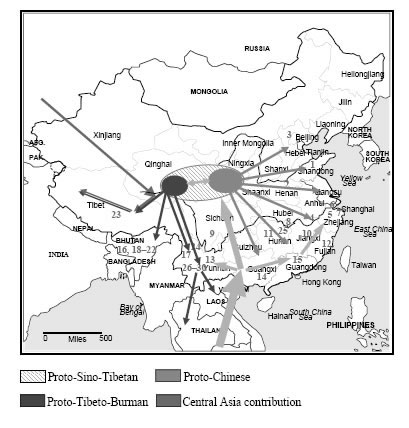

All of the above, linguistically and racially, appears to have played their historical role in Vietnamese with ancient Chinese residual vintages as expected for the reason that ancient Annam used to be a part of China. Politically, Vietnam is always regarded by Chinese rulers at all times as a breakaway vassel state, or even a renegade prefecture – cf. Taiwan, a living case in our time, so to speak – even though the last time Annam was under the rule of the Middle Kingdom dated back before 907. As the mainland of China went through turmoil periods, after that year, Annam continued to be a part of the "Great Han" (大漢, or NanHan 南漢) after 918 that had been called "the Great Yue" (大越 DaYue) until 917 (state name was changed for the reason that the DaYue's king surname was Liu (劉) who thought he was descendant of Liu Bang, Liu Bei, etc., of the Western and Eastern Han. Recognition of such geo-political tugs and twists is crucial to understand the affiliation of both Vietnamese and Chinese entities with all probabilities that there exists a continuation that interconnects the present Vietnamese with Chinese anthropologically.
Of course, one could not be more correct than saying the proto-Chinese had nothing to do with the proto-Yue or proto-Vietic people. The differentiation lies in the nominal. 'Chinese', as said, is a civlization, not a race. In the earliest prehistoric stage the proto-Tibetans were believed to be ancestors of the proto-Chinese who had conquered and mixed with the Taic natives and gave birth to the pre-Chinese who would later intermingle with the Yue in the South, aka Nanman 南蠻, around 3000 B.C. The racial admixture of all habitants of the ancient Central and Southern China would later become subjects of other powerful emerging states in the Eastern Zhou {Z} period scattering all over pre-Han's territories. The ancient China could have been called Chu Empire of the Taic people {Y} instead of Han Empire for the subjects {H} having come from their descendants, the very same Yue people {Y} who also made up the populace of the NanYue Kingdom. Just change the name calling and we will see their relations appear just like those of the Vietnam's Kinh majority {4Y6Z8H} with other minorities such as Cham, Khmer ethnic groups {+CMK} in Vietnam that had existed for the last 1,500 years – {4Y6Z8H+CMK}.
For the better or worse the Vietnamese inherited the Chinese culture after 1,000 years under China's rule and they continued to pass down one generation after another until the late 20th century. The worst must have been the Confucian values, such as observance of the hierarchical line that required their subjects obey, firstly, their ruler, secondly, their mentors, and, lastly, their father (君,師,父). That is where all the national messiness arises; the Vietnamese people have been taught to obey by the state all along. Interestingly enough, by any standards, however demeaning such Chinese legacy – Confucius ideas – would turn out to be, the country's nationalists, as previously discussed, undoubtedly still accept and value whatever neo-monarchal depotism in disguise has to offer. Confucian ideas protect the ruling class and its supporting echelons. The people within were born and learn to listen and obey orders from the authority.
Additionally, evidences of such a mindset that manifest in their preference of more male descendants so that their heirs do not fail to carry down a family surname. The penomena could be explained by way of anthropology that their brains have been genetically wired as such. For instance, for practical reasons the Vietnamese would never question its spiritual values in respective family genealogy. In effect, it is one of major Chinese cultural characteristics that the Vietnamese also inherited and deeply share with the Chinese while the Khmer culture lacks. In other words, their ancestral birthplace was not in the Indo-Chinese penisula where native people did not have the custom to carry their family surname. When we talk historical linguistics, that also means we speak of anthropology. That said, in a larger view of collective unconsciousness that is buried in the back of the Vietnamese people as a whole, their family lineage then could be traced back to native ancestors not only limited to the region of northernmost Vietnam where the ancient Vănlang State was initially established, but also that of the China South where the orginal Yue (百越) were once inhabiting.
Moreover, the overall transformation of cultural tradition of adopting Chinese names and the likes had deeper roots in Chinese civilization as demontrated in both the culture and history of Vietnam. Genealogically, descendants of those northern resettlers from the mainland of China to the southernmost prefecture in the eastern region of today's North Vietnam continued on with their own children who carried Chinese last names one generation after another as given in the previous examples regarding famous people who carry obvious Chinese surnames. What is the chance a particular personage of certain ethnicity to appear in the prominent spotlight?. The noted Chinese faimily surnames are actually only a subset of even larger ancestral pool of hundreds of them that made up the melting pot Yue-Han, i.e., Chu-Han 楚漢, in China South, to be exact.
Speaking of the northern genetic affiliation, racial factions that made up China distributed equally to the early Annamese land until the collapse of the Tang's Dynasty in 907 AD. As the ancient Annam expanded to the south after independence, only then did she absorb more of other racial elements into the ancient Vietnamese melting pot, consisting of lighter-skinned settlers from the north and darker mixed ones in the south. In effect, altogether the latecomer factors joined the earlier resettlers' characteristics throughout the historical periods of the states of the NanYue, the Chu, the Qin, etc., because they reflected not only in different family surnames of most Vietnamese nationals but also – except for a few cases of name changing due to identity hideouts or being regarded as a taboo (Nguyễn Thị Chân Quỳnh, ibid. 1993) – setting in the tones for Vietnamese personal proper names as well.
In term of geo-polical perspective, many of them were included in the tally of population statistics under the Great Tang Empire that totaled nearly 42 million people altogether as of 726 A.D. (Bo Yang. 1983-1993. Ibid. Vol. 51. 1991. p. 86). WIth respect to the latter matter, in 763 A.D., unimaginably, however, the overall population had greatly decreased to 17 million after only a little more than 12 year war fighting against An Lu Shan (安祿山) Rebellion (Bo Yang. 1983-1993. Ibid. Vol. 53. 1991. p.214). Such statistics was not unrealistic as one realizes that in China's history thousands of people were slaugtered on a grand scale in each major battle in any Chinese wars. For example, in 878, the Tang's troops eradicated 50,000 rebels in the Huangmei (黃梅) battle against the Huangjiao uprising. (Xu Liting, 1981. p. 217)(一)
For the same matter, there had been no reports of changes in the population of the Tang's Annam Protectorate as it might have barely escaped from the killing craze in the slaughter house up north. Note that in the Western Han's Jiaozhou Prefecture (交州 Giaochâu) the number of the Annamese population around that time was recorded at about 900,000 heads, many of whom were descendants of more than 30,000 local women who were forced to marry the Qin soldiers in the earlier period that could easily grow up to 90,000 given an average 3 racially-mixed children per couple within the first generation. Of course, that number would have multiplied over time exponentially long before the beginning of the first century. Similarly, 1,000 years later as a part of the Tang Empire for the last 300 years, there could be even more additional Annamese who were descended from those children fathered by thousands of Chinese infantry stationed in the Annam Prefecture in addition to many more immigrants from the mainland who kept arriving and chose to resettle there permanently, and they themselves likely married local wives throughout the 1000 year-long colonial period. That phenomenon lasted at least until 939 and then slowed down with later Chinese immigrants until present days. The same southward movement process was repeated again during the advancement of the new Annamese settlers moving into the annexed land from Champa and Khmer kingdoms since the 13th century.(E)
Analogously, in comparison with Singapore and Taiwan in terms of racial ratio of late Chinese immigrants and local people their status shows the spot the ancient Vietnam stood more than 1,000 years ago. A similar process is currently taking place in those two countries right now in terms of linguistic development except for the fact that in our modern era with advanced communication media such as that of the internet or mobile phone, the modern Mandarin language that the Chinese people are speaking now would not much noticeably change down the road because Chinese learners will stick to standard Putonghua as being already adopted by Malaysia and Singarpore. Taiwan has started replacing its old romanized zhuyin with the new China's pinyin system while Hongkong is picking up putonghua with Simplified Chinese scripts instead of Cantonese with old Traditional Chinese. In comparison with what happened in the ancient times, Chinese mandarins in use in Annam must have gone through much more complicated 2,200 years ago when means of transportation and communication were certainly restrictively distributive and their southward advancement moved an average of 1 kilometer per year since the Han occupation in 111 B.C.
Besides those historical evidences cited throughout in this paper coupled with other apparent Chinese linguistic properties existing in Vietnamese, historical linguists will still have to deal with other complex semantic issues other than sole phonetic changes. Besides those identifiable Chinese cultural aspects variations from Chinese elements could pose formidable obstacles in positing words which appear to have Chinese kinship but cannot be found in those commonly spoken subdialects. What that means is our sinologists must dig hard deeply into other peculiarities of some 900 Chinese subdialects to look for them, for instance, basic words used in calling close kins such as 'ôngnội' (內公 nèigōng? 'paternal grandfather') as apposed to 'ôngngoại' (#外公 wàigōng 'maternal grandfather') and 'bànội' (內婆 nèibó? ''paternal grandmother') vs. 'bàngoại' (#外婆 wàibó 'maternal grandmother'), of which the two former words, respectively, do not exist in modern Chinese as far as we know. For all of the above, it is possible, logically, because there existed words such as 天公 Tiāngōng (VS 'ÔngTrời) for 'the Supreme Creator' as apposed to 地公 Dìgōng (VS 'ÔngĐịa') for 'the Earthly God', not to mention other terms of endearment and intimacy. To be exact, words used in Chinese kinship and affiliation evidently point to the whole the genealogical line that indeed makes up the racial balance of the Vietnamese populace, e.g., 'tía' 爹 diè (daddy) vs. 'cha', or 'ba' 爸 bā (papa) vs. 'bố' 父 fù (father), 'nạ' 娘 niáng (mommy) vs. 'mẹ', 'mợ' vs. 'u' for 母 mǔ (mother), etc., all of which concurrently exist in Chinese and Vietnamese. The matter appears to be as simple and straightforward once similar issues like those identifiable items such as 首 shǒu for VS 'sọ' (cranium), 足 zú for VS 'đủ' (enough), etc., but it turns complicated in other cases. For example, archaic Vietmuong */dak7/ is cognate to modern Vietnamese /nɨək7/ and variant /nak7/ (water) which could be posited with Chinese 水 shuǐ (SV thuỷ) [ cf. 踏 tă for 'đạp' /dap8/ (trample) ]. In some other case, it is not easy to ignore similar items as such in any cited Austroasiatic languages of the same nature besides the cases of 'mắt' (eye), 'bươmbướm' (butterfly), among plausible others.
Let's now move to other anthropological issues. It is said that 'Chinese' is a civilization, not 'race'. There had been no 'Chinese', at least conceptually, prior to the emergence of a unified Qin Dynasty (秦朝), the first unified empire of all Chinese entities (221 B.C. - 207 B.C). In the chained reference, the whole argumentation leads to the fact that, historically, the Vietnamese refers to them as 'Tàu' for the SV term 'Tần' that is considered as a degrading term that might have been shared by subjects of those old states in the Warring Period (475 B.C. - 221 B.C.) of which all the latter states were later totally eradicated by the former one. Note the "Tàu" could also have originated from "Tiều", that is derived from "Triều", short form for "Triềuchâu" or Tchiewchow (朝州 Cháozhōu). If that is that case, the pronunciation 'Tàu' is then proved to be groundless for any bad or contemptuous denotation.
In similarly racial term, today's Vietnamese 'composite' people consist mainly of the Kinh majority, analogous to what the 'combo' Han 'race' means to other minorities in China – cf. 'the melting pot' as opposed to the concept of 'Amercan salad bowl'. The author has discussed at length that all the other descendants of the Yue natives have partly made up both the Han and Viets. They altogether with 52 minority ethnicities as identified in the govermental census as the Tày (Daic 傣族), Nùng (Zhuang 壯族), Hmong or Mèo (Miao 苗族), Thuỷ or Thái (Shui 水族) in the northwestern border areas currently shared by both China and Vietnam spread to remote mountainous regions to the north and west of Vietnam. In the same integrating process after the Han took over the NamViet Kingdom, the Yue peoples emigrated away from China South region and later emerged as the Kinh majority in the south that paved way to the last split up of the ancient Vietmuong people into the Muong and the Vietic groups. Offsprings of the Muong branch are currently living in Hoabinh Province. Meanwhile as the Kinh people moved south, they continued to mix with the Chamic people who inhabited places now located in the Central coastline townships, inchuding the Mon-Khmer in the Highland Plateau to the west and in the southermost region.
There are many mistakes already made in identifying a biological line of people and their language matching one for the other among Vietnamese and Chinese in Vietnam. Similar situation is less likely to occur in Japan or Korea where Chinese ethnics still stand apart. For the same matter, an affiliated Chinese connection in Indonesia or Malaysia, members of Chinese minority are distinctive even though in many cases several generations have passed by since the time their great-grandparents set their feet on those foreign shores and their descendants even adopted the Indonesian last names as strictly imposed by laws. In Malaysia, even the populace of Chinese ethnic minority have grown up to approximate 30 percent of the overall population, they are still considered as of Chinese descents and cannot parttake in many governmental posts.
Numbers of people having composition of "Chinese" genes in their blood are more closely comparable to the situation that make up the populaces in the Dutch's Formosa, now called Taiwan. The islanders, Taiwanese, having Chinese racial mixture with the aborigines on the island, have made up the total population overall, especially in the southern part of the island. In the 17th century, massive numbers of Fukienese laborers from mainland China crossed the Taiwan Strait to find manual work in Dutch plantations there. In 1949 after the Kuomingtang government lead by Generalissimo Chiang Kai-Shek was defeated by the communists, mainland's Chinese refugees followed its defeated foot soldiers and officials to flee to the island and stationed there. The indigenous people were quickly absorbed into the even larger Chinese ethnicity pool, many through intermarriages. For the last 28 years as of 2018, approximately 180 thousand or so Vietnamese women have been married to Taiwan, besides other nationalities throughout Southeast Asian countries. So their Taiwanese-Vietnamese children carry in their blood the composition of {4Y6Z8H+CMK+T} now, where T=Taiwanese {4Y6Z8H+I} and I=Indigene.
The whole Taiwan's anthropological experience with all the events that have happened in the island nation for the last 350 years was in much lesser magnitude as compared to what Vietnam has gone through to accommodate hundreds of thousand Chinese immigrants since the time she was still a prefecture of China. It is no need to explain why all those earlier Chinese immigrants actually had become an undistinguished part of the Vietnamese popuplace. In the 16th century massive 50,000 of Ming's subjects fleeing from the mainland of China after the Manchurian invaders took power over there and resettled in the annexed southern territory governed by Annam, where those early would-be Vietnamese looked more like Chinese but spoke Vietnamese like natives; they were usually identified with the "Minhhương" (subjects of the Ming) people which consist of many Tchiewchow dialect speakers. Their family surnames are barely different from the rest of the Kinh majority, except that they soud a bit different from those earlier pronunciation of words of the same source, for example, 'Huỳnh' vs. 'Hoàng', 'Võ' vs. 'Vũ' with respect to those of Chinese surnames, namely, 黃 Huáng and 武 Wǔ, repectively (see more elaboration below.)
For the same matter, Vietnamese family surnames are identical to most of the Chinese in naming covention and connotation, semantically very similar to MC phonology and tonality. Interestingly, many names still retain the Han style, composed mainly of surname and given name. Beyond practical purposes of filing official forms, only those recent Chinese immigrants freshly off the boats in much less than a century ago, literally, are identified in the contemporary national census as the "Hoa" (華) ethnicity, mostly Canonese, Fukienese, Hainanese, and a few Hokkienese or Hakka speakers, which totaled about 900 thousand people.
Racial issues, in reality, underline much more complications than those of linguistic subtleties alone such as family genealogy. What phonetic forms appear in one's own C-origin surnames, e.g., Vietnamese "Huỳnh" or "Hoàng" for Chinese 黃 Huáng, "Vũ" or "Võ" for Chinese 武 Wǔ, etc., say something about their ancestral roots from Chinha, where and when they first arrived and resettled. Physically and visually, a Vietnamese national could be mistaken for a southern Chinese person and vice versa in China's provinces of Guangxi, Hunan, Jiangxi, Guangdong. The phenomenon of wrong identification among Chinese and Vietnamese people is observable outside of China as well. Unless you do not put a group of northern Beijing students having been just recently fresh off the boat side by side with those Vietnamese youth for comparison, for those who have long resided in the same region such as the sunshine Southern California, perceptionally on the surface anyone can miserably fail to recognize most of the Vietnamese standing in the crowd among those Chinese youngsters posing for school pictures. For the most parts they are presumed to be of Chinese origin before being positively identified otherwise. Personally the author often incorrectly does so, say, in a public gathering or crowd in Chinatowns across North America's cities. In other words, by the mere look, Vietnamese and Chinese youngsters who were born and raised in a Western country like the US are not easy to be distinguished from each other.
Moreover, unlike 'American Caucasians' in Europe among other white Europeans, it is next to impossible mission that out of a sudden one could tell Vietnamese lone travelers amidst those Chinese locals in markets or restaurants in any cities in China. Any Vietnamese visitors to China might already exprience such perception, that is, they are unavoidably mistaken as of 'their own kind' who might be assumed to come from other parts of China, given the fact that the Northern and Southern Chinese distinctively stand apart, ones of Altaic descents as previously said while the others from Taic-Yue origin, respectively. Again, the author, being able to speak non-native accented Mandarin, was often mistaken as another fellow Chinese national from Guangdong in Beijing for having a dark complexion. Putting all political differences aside, many Vietnamese holding a US passport at China's customs chect-points are being questioned in Chinese. The author have encountered misidentification nine out of ten times at China's border gates even though in his US passport, the item 'birthplace' clearly indicated that he was born in Vietnam.
Anthropologically, two phenomena from the overseas Chinese from Vietnam could be easily observed through their behaviors in their new resettlements in North America, especially in big US cities. Shops owned by Chinese-Vietnamese have been mostly established in either Chinatowns – San Francisco, Oakland, Los Angeles, New York, etc. – or Vietnamese towns called 'Little Saigon' despite of the fact that, historically, the Vietnamese hate China's Imperialism against their country. The same resentment hold by the Koreans who feel toward the Japanese imperialists who occupied their country in the past. The Korean immigrants, however, also follow the customary pattern that their community tend to cluster their business presence in Japantown or Koreantown instead. The phenomenon can be explained that in the back of their collective sub-consciousness they are more likely than not being drawn to gather within their familiar anthropological settings. Meanwhile, the Chinese-Vietnamese enjoy mingling with other fellowmen freshly from Vietnam, including overseas Vietnamese, rather than with any other Chinese expats from Hong Kong, Taiwan, or mainland China, of which by and large, all early Chinese immigration waves to the US, until the 1980s, mostly were from Canton. The point to make here is that of the 4 countries – China, Vietnam, Japan, and Korea – that were built with Confucian values, as opposed to those of either capitalism or socialism, people of each respective country are still conciously attracted to those who seem to be compatible in terms of anthropological affiliation, so to speak.
.Linguistically, with an interesting fact that both the Japanese and Korean, on the one hand, historically had systematically amassed a larger amount of Chinese vocabularies for their own use, having purportedly borrowed a complete set of common Chinese characters from the long identified past until recently, sounds of a toneless foreign speech spoken by either a Japanese or Korean are doubless peculiarly distinct even to the untrained ears of a Chinese or Vietnamese, on the other hand. In the meanwhile, when hearing Chinese speak their dialect on the other side in a ballroom, for example, a Vietnamese person firstly needs to listen and concentrate very hard in order to tell if it is not another Vietnamese subdialect, partly because the pitch levels of tonality of their languages sound so familar as one of the kind. Westerners oftentimes mistake Cantonese for Vietnamese for the same reason. The author's wife, a 'Hainanese-Han' (海南人), speaking some Cantonese, commented the same thing when she had first heard Vietnamese. If we analogize that Mandarin were English, then German would play the role of Cantonese and Dutch could become Vietnamese in a linguistic perception guessing game.
Figure 6.12 - Races and languages
It is noted that in many cases the race and language of a people may not be related at all. Some Asian countries, such as India, the Philipines, or Singapore, adopted English as their official language. Similarly, countries of Latin America picked either Spanish or Portugese as their national language that is a non-native one, all for the convenience of their national communicative unification. That phenomenon is comparable to the what had happened to the Middle Kingdom from the ancient times for what it became known as Mandarin, now called 'putonghua', literally meaning 'popular language', which used to be called 'national language' (國語) and oftentimes still so referred now. In the former cases, for some Latinos or India's nationals, even those people of Spanish or Indo-European origin are not completely up to the language they speak. For example, there were reports that the earliest Apple's iPhone 2 voice recognition Seri app tended to recognize English spoken by an English speaker of Indian descent better than a US-born person. That is easy to understand because English is widely spoken with varieties of acccents in different places of the world. Some Indians in certain regions speak their own English "dialect" that is hard to understand for English as a second language learners.
The relevancy of the passage above applies to the case of an ancient Vietic language that the local people could have spoken – some kind of lingua-franca to communicate with northerners, i.e., the Han colonists – which could have started forming since 111 B.C. and continued to have evolved into modern Vietnamese.
In the case of Vietnam, however, in terms of ethnicity, for the Kinh majority, issues of unresolved mystically genetic affiliation with the historical Han-Chinese mixture is still a matter of debate. Could the race issue be finalized if scientific DNA maps come out? That may not be the case, though. If we look into the end results of scientific studies of DNA that have been done on the Taiwanese model, there is always something else involved, a mixed result with human emotion.
It is assumably that those mixed genes carried inside the blood of the Vietnamese are compatible with the racial composition of the 'Han-Chinese' in the provinces of Fujian, Guangdong, Hunan, or Guangxi, etc., that are Sinicized descendants of ancient 'the Hundred Yue' (百越民族), including YuYue 于越, GanYue 干越, MinYue 閩越, DongOu 東甌, DongYue 東越, NanYue 南越, XiOu 西甌, LuoYue 駱越, OuYue 歐越, YangYue 揚越, DianYue 滇越, TengYue 騰越, and YueXi 越雟, among others natives who live within the peripherals of China South long before the Qin-Han era (先秦漢). After permanent occupation by the Altaic normadic invaders such as Turkish, or Tartarian, and Mongols from northern China, make-up of 'the Northern Chinese' have become more distinct and different from those Sinicized Yue southerners residing further in the south who, as many a time emphasized, were actually descendants of the Yue natives (herein perceptionally coded as {X2Y3Z4H}). The southern Han Chinese had their genes mixed with earlier Taic people of Chu State – again, be reminded that Liu Bang and his people had been Chu subjects before they founded the Han Dynasty – in addition to those Yue people living in the habitat of the late NamViet Kingdom (南越王國) that stretched from today's China's Guangdong to northeastern part of Vietnam. As a result, the Sinicized populace in the China-South region still remain certain traits in their physical appearance that cannot be mistaken with other northern Chinese from Shaanxi, Shanxi, Shandong, or Beijing, etc.
Figure 6.13 – The Chinese mentality is the emigration mindset
The Chinese people are too partial to emigration to seek better life abroad that has changed not only the racial makeup of Vietnam long after her independence in the 10th century up until present day. While in the 13th century, the ancient Annam defeated the Mongol invasions 3 times but the influx of refugees from the mainland of China after the fall of the Song Dynasty after the conquer of China spelled over beyond the southern border. Historically, the country has gone through a long period of time under the rule of China throughout different monarchs with incessant stream of Han migrants who kept coming in up to now, yet, it still remains uniquely Vietnamese with her sovereignty all along as the Vietnamese have been perseveringly resisting against the sinicizing pressure increasingly put on by China since the past 2 millennia. Comparatively, Taiwan has undergone some 355 years of having connection with the mainland of China with immigrants from Fujian Province who actually outnumbered the native Taiwanese of Austronesian origin who continued on the process of sinicization of the island that started 2,200 years ago in the mainland. In other word, on the becoming another distinctive soveignty in the 21st century, Taiwan is a mirror to the Vietnam's past experience as a Chinese colony for more than one millennium since 111 B.C. to 939 A.D. Meanwhile, Chinese refugees and immigrants still continued on arriving into the place where is now called Vietnam. With regard to the Chinese emigrantion mindset, Taiwan also share more of the Vietnam experience as a country of Chinese immigrants. The racial makeup of both countries, hence, are products of China's emigration mentality, so to speak. For those who were not able to make it in their lifetime, they would defended themselves with the old saying that helps save their face, "離鄉背井" that nobody wants to abandon their homeland, but actually the Chinese emigration have changed the landscape of many hosting countries around the world.
The case of the birth of Taiwan brought into the overall picture above is to illustrate a series of similar historical events that shape the nation of Vietnam. Events of both countries are discreetly tailored to embrace Chinese-conscious nationals who live among the hard-core nationalists in both countries who have become weary and would stubbornly refuse to open more for the Chinese ideology. Taiwan, as short as the history of the island is, by any measure, has experienced less with China than what Vietnam had gone through, including all other prehistoric contacts from the ancient times throughout the periods recorded in history as applicable to both locales.
For an illustration, read the episode below about a journey of some contemporary Chinese-Vietnamese refugees to the US from 1975 to 1995. It is so picked because the significance of it is analogous to the saga of the displacement of Yue people over the rugged Lingnan mountainous ranges out of their native China South fleeing further to the south into Vietnam's Tonkin region in two millennia. That was how the nation of Vietnam was formed with the newly emerged Kinh populace in the ancient Annam. The story gives hints on how the Vietnamese language developed over time regardless of which existing version to date one would want to hear.
Here it goes. Let the author take you to a place in America where mistaken identities could possibly occur in distinguishing Vietnamese individuals of Chinese origin. It is a small sample but the implication is significant in a much larger scale. As a regular customer of a thriving Vietnamese cafe in Oakland's Chinatown, California, I love the Vietnamese food the cooks in the shop prepare. I recognize and interact with some employees working there, hearing their responses to my comments now and then, so I know who they are. Like myself, originally they were boatpeople refugees from Vietnam after 1975. I thought I know, genealogically, their ancestors had been also refugees from the collapsing Ming Empire in the mainland of China, fleeing the Manchurians to Vietnam in the 17th century, many being Chinese Tchiewchow speakers. In real life besides their fluency in Vietnamese I heard tem talking in some other Chinese dialects with different local Chinese customers. I truly admire the ability the employees switch back and forth with ease from Vietnamese to other Chinese dialects at ease, unconsciously and naturally. The owner and the rest of employees of the eatery there, like many Vietnamese nationals, are half-and-half ethnically in the sense that they are Vietnamese of "Chinese" ancestry, except for the cooks being Vietnamese for not speaking any Chinese but only the Heaven knows if they might also be descended from China or not.
In all probabilities, I have never questioned the authenticity of the tasty food they cook, presumably Vietnamese cuisine, a few items obviously being of Chinese origin but you consume them like any Vietnamese dishes anyway because the Vietnamese version of them differs from the Chinese cuisine with less oil. For the Chinese palates they mostly taste with common ingredients as prepared in Chinese culinary, such as herbal anise and cinnamon. The only exception, however, is that the Vietnamese dishes are usually being sprinkled with fish sauce and added bits of lemongrass that make the taste to stand out, for example, the subtle flavor of Vietnamese pork pulls vs. Chinese dongpo meat stew. In all I enjoy their cooking with those delicious dishes in my favorite cafe. The keyword in Vietnamese cusine is balance, always carrying the two halves of opposite taste in their mixed seasioning, e.g., salty vs. sweet, sour vs. bitter.
You may also love Vietnamese-seasoned Chinese dishes – or Chinese food with Vietnamese flavors, for that matter – as you do with those of southern-styled Khmer food, which adds up a bit more of sweet and sour balanced taste, to say the least; yet, they are not the same as Khmer or Thai plates. All said, metaphorically, the deliberate details are brought up therein is to illustrate an analogy of the racial and linguistic admixtures streaming southward from the north throughout the length of Vietnam history. How good the Chinese-Vietnamese food servers in the shop are identified with the Vietnamese nowadays is what they interact with their Vietnamese fellow countrymen overseas, talking and behaving like any natives of Vietnam, such as idolizing Vietnamese pop singers or gossiping some Vietnamese showbiz scandals, for example. All 'Vietnamized' characters associated above represent a fair picture of Chinese minority, especially those of Tchiewchow ethnicity in southern Vietnam that has totally immerged into the Vietnamese melting pot as opposed to other Chinese newcomers lately in the contemporary period. For them former group, they usually identified themselves in the official census as "Kinh" versus the "Hoa" by the latter group.
The existing Sinitic-Vietnamese words become organic matters of linguistics just like the air and food around that Vietnamese speakers breathe and eat without even questioning the 'foreign Sinitic' elements in them. Analogously, compared to what some of us might still remember how we reacted when we happened to notice and secretly admire how a young German salesperson in a store somewhere in Germary spoke English so well, fluently not much differently a Britain's native. Similarly, don't you realize that we somehow paid much more attention to some rare one-of-a kind American comedian or pop singer who can talk and sing in Vietnamese in Paris by Night's concerts? In contrast, we as Vietnamese historical linguists have missed the same notable conjecture with those Vietnamese of Chinese descents (CV) – like the multilingual food servers who can speak Vietnamese and multiple Chinese 'languages' in the Vietnamese cafe mentioned above, to say the least. One of the reasons we have taken it for granted is that it was 'no big deal' for a Vietnamese of Chinese descents to acquire Vietnamese with native fluency. The point to make here is that we expect them a 'part' of Vietnamese national just like any Kinh individuals. Ironically, the Chinese heritage of all of the above is stripped off in the plain view.
If you happen to be a national of Vietnam, look around within your social circle and you may gradually realize that many acquaintances of your close Vietnamese social network turn out to have come from Chinese ancestry as you might never pay attention before. You may have never considered the matter as an issue in your social intercourse, say, prejudice in judgment of some particular group. Our readers may want to look hard into your family genealogy, and who knows your ancestors might be one of them only a few generations in the past. That whole scenario is about how innumerous Chinese immigrants all around you having become the Vietnamese Kinh majority in the process. Now that towards those Chinese friends, you all as Vietnamese society absolutely have no discriminative or hard feelings about your "Chinese" buddies simply for the reason that you could be one of the same kind. Many of you may have come from such family background and were a national of Vietnam at birth. Let us do some arithmethic on the probabilities of the case to become a celebrity among the Vietnamese, say, only one chance among tens of thousands that somebody can shine a famous pop singer. The author did take a notice that many of them, interestingly, might have been recent Chinese origin based on their particular given names. In effect, the language and it speakers just like having their heads barely emerged from water grasping for breath in the Chinese culture pond. The episodes of Vietnamese pop-stars, e.g., Lam Trường, Quách Thành-Danh, Trấn Thành, Đàm Vĩnh-Hưng, etc., are specifically depicted herein for not only their having shared Chinese background with the world but that also include those who have Chinese family and given names, e.g., Lâm Ngọc Thoa, Lều Phương Anh, etc. and their names betray their replies if asked. In a larger scale, Chinese is the principal domain that emerged from admixture of Yue and proto-Tibetan entities making up the Sino-Tibetan family and the Sinitic one is of its subfamily. In other word, Vietnamese is just another linguistic sub-family of a larger Sinitic one which has, in effect, become a part of the Vietnamese linguistic heritage being passed down by their forefathers. They themselves or their offsprings would become a tidbit in the racial melting pot of Vietnam but they are representative by and large in the racial makeup ratio that many Vietnamese nationals so share. (See APPENDIX L)
On the formation of the national identity in our contemporary era, affecting also Vietnamese diasporas, they were born and associated with Confucian – read 'Chinese' – cultural values that have taken deep roots in the Vietnamese society for hundreds of years. Imagine we were back in time more than 1,000 to 2,200 years BP when portions of the ancestral Viet population started to move out of the China South region. By the 13th century the early emigrants kept moving southwards accross 16th parallel into the newly acquired territories of the Kingdom of Champa and the late resettlers reach the current geographical southernmost of the Camau tip by the 18th century, which was independent of previously earlier resettlement in the Indo-Chinese peninsula where Mon-Khmer people had all ready lived there.
Along the their migratory path the early resettlers might come accross many of their own kind – those officials in exile, economic opportunists such as land speculators, vagabond migrants, including fugitives on the run, refugees like those exemplified in the Vietnamese cafe in the US as dramatized above – with whom they all usually communicate in Vietnamese as a common bond in intercommunication and have never discerned slight Sinitic elements in everything interactive around them that they have been so accustomed to. There is no reason to shed doubts about the authenticity of the mother tongue and, after long period of time in close contact with Chamic and Khmer outlanders, the vocables they utter became basic words as they mixed well with those Sintic-Vietnamese words without consciousness like mixture of air and water, naturally.
Historically, Vietnam is always in the state of preparing for her next war even when she and her belligerent neighbor up north are in détente. As a rule of the thumb, whenever a Chinese dynasty outgrows its older shell to evolve into a significant power, its rulers would get back to the "renegade Annam", its being the first on their list. For any persons with average intelligence would think the same and say under no circumstance Vietnam would have the chance to win again if a war between Vietnam and China breaks out today. To be truthful, putting aside many negative comments posted in different media noting that they were corrupt, idle, greedy, but timid, in general, patriotism is not something abstract but a matter of survival that when being cornered against a wall, like their forefathers, they themselves have fought and won in all wars against Chinese invasion as long recorded in history; otherwise, their country would not ever exist until now. Such an affirmative statement is not an exaggeration at all if one takes a deep look at the China's geo-political map and study its history in which there are no words mentioning an independent Annam in 939 but only a rebellious prefecture that would never be referred to again after it broke away from the then collapsing NanHan State (Bo Yang. Ibid. Vols 2 - 72), and out of nowhere, in China's modern history, Vietnam emerged prominently as a sovereignty which lacks the continuity as a prefecture since the Qin-Han period.
The Chinese conviction on defeating Vietnam in the next war was what emperors of China of the great empire of the Han, Tang, NanHan, Song, Yuan, Ming, Qing, PRC (1979) ever strongly believed. Even though history proves otherwise, there is no exception to such mentality hold by the modern ruler of China today as well. So now there occurred all provocative acts such as its initiating border wars against Vietnam on land (1979) and at seas (1974, 1984), China's chauvinism has lived on well into the 21st century as demonstrated in separate events. In May, 2014 when China moved its oil-rigs into the disputed region of Spratly islands, local Vietnamese workers in plants owned by Chinese companies inside the country simultaneously broke out with uncontrollable outbursts and turned into deadly forces with violent riots spreading to more than 100 factories that were burned down or vandalized, which forced all Chinese mingrant workers had to be evacuated back to China. As events continue on to develop from 2015 onward, China began building navy bases on disputed islands in the South China Sea where it has unilateraly exerting its territorial claims, we have seen war appearing in the South China Sea's horizon where Vietnam call "Vietnam Eastern Sea".
What does all of the above have to do with linguistics? As repeatedly mentioned previously, the academic entanglement with politics because history, specifically for both China and Vietnam, is fabricated to serve the ruling regime. Western researchers never bring up the political factor in their academic work because they might neither be aware of the matter nor feel comfortable enough to put their feet into such hot water. In either case they still would find it hard to understand why many locally grown Vietnamese scholars refuse to accept the de facto Chinese cultural imprints in all cultural facets of life of any Vietnamese speakers. They are ignorant on certain of undeniable truths, namely, (1) Chinese is a culture not a race, (2) China is a union of muti-racial states since the Qin-Han times, (3) one of which left the "Sino-Pact of vassal states" since 939 and has been a sovreignty that is today's Vietnam – which explains the reason why the Chinese influence on Vietnamese language has been so profound. While Confucian values dominate every aspect of Vietnamese culture so much that all rigidly intrinsic cultural elements govern each and every Vietnamese from birth, most of Vietnamese scholars choose not to submit themselves to any Chinese exertion, though, on topics that would disaccord with their nationalist belief. Ironically, such unbending attitude could only distance themselves further from the political neutrality that is really necessary in finding the truthfullness of the origin of Vietnamese, specifically. They could not afford to trade in their nationalism for the academic objectivity that will constitute a compromise of patriotism.
Given their mistrust of China's past and present, Vietnamese academics feel sentimental on historical issues and quick to react unfavorably to any Chinese centric arguments, either linguistically or anthropologically. Unsurprisingly, home-groomed scholars do not go with the Sino-politics. Their treatment of history of their country is always instrumental in protecting a nationalist ideal so that it could not to be easily shadowed by Chinese historical records. Building awareness of objectivity in academic domain, therefore, has long been in limbo due to nature of stubbornness that exists in their circle of intelligentsia. As you wiil see later, some non-Vietnamese authors have made any milestone breakthough by taking such approach but they are not acknowledged accordingly.
As the organs of the regime the Vietnamese scholars always behave exactly the same way working to that effect. Unlike their peers in Western countries, it is difficult for them to appreciate what it means for academics to be free of politics no matter what. Politics would eventually nullify the authenticity of their accomplishment. For those readers who do not believe in apolitical history, the author is going to solicit understanding from readers for his unpopular viewpoint presented in this research so that it could take off from its shelf without the need to engage in a fight for recognition. In the past, he did not fight back, attacking critics appearing on the internet, though. He focused only on refining his work. However, it is no point for the author to incur more time beating around the bushes with those nationalist fanatics. Let the core of a Vietnamese proverb that goes as 'Let's better offend first then please each other later' ("Mấtlòng trước đượclòng sau") to prevail by putting all the political cards on the table. If politics is here to influence academics, make it not with linguistics but history for the latter has been with Vietnam and China since their dawn.
For some well-founded reason, firstly, the author also purposely writes this paper in English in order to seek understanding from learned readers on the Vietnamese language, a bold venture in an uncleared land-mined field that he has been anxiously tiptoeing hoping for the best. He will fight to defend his belief. He already knows the fate of all other efforts taking the SIno-Tibetan path. More often than not, the Vietnamese linguistic circle already shuns and deplores revelation about the hereditary affiliation between the Vietnamese and Chinese languages. Such a biased view would not deter the author's determination to forge forward with an altruist heart. If any recognition is to be conferred upon the author's work at all, as in many precedent cases, the author foresees such a significant event would likely happen only after his death.
As long as threats of invasion from the north appear to be real, each and every Vietnamese generation tend to show their latent antagonism against almost any Sino-centric interpretation. Collective sentiment simmering at national level could further elevate historical "anti-Siniicism" among the Vietnamese majority, oftentimes hysterical and phenomenal, under the banner of nationalism. Such emotional suppression could erupt into ugly destructive force capable of brainwashing a whole generation of school of thoughts on Sinitic theorization, which could lead to blunt rejection of acceptance of the author's elaborative efforts in addressing those existing Chinese and Vietnamese etymological issues herein.
In additon to all aforementioned nusances, on the other front it is unavoidable that the old Mon-Khmer conservatives of the Western linguistic world will inevitably team up to defend new threats that go against their Austroasiatic presidio. Surprisingly, however, the irony is that my true allies, unexpectedly, happen to be those Western specialists in the Austroasiatic camp who are open and patient enough to hear what I have to say on subject matter of SIno-Tibetan linguistic affiliation of the Vietnamese language. The problem is, then, though, that those listeners are still not convinced enough with my Sinitic hypothesis; it is probably for a couple of reasons that I could think of, that is, (1) my reconstruction of ancient phonology may be unconventional, and faulty at times because tabulations of corespondences of multiple sound values to have evolved from the same root and without any further proof, (2) Western linguists are still being so rigid in adjusting their Western methodology to make their sound change rules to work for tonal languages, or simply, (3) I just do not know how to package my ideas and sell them.
While reading this paper, as a reader, try not to let your personal sentiment to cloud your judgment for the sake of saving your sanity. New finds of Sinitic-Vietnamese etyma will elevate readers to another recognitive level and open up possibilities to anyone who is pursuing the Sinitic-Vietnamese study to decide whether they should twist their career path to follow my rugged road, consciously or not, taking risks of being alienated from an unpopular study field.
C) Prelude on the Sinitic etyma
The meaning of prelude is, well, prelude, (Chin. 序言, VS 'lờitựa'), notthing of substance, yet enough for readers to grasp a sense of what to expect next. For academic purposes, this paper deals specifically with those underlined Sinitic elements lying dormant beneath Vietnamese etymological layer and their postulated cognates will avail the academic world to reinforce the shaky SIno-Tibetan foundation. Regardless of how discriminatory with what follows, some well learned Vietnamese might feel dismayed and become disoriented due to the appearances of multiple layers of Chinese substrates on top of what is left from the native residues as normally treated as loanwords. The main purpose of this prelude is to identify possible etymological candidates through interesting findings as briefly follows.
To be on the safe side for the statement of the identified Yue vs. Chinese substrata, the postulation of core basic words as exemplified below, to a lesser extent, actually is neither intended to initialize a direct line of genetic linguistic affinity between Vietnamese and Chinese dialects nor among those of Tibetan languages in anyway. It is only that undeniable milar appearances suggest some "possible kinship", or, metaphorically, "long lost relatives" from one or more SIno-Tibetan etymologies. As we draw a sketch of family-tree branches connecting Vietnamese to the SIno-Tibetan linguistic family, it is because their commonalities point to Sinitic roots. Linguistic traits such as tonality and phonology go hand in hand with the subtle intimacy embedded in the terms of endearment in their semantic conveyance, along with all other conceptual connotation, carry the implication of close affiliation, for example, the concepts of 'mater, maternal, mother, blood mother, step-mother', or 'mom', the Vietnamese language has the concepts of 'mẹ', '(cậu)mợ', 'má', 'u', 'nạ', 'mẹđẻ', 'mẹruột', 'mẹghẻ', etc. which are in parallel with '母 mǔ', '(舅)母 (jìu)mǔ', 媽 mà, 姆 mǔ, 娘兒 niár, 母親 mǔqīn, 親母 qīnmǔ, 繼母 jīmǔ', respectively. Hence, "bố" 父 fù (father), "tía" 爹 diè, etc. They are all in the category of basic word domain.
As theyall appear in their native encapsulation, the author will approach such controversial postulation of Sinitic matters to pin down on linguistic aspects that secure certainty of the shared etymology after the revelation of possible cognacy of items involved. For example, the author postulates that 抵賴 dǐlài gave rise to 'đỗlỗi' while posit 賴 lài as 'tại' [ that conforms strictly to the pattern { l- ~ t- } ] (both mean 'to blame someone for something' or 'because of (you)...') [ 賴 lài with SV 'lạl' to mean 'depend on' ]. The approach that reveals this result is somewhat new that will crack the formulary of sound change patterns of those cited items surpass what is usually expected from Chinese loanwords for the rason that borrowed words do not need come from the same interchange of extant words that carry the same sound, that is, 抵賴 dǐlài ~> 'đỗlỗi' is a Chinese loanword while 賴 lài as 'tại' (because, due to, since, etc.) is not. For this specific case of 'đỗlỗi', the vocable 'đỗ' is only associated with and loaned from 倒 dăo (SV 'đảo') that sounds simlar and means 'overturn' while 'lỗi' from 罪 zuì (SV tội) 'wrongdoing' and the locative adverb 在 zài is SV 'tại' (to be at'), respectively. Consider the Chinese loan 'đỗthừa' <~ 推卸 tuīxiè (shift the blame) that also shares the same associative characteristics. The whole supposition is totally based the breakup of the polysyllabic word, i.e., "đỗlỗi" into two morphemic syllables, that is, smaller units as syllabic-words that can carry its own meanings because it originates from a Chinese character that is then further associated with each individual syllable to an unrelated core root, in this case "đỗ" <~ 倒 dăo (SV 'đảo') and 'lỗi' 罪 zuì (SV tội). Each lexical entity has been taken out of its context and wholeness. That is the same underlining priciple that is used to posit "在" (tại) in 在意 zàiyì as VS 'đểý' (pay attention). The author's newly proposed approach has helped identify and posit those Vietnamese-Senetic etyma. But as far as we are concerned, they are still considered loanwords; however, the point to be made here is their plausible cognatenes based on sound change association, a new approach proposed by in this paper..
As a matter of fact, the objective of this section is to acquaint you with postulations similar to the above as well as to answer some questions on the existence of Sinitic elements in the Vietnamese language. The author will examine those underscored linguistic traits where the contemporary Vietnamese speech carries most of the peculiarities that are also found common in different Chinese dialects. Readers will understand why and how Vietnamese and Chinese coloquial expressions in some dialects are interchangeable in the absence of proactive intervention from knowledgeable bodies on peculiar usages of words e.g., 'lâylất' 賴活 làihuó (hand-to-mouth), 'bànchân' 腳板 jiăobăn (foot), 'ănmày' 要飯 yàofàn (beggar), 'đitiền' 隨錢 suìqián (give the monetary gift), including those scholarly Sino-Vietnamese items in coloquial Vietnamese, such as 'sưtửHàđông' 河東獅子 Hédōngshīzǐ ('a tiger wife of Hadong) or 'máuđàonướclã' 血農於水 xuěnóngyúshuǐ (kins share blood type), and so on so forth.
As a matter of fact, at first count, more than 420 fundamental monosyllabic lexical items from a variety of SIno-Tibetan etymologies as listed by Shafer (1972) have been selected to include in this survey. They are coins for our thoughts (See Sino-Tibetan etyma). What makes them to appear so close and why does nobody seem to notice them in the first place? Even though the cognateness with the Vietnamese among any of the listed SIno-Tibetan etymologies is so obvious to any journeyman in this Sinitic-Vietnamese field of historical linguistics, it is needless to say the task of proving the genetic affiliated of all languages is still tantamount, that is awaiting another SIno-Tibetan figure to pick up and refine Shafer's work on such colossal work.
The focal point to be reinforced here is based on preliminary etymological evidences in several SIno-Tibetan languages as to be elaborated in the next chapter, either directly or indirectly. While, this paper in a sense is original, it is not a good idea, though, to renew argumentation on a controversial issue of re-classification of the Vietnamese language into the SIno-Tibetan linguistic family, even implicitly, in scholarly terms. For those readers who are sensitive to something Chinese, beware that what they are going to read is about unpopular propositions to postulate new Vietnamese etyma of Chinese origin that may not suit their taste. For example,
- 秦 Qín for 'Tầu' [ SV 'Tần', ArC /tɐn/, cursed enemy of all other ancient states before it conquered and unified the whole China in 221 B.C. ],
- 水 shuǐ for both 'nước' / 'nák' <~ 'đák' (water) { cf. 踏 tă 'đạp' (tramp) } and 'sông' \ 'kông' <~ 'krong' (river) { cf. Cant. 'kong5', 工 /kong1/ (work) }
- 川 chuān 'suối' (creek),
- 井 jǐng 'giếng' (the well),
- 艘 săo 'tàu' ('ship' to imply Chinese immigrants in Vietnam as 'boatpeople' since ancient times),
- 江 jiāng for 'sông' (river),
- 泉 quán 'suối' (spring),
- 日 rì for 'giời' (the sun) vs. 天 tiān 'trời' (sky, heaven),
- 石 shí for 'đá' (stone) vs. 石 dàn for 'tạ' (weight unit of 100 kilograms) ],
- 土 tǔ for 'đất' (soil) vs. 地 dì (earth),
- 鼠 shǔ 'chuột' (rat) vs. 子 zǐ 'chuột' (as in the year of the 'rat'),
- 羊 yáng 'dê' (goat) vs. 未 wèi 'dê' (as in the year of the 'goat'),
- 貓 māo 'mèo' (cat) vs. 卯 máo 'mèo' (as in the year of the 'cat'), and so on or forth.
are found in Sinitic etymology on top of those already in existence which are recognized as cognates as follows,
in additon to re-instatements of many other popular etyma to be included in the SIno-Tibetan baseline, such as
Until now the way the llinguistic world ushered us to seats where we see only those Vietnamese basic words of Austroasiatic Mon-Khmer origin. For example, the Khmer number 1 to 5, i.e., "muəj" ,"piː (pɨl)", "ɓəj", "ɓuən", "pram", are presented to us as sure cognatess of Vietnamese "một", "hai", "ba", "bốn", "năm", and while they are basic words (?) so they come from the same linguistic family. As they go on with other cases with the same overwhelming approach, we get stuck there in defensive position, asking thew same old question, "what happened to the number 6 to 10, then?". The whole picture of the core matter from the start has been a repeat one after another that echoed some Austroasiatic Mon-Khmer version initiated by early authors on the Austroasiatic Mon-Khmer theory and passed down just like a chained re-post of another re-re-post from the same source somewhere on the internet. On such scenario, in the end, returns from a search engine on similar queries such as 'Vietnamese basic words' are simply recurrences to the effects that obstruct the SIno-Tibetan view, which would make serious readers to proactively rewire their thinking as a result before they have a chance to explore the SIno-Tibetan theory. The whole business makes huge impact on how they have been viewed, to say the least.
The author does not want to see his newly-founded approach on the Sinitic-Vietnamese etymological study to turn sour due to what is discussed above, in addion to negativism on Chinese related matters due both political and academic reasons. To counter such hinderance, the author will start with some light touches first. Metaphorically, our complementary illustration here is like that of the restoration work to trace and retouch those faded spots on an old painting again and again until viewers see what the painting was intended to be. For what the authors will present in the next chapter, hopefully the linguistic world to take notice and start to investigate the proposed affiliation furthermore on some 400 undeniable Vietnamese words that are found to be associated with a wide range of SIno-Tibetan etyma as to be presented next in Chapter 10 on Sino-Tibetan etyma.
It is important that presence of Sinitic-Vietnamese etyma posted by the author herein will help establish SIno-Tibetan stand on the internet. So long as we persistently hold on to our own spots on the internet, literally in the very sense of it, they will have a variety of choices rather than limit themselves with the same old views flooded from the Austroasiatic camp every time old and new readers making queries on the Sinitic-Vietnamese related subject. We are not playing catching games here but it is truly essential for SIno-Tibetan theorists to build hyperlinked indices, started either large or small, one at a time, so that readers could find links electronically to our specific Sinitic theorization. Meanwhile the author's strategy is to post hundreds of pieces of Sinitic-Vietnamese etyma here and there in the cyberspace toward reaching that goal, his study could become a major source for some new starts to base on. For example, let's take a look at some common fundamental words, such as
- 'sông' (river) 江 jiāng (SV giang) and 'suối' (creek) 泉 quán (SV tuyền) diverting our attention from 川 chuān (SV xuyên),
- 'cửa' (door) 戶 hù (SV hộ) camourflaging 口 kǒu (SV khẩu),
- 'hiểu' (understand) 會 huì (SV hội) replacing 曉 xiáo (SV hiểu),
- 'hiền' (good nature) 善 shàn (SV thiện) taking place of 賢 xián (SV hiền),
- 'ông' 公 gōng (SV công) associated with '翁' wēng (SV ông),
- 'ong' (bees) 蜂 fēng (SV phong) being a doublet of 螉 wēng (SV ông),
- 'lợn' (pig) 豚 tún (thốn), in c0-existence with 'helo 亥 hàn (VS hợi), 'chó' (dog) 狗 gǒu (SV cẩu) and 'cầy' with variants VS 'cún' 犬 quán (SV khuyển), etc,
- 毫無 háowú (no, not) ~> 'khônghề' / 無 wú ~ 'hổng' @ 'không' 空 kōng ,
- 拉活 làhuó (look for work) ~> 'làmviệc' / 拉 là ~ 'làm' <~ 'làmviệc' 幹活 gànhuó (work),
- 安樂 ānlè (peaceful and happy) ~> 'anlành' / 樂 lè ~ 'lành' <~ 良 liáng (benign),
- 太陽 tàiyáng (sunny) ~> 'trờinắng' / 太 tài ~ 'trời' + 陽 yáng ~ 'nắng',
- 天井 tiānjǐng (skyline) ~> #'giếngtrời' / 井 jǐng ~ 'giếng' (well), 天 tiān ~ 'trời' (sky)
we can make out one etymon on top of the other, not to mention each morphemic syllable in numerous dissyllabic forms could give rise to different doublets and homophones in Vietnamese via associative rule of sound changes, for example,
and so on or forth,
This research will not give all satisfactory answers in a well-defined manner significant enough for the whole world to accept but it has caught some attention and returned feedbacks since several drafts of this paper first appeared on the internet for more than a decade ago. The author is glad to see that in his lifetime, both the Austroasiatic and SIno-Tibetan camps have finally acknowleged the presence of his findings as meaningful. In any case this survey, while open for further refinement, will help demystify those puzzling entanglement of genetic affiliation with regard to the theory of some "linked kinship" between Chinese and Vietnamese etyma.
Academically, this SIno-Tibetan etymology project has been a result of peinstaking effort that undoubtedly would burn the midnight oil. Methodologically, the act of steering this research towards that predetermined SIno-Tibetan direction while avoiding making exceptions by adhering to sound change rules – that is, attempts to follow strict linguistic reguation on phonological patterns as in Middle Chinese ~ Sino-Vietnamese, or Middle Chinese ~ Mandarin for the same matter – and, at the same time, detour from ad hoc measures by utilizing available western analytic methodologies to establish our cognitive approach on Sino-Tibetan etyma. While the whole effort may not be necessarily enough to build a strong case in order to uproot the belief in the Western-initiated Austroasiatic hypothesis, we certainly can adopt plausible Austroasiatic Mon-Khmer basic words that were once widely reckoned in the linguistic world by classifying undeniable basic words into fundamental core base,
By the norm, based on possible velocity of a new theory to become materialized side by side with contrast viewpoints, it usually takes another cycle of 60 years or so to shift an old consensus hold by believers in the field in order to change focus to different direction. By then veteran theorists of either school, SIno-Tibetan as well as AA, all will have been out of the podium's spotlight. In theory, no theory will uphold forever but it is likely that at certain point of time the possibility of the renewed SIno-Tibetan theory once again could resurrect by newcomers in historical linguistics whose untainted brains might be impartial and less bland. The 60 year mark could resuscitate and nourish the SIno-Tibetan theory to escalate with more findings of VS etyma that can help the next generation of SIno-Tibetan theorists boost up energy for their hypothesis given the fact that the opposite Austroasiatic resources has been depleted, of which quotes appear repetitive and duplicative, anyway, one following after another.
More on historical facts as emphasized in the perivious chapters will further pound and express the influential essence that help shape the course of the development of Vietnamese, so do its speakers. It is a part of a strategy using propaganda as a tool to reinstate what has been proposed in the hope mending damages done for all these years. It is, of course, not an easy task. As suggested earlier, the sole apprearance of many basic Austroasiatic lexicons have deceived many veterans in other Sinitic fields. If it were not the case, why do Austroasiatic forms exist in Vietnamese? For those Austroasiatic traces in Vietnamese having Munda or Mon-Khmer origin, it is explicable given the fact that in the remote times migrants moved to places and on contact with the indigenes they exchanged words first; some even lost their mother tongue in the process and identified themselves with the aboriginals on spot (Phan Hữu Dật. ibid.) Many of those Austroasiatic remnants existing in the Vietnamese language also concurrently convey Sinitic substances that suggest something that came from the north, i.e., the China South region. In other words, all originated from the Yue sources. If it is the case, terminologically, like that of the Sinitic term, Austroasiatic would be another misnomer.
As discussed earlier on some related issues with regard to the terminology "Sinitic" that signifies an affiliation having something to do with "Chinese" as we know it in our time while the core matter of that 'Sinitic' concept was in practice used to indicate what had come into existence long before the rise of the unified Qin Empire, of which the name "Qin" gave rise to the term "Sintic". The terminology has unexpectedly enhanced the validity of Austroasiatic claims that try to discredit anything Chinese. That is, the Sinitic dominance existing in over 99 percent of Sintic-Vietnamese etyma that includes basic words must have existed hundreds of years before the emergence of the Qin State, so the Austroasiatic theorists insisted they could not plausibly originate from "Sinitic" linguisitc family because "It" had not existed yet. What do they expect us to call it not by the name "Sinitic" then? What is about "Vietnamese" then? In this paper we call it "Sintic-Vietnamese" (whence Vietnamese did not exist then) to cover what made up both the Chinese and Vietnamese languages whether or not originally certain etyma were actually from Chinese, for all the Yue elements existing in them and other linguistic factors that became of in either direction.
Vietnam is a case of breakaway to form a sovereignty from a Sinicized colony of feudal society when the ancient Annam was still a prefecture under the rule of the imperial China going through many dynasties since 111 B.C. until 939 A.D. as repeatedly mentioned so readers will bore that in their brain. The whole scenario would later repeat with Middle Chinese, i.e., process of linguistic changes, by northern Mandarin that continued to influence Vietnamese despite of its own unique development – especially during the 20 years that Vietnam fell under the 4th Chinese domination of the Ming Dynasty (1407–1427). Besides, history witnessed pronounced Chinese immigration to Vietnam due to hunger and destruction of savage wars and full integration of Chinese resettlers in Vietnam, which manifests the genetic affiliation among people of the two countries. Of course they brought with them many Chinese words into the Vietnamese language, including the most unsuspected basic words originated from the Sinitic languages that were previously normally credited to Mon-Khmer languages, for example, "chồmhỗm" (犬坐 quánzuò 'squat like a dog'), "hủtiếu" (果條 guǒtiáo 'rice pasta'), etc..
All in all, the Vietnamese language might have evolved from its ancestral form of Yue initially similar to some variant Taic speeches probably spoken by the Chu subjects (楚民) (see APPENDIX K - 越人歌 'Song of the Yue') (see also Bình Nguyên-Lộc, 1972) that had existed prior to the emergence of Sinitic entities, i.e., Zhou, Qin, Han, etc. The Taic linguistic family also gave rise to those Yue speeches spoken by the Zhuang or Dai minority groups in China South. The early development of Vietnamese must have gone through the similar process as those of Fukienese (Minnan) and Cantonese (Yueht) until 939 A.D. For the latter two dialects, prominent elements of the Han and Tang dynasties, respectively, they virtually replaced nearly all of its ancestral forms native to those of aboriginal Yue speeches once spoken by the Yue people about 3000 years ago. (See Drake, F.S. ed. Symposium on Historical Archaeological and Linguistic Studies on Southern China, South-East Asia and the Hong Kong Region. 1967.)
The Sinitic-centric charateristics of Vietnamese, had it, hypothetically, classed as a language under the SIno-Tibetan linguistic family long before the emergence of the Austroasiatic Mon-Khmer theory in the early 20th century. Loosely it can be probably described as a 'Sino-Xenic topolect', or, metaphorically, a Sinitic hybrid or 'graft' language – as opposed to that of an 'adoptive language', or purely a 'hybrid' one (as described by Bloomfield, 1933, of Albanese), or even another creole (cf. French-based speech spoken in New Guinea or Haiti) – that came straight out of the systematic and scholarly transformation from an official Chinese language called Mandarin used in imperial courts throught out the ages.
This research will present the results of some findings cognate to those Chinese words, which could pave the way to have the Vietnamese language placed in a Sinitic-Yue linguistic branch on par with the Sinitic sub-family in the SIno-Tibetan linguistic family. It is still shy of positing Vietnamese as a Sinitic language, though. Sinitic-Vietnamese (VS) is all about Sinitic linguistic elements that exist on top of multiple layers of fundamental ancient Yue substrata. You can visualize such phenomenon as a Sinitic 'graft' language in a concrete picture that Vietnamese itself is a linguistic tree with Sinitic plant tissues, branches, and leaves branching from a trunk grafted onto the root of an aborigine Yue language. Many of you have seen apple trees in nurseries which grow many different kind of apples, haven't you?
In contrast, characteristically, the Sino-Vietnamese (SV) stock of the Vietnamese language are more like those of Middle Chinese (cf. Cantonese). For those Sino-Vietnamese words that overlap the Sinitic-Vietnamese portion, they are, interestingly, more like that of the northern Mandarin vernacular, especially the coloquial part of the official language of the court for more than 1000 years, for in stance,
- 'đừng' 甭 péng (don't),
- 'xong' 成 chéng (done),
- 'được' 得 dé (okay),
- 'vâng' 行 xíng (yes),
- 'Dạ' 喳 Zhā (Yes Sir),
- 'mainày' 明兒 míngr (tomorrow),
- 'luônluôn' 牢牢 láoláo (always),
- 'đượcrồi' 得了 déle (fine), etc.
To be exact, Mandarin is a northern Chinese dialect that evolved from the Middle Chinese and became of shape under heavy influence by languages spoken by the Tartarian people of Altaic origin who had conquered and established their rule throughout the period of 1000 years – the length of time equal to that of the historically colonialized Vietnam under the rule of China with her area being one third of the current size on the political map of North Vietnam. For the Northern Chinese through long period of different dynasties, they later emerged as the northern Han Chinese entities as opposed to those of China South – parallel to the anthropology of Northern vs. Southern Vietnamese – such as that of the BeiWei State (北魏) of the Tartar origin, also known as the Xiongnu (匈奴), during the Period of Southern and Northern Dynasties (南北朝, 420-589, Xu Liting, et al., 1981. p. 167), the Yuan Dynasty by the Mongols of the 13th century, the Jin (金), or Jurchen, in the Northern Song Dynasty (see Bo Yang. 1983-1993. ibid.), and, especially, the Manchurians of the Qing Dynasty that ruled the whole Middle Kingdom in the last 300 years until 1911.
China's history supports the supposition of colloquial Mandarin influence in the Vietnamese language. Most of the examples cited in this paper are original, in a respect, which could complement other etymological works previously pioneered by veterans such as Sergei Anatolyevich Starostin (http://starling.rinet.ru/, 1998) or Lê Ngọc-Trụ, etc., for their proposed terms of Chinese origin. For example, the author accepts Starostin's posits of VS 'màu' (color) 貌 mào (SV mạo), VS 'khói' 氣 (汽) qì (smoke) for the already known SV 'khí' (air) and VS 'hơi' (vapor), Lê's posits of 役 yì (SV dịch) and 務 wù (SV vụ) for 'việc' (work), and other author's postulations of 'buồn' 煩 (SV phiền) in addition to those etyma such as 悶 mèn (SV muộn) for 'sad', 活 huó (SV hoạt) 'work', etc.
To what extent that you are inclined to believe in the truthfulness of the etymological evidences all depends on your background of historical linguistics and strong belief in the Sinitic theorization as discussed in this paper. Except for those who have a grasp in many disciplines related to the subject being discussed above, there is in reality not many novices who truly comprehend or appreciate a greater number of postulated cognates for the reason that people tend to believe in what they have already believed to start with. Some even will never understand many self-evident and self-proofed etyma which are so obvious and simple such as 早 zăo for 'chào' (hello), 腚 dìng and 臀 diàn for VS 'đít' (buttocks), that is, one more on top of other words including 屁 pì (SV tí 'hip') for the same concept still in use with extended meaning like "屁股" pìgǔ (VS 'phaocâu' or 'chicken butt as a local delicacy', while possibly associating it with #'cáiđít' \ 股 gǔ ~ 'cái' 個 gè (SV cá), for the concepts of 'butttocks'). In this case, specifically, we may need to treat them as doublets to explain the sound change patterns /-ng/, /-n/ ~ /-t/ and /p-/ ~ /d-/, etc.
Whether all the postulations are plausible or not, old past etymological findings of Chinese origin as cited above will still hold their merits. For those newly-found etyma cited in this research, the author will bring them to life with elaboration on their etymology to show in detail of how sound change patterns could happen on both common and specific cases of cited etyma. The linguistically rescontructed work in scholarly depth could be done in the same manner as that of the work to restore subtle details from an old painting counterpart on the fading spots. That is how we approach those etyma postulated in this paper. It is assumed that readers are already familiar with sound change patterns as similar to those patterns of Chinese /j-/ ~ Vietnamese /g-/ and /zh-/ ~ /gi-/ as in 雞 jī ~ 'gà' (chicken) or 紙 zhǐ ~ 'giấy' (paper), respectively, which could be omitted and they should be kept to the minimum for simplicity. (see APPENDIX B - Sound change patterns)
You will see more discussions on the author's new etymological approaches that enable him to find more camouflaged Sinitic-Vietnamese etyma throughout this paper because missing links in Vietnamese and Chinese affiliation from "linked kinship" to mark-ups over with cultural relationship based on actual historical facts as a result of more than 1,000 year domination of the Han Chinese in the ancient Vietnam.
(K) Kelley, Liam C. (2012). The Biography of the Hồng Bàng Clan as a Medieval Vietnamese Invented Tradition". Journal of Vietnamese Studies, Vol. 7, No. 2: 87-122, published by: University of California Press.
ABSTRACT: This paper critically examines an account called the “Biography of the Hồng Bàng Clan” in a fifteenth-century text, the Arrayed Tales of Selected Oddities from South of the Passes [LĩnhNam chíchquái liệttruyện]. This account is the source for the “historical” information about the Hùng kings. Scholars have long argued that this information was transmitted orally from the first millennium BCE until it was finally written down at some point after Vietnam became autonomous in the tenth century. In contrast, this paper argues that this information about the Hùng kings was created after Vietnam became autonomous and constitutes an invented tradition.”
(W) Journeymen in the field will understand why the SIno-Tibetan hypothesis of linguistic wave-theory is being shunned by the hard-cored Vietnamese nationalists, let alone the traditional family-tree one (Bloomfield, 1933. pp. 317, 18).
(周) "The findings in the journal Science may help rewrite history because they not only show that a massive flood did occur, but that it was in 1920 BC, several centuries later than traditionally thought.
This would mean the Xia dynasty, led by Emperor Yu, may also have started later than the period that Chinese historians have thought. Read more at: First evidence of legendary China flood may rewrite history"
More information: "Outburst flood at 1920 BCE supports historicity of China's Great Flood and the Xia dynasty,"
(董) Thánh Gióng, also known as Phù Đổng Thiên Vương (扶董天王), Ông Dóng and Xung Thiên Thần Vương (冲天神王)
Source: http://en.wikipedia.org/wiki/Th%C3%A1nh_Gi%C3%B3ng
(X) Only the first Mon-Khmer numbers 1 to 5 are plausibly cognate, namely, "muəj" ,"piː (pɨl)", "ɓəj", "ɓuən", "pram", an eclitic assumption such as piː for "hai", in opposition to the 10-based numerical system in Vietnamese of which only the first 5 numbers corespond to "một", "hai", "ba", "bốn", "năm", respectively.
As a matter of fact, the Vietnamese speakers are at ease with Chinese origin numbers in common usage and expressions such as "hạngnhất" (一等), "thứnhì" (第二), "bấtquátam" (不過三), "tứquái" (四怪), "mâmngũquả" (五果盤), "ănchia tứlục" (分利四六), "thấttuần" (七旬), "bátquái" (八卦), "bảngcửuchương" (九章版), "chục quảtrứng" (十個蛋), "mộttá" (一打), "nhịthậptứ hiếu" (二十四孝), "báchnhiên" (百年), "thiênthu" (千秋), "ngànvàng" (千金) "vạntuế" (萬歲), "muônthuở" (萬世), "tỷphú" (億富), etc. The Chinese numerical expressions in Vietnamese are imnumerable, so to speak.
(A) An Dương Vương is the title of Thục Phán, who ruled over the kingdom of Âulạc (now Vietnam) from 257 to 207 BC. The leader of the ÂuViệt tribes defeated and seized the throne from the last Hùng King of the State of Vănlang, and united its people, known as the LạcViệt, with the ÂuViệt. In 208 BC, the Capital Cổ Loa was attacked and the imperial citadel ransacked. An Dương Vương fled and committed suicide.
Source: https://en.wikipedia.org/wiki/An_D%C6%B0%C6%A1ng_V%C6%B0%C6%A1ng
(I) Namquốc Sơnhà (Territory of the Southern Nation) written in 1077 by Lý Thường Kiệt and recited next to the defense line of the Nhưnguyệt River (Cầu River), originally for raising the spirit of the soldiers to fight against Chinese invaders and
(V)
1) Dương Đình (Diên) Nghệ 楊廷藝 or 楊延藝 (931-937)
2) Kiều Công Tiễn 矯公羨 or 皎公羨 (937-938)
3) Ngô Vương reign: 939–944
4) Dương Tam Kha reign: 944–950
5) Hậu Ngô Vương: Nam Tấn Vương & Thiên Sách Vương co-reign: 950–954
6) Thiên Sách Vương reign: 954–965
7) Ngô Sứquân (吳使君) reign: 965–968
8) "The Anarchy of the 12 Warlords" or "Thập Nhị Sứquân Rebellion" (966–968)
(Source: http://en.wikipedia.org/wiki/Ng%C3%B4_dynasty)
(H) See: https://en.wikipedia.org/wiki/Hoa_people
(T) For the pronoun "they" instead of "she", "he" or "s/he", the author find that sometimes the current usage of the singular "they" is suitable in many circumstances adopted by the Washington Post in its stylebook in December 2015 or US local Examiner newspapers in September 22, 2016. It was also American Dialect's word of the year in 2015.
(M) The Mongol invasions of Vietnam or Mongol-Vietnamese War refer to the three times that the Mongol Empire and its chief khanate the Yuan dynasty invaded Đại Việt (now northern Vietnam) during the Tran Dynasty and the Kingdom of Champa: in 1257–1258, 1284–1285, and 1287–1288. (Source: https://en.wikipedia.org/wiki/Mongol_invasions_of_Vietnam
(英) That is metaphorically comparable to elaborating on China's Simplified Chinese vs. Traditonal C, along with Pinyin vs. Zhuyin transcribing systems being in use in Hong Kong or Taiwan or, analogously, cf. 面 miàn (face, noodle, wheat) for 麵 miàn (noodle, wheat) vs. VS 'mặt' (SV 'diện') and 'mì' (SV 'miến'), respectively, so to speak.
(Y) "It is so said, their ancestors were descendants (of...)", because, relatively speaking, forefathers of a nation who had lived in a place hundreds of years ago were not necessarily the ancestors on a direct biological line that gave birth to the people who are living there now. In that specific Cant. case cited above, we have to take into consideration the fact that for the last 2000 years, there have been changes and displacements in the original populace, such as immigrants vs emigrants and locals vs. resettlers, Han-Tang subjects vs. Han-Yue subjects, etc. Of a great number of migrants in and out of the historical Canton's region, many were not of the Yue ancestry anyway, even in the way they called their own "Yueht8wa2", instead of "shwjeng5Jwet8" (the Yue language) or "tiếngViệt" (the Vietnamese language).
Similarly, in the case of Vietnam which shares the same historical background, a much larger percentage of today's Vietnamese populace is not direct descendants of native inhabitants who helped "18 kings Hungvuong" build the Vanlang (ancient Vietnam) nation; it is no matter whoever they were, originally of the Yue or Mon-Khmer racial stock, the Vietnamese Kinh people who are living in the spot where Vietnam is located now might not necessarily be direct descendants of the founders who built the nation more than 2000 years ago.
(交) XYZ racial formulary revisited: Symbolistically the proportion of ethnic mixture could be formulated. Let's assign some symbolistic weights to the racial compositon of the Vietnamese people by using properties of {4Y6Z8HCMK} loosely based on historical records such as census data of population increasing from 400,000 to 980,000 people — Annamese {2Y3Z4H} — in 3 prefectures under the Han's jurisdiction, that is, Jiaozhi 交趾 (Giaochỉ), Jiuzhen 九真 (Cửuchân), and Rinan 日南 (Nhậtnam) during 100 year period from 111 BC to 11 BC. Historical records show that in Qin Dynasty, NamViet's 15,000 to 30,000 unmarried women were forced to marry with Qin foot solders (Lu Shih-Peng, 1964, Eng. p. 11, Chin. p. 47). Note that China has a long history of household tightly-controlled system that their census was likely fairly accurate.
The racial make-up of ancient Annam's populace was much like that of Han-Chinese. That is a process during which the early proto-Chinese {X} intermingled with the proto-Yue aboriginals {YY} — on the proportional scale of 2 to 1 for what represented in the China South region — to become parts of ancient Yue indigenous populace represented by {ZZZ} in those ancient states of Wu, Yue, Chu, etc., who were later to be called the Han, symbolized as {HHHH} — that is, 3 times Z, 4 times H, repectively — in a unified Middle Kingdom of the Han Dynasty, a product of the United States of QIn (China), analogously.
Composition of the later Han-Chinese could be described as {X2Y3Z4H}, that as a result of racial mixture of {X}{YY}{ZZZ}{HHHH}. In the meanwhile racial components of the Viets were made of the proto-Yue {YY} and later Yue {ZZZ} to become the proto-Vietic Viets {YYZZZ}, ancestors of the Vietic, or early Annamese {2Y3Z4H}, who would later become Vietnamese {4Y6Z8H+CMK} of the modern Vietnam where Chinese is for Cham and Mon-Khmer Mon-Khmer, a componental double of {2Y3Z4H} plus {CK} taking place with a series of similar events that had brought about the same composition of the Fukienese or Cantonese populace within the China's setting, that is, they had the same racial transmutation as that of the Vietic mixture during the same period of Han Dynasty. If it was so, then symbolistic formula for Austroasiatic could be assigned as {6YCMK} as opposed to that of the Vietnamese components of {4Y6Z8HCMK} (See Chapter 2: B) Rainwash on the Austroasiatic Western front).
(一) In the Chinese language, there is an old saying that reads "一將攻城萬骨枯" yī jiàng gōngchéng wàn gǔ kū ('nhất tướng côngthành vạn cốt khô') is to convey such dreadful fact, that is, thousands of innocent residents inside living quarters of a citadel could easily have lost their lives under the hands of winning troops in the fighting. That is the customary norm of Chinese culture, so to speak. As we can see now, the population of the farway and southernmost Annam prefecture could have already reached over a tenth of the 17 million of the Tang population by then.
(E) The whole picture is even easier to see by comparing the growth of the population with approximately more than 50,000 'Eurasian Vietnamese' who were fathered by those American soldiers who had been sent across around half of the globe on their two-year mission to the country in South Vietnam to fight in the Vietnam's War within the short 10 year period from 1965 to 1975 out of the South Vietnam's population of about 22 million by that time.
Just imagine how California of the US would be like 2 thousand years later if it were to become an independent country 1000 years from now? How is about Taiwan?
(S) Fanqie is traditional method of indicating the pronunciation of a Chinese character by using two other Chinese characters, the first having the same consonant as the given character and the second having the final and tone. (Handian: 古漢語注音方法, 用兩個字注讀另一個字, 例如 '塑,桑故切(或桑故反)'。被切字的聲母跟反切上字相同 ( '塑' 字聲母跟 '桑' 字聲母相同, 都是 s ),被切字的韻母和字調跟反切下字相同 ('塑' 字的韻母的字調跟 '故' 相同, 都是 u 韻母, 都是去聲。Source: 汉典 http://zdic.net).
(文) A good examples is from "Bình Ngô Đạicáo Tânthời" written in classical language with a modern context by the author. It is a cynical version of the 'Vietnamese proclamation of independence from China' in 1428, Vietnam's Le Dynasty. You may want to read the full version of it in APPENDIX L or do a Google search to see how "nationalism" and "politics" can obscure some good judgment:
"凭吾丑告: 女丑讨华, 占有千秋, 婆权成性, 历载叶千, 巨大无双, 蝴蝶婆脷, 汉和岭蛮, 缩头乌龟, 中擦外伤, 坏而恋战, 南越百族, 湖广七雒, 独吾健在, 雄居南方, 旗花移到, 吾邦挚友, 好客有方, 来者良家, 流氓勿忘, 白藤江待, 南杀西杀, 旗中无敌, 维我独尊, 骑越虎也, 上之毋下, 入生出死, 大鱼气小, 急吃豆腐, 九死一生, 贪食疾身, 女等欺人, 甚不可忍, 君子报仇, 十年不晚, 咱走着瞧, 霸权破脷, 惹火焚身, 九泉归依!"
(Trâu Ơi Bố Bảo: Trâu số đạo hoa, ngàn lẻ thu qua, hay thói quyền bà, sửxanh ghichép, cụ đại vôsong, baybướm lưỡibò, hánhởmulạnh, đầurùa lấpló, trong sứt ngoài thoa, lâm chiến bại hoài. HồQuảng dù mất, NamViệt vẫncòn, Hùng cứ phươngnam, kỳhoa dịthảo, hữuhảo chi bang, chuộngchìu hiếukhách, nhàlành kếtmối, lưumanh chớhòng, Bạchđằng BểĐông, Trườngsa Hoàngsa, duyngãđộctôn, kỳ trung vô địch, cởi cọp Việtnam, lênvoixuốngchó, vàosinhratử, ỷlớnhiếpbé, nuốtxương mắccổ, dỡsốngdỡchết, thamthựccựcthân, lũbay bốláo, đắcchí tiểunhân, nhịn cũng vừa thôi, quântử ratay, bàihọc ngànnăm, tổcha tụibay, báquyền bảláp, rướchoạvàothân, ngậmngùi chínsuối!)
ā ē ě ī ǐ ă ō ǒ ū ǔ ǖ ǘ ǚ ǜ ü û ɔ ɑ ɪ ɛ ɤ ə¯ ɨ ŋ ɯ ɪ ʔ ʃ ö ä ü ɐ ɒ æ χ ɓ ɗ ɖ ɱ ʿ ʾ θ ñ ŕ ţ ť tś ı ć ¢ ď Ā ź dź ƫ ć ń ç ď ş ŗ ż ſ ņ ʷ ⁿ ɲ ʈ ɫ ɬ ʈ ƫ ʐ ɣ ɔ˦˩˧ Ś ¯¯ ¯ ˉ ©